Northwestern University Feinberg School of Medicine, Chicago, Illinois; Eosinophilic Gastrointestinal Diseases Program, Division of Gastroenterology, Hepatology, and Nutrition, Department of Pediatrics, Ann & Robert H. Lurie Children's Hospital of Chicago, Chicago, Illinois; John H Stroger Hospital of Cook County, Chicago, Illinois.
Northwestern University Feinberg School of Medicine, Chicago, Illinois; Eosinophilic Gastrointestinal Diseases Program, Division of Gastroenterology, Hepatology, and Nutrition, Department of Pediatrics, Ann & Robert H. Lurie Children's Hospital of Chicago, Chicago, Illinois.
Clin Gastroenterol Hepatol. 2017 Nov;15(11):1698-1707.e7. doi: 10.1016/j.cgh.2017.05.048. Epub 2017 Jun 8.
BACKGROUND & AIMS: A 6-food elimination diet induces remission in most children and adults with eosinophilic esophagitis (EoE). The effectiveness of empiric elimination of only 4 foods has not been studied in children. We performed a prospective observational outcome study in children with EoE treated with dietary exclusion of cow's milk, wheat, egg, and soy. The objective was to assess the clinical, endoscopic, and histologic efficacy of this treatment in EoE.
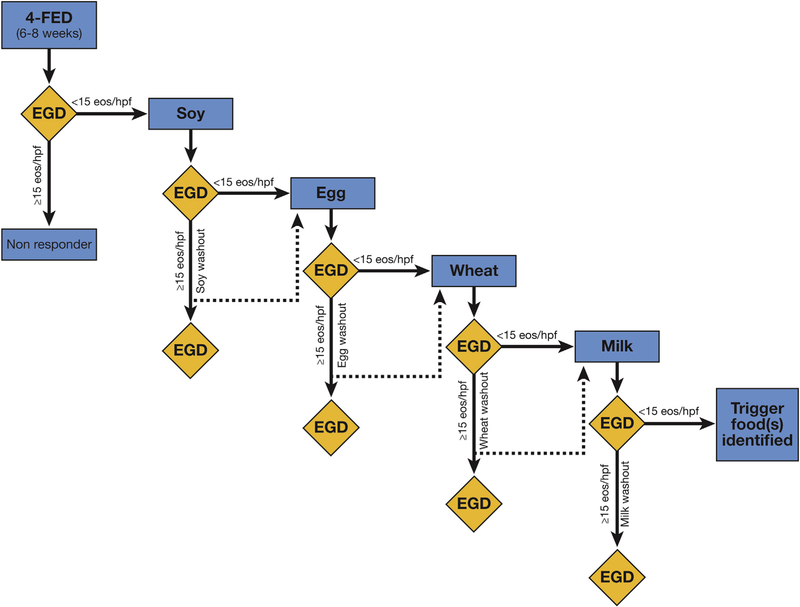
We recruited children (1-18 years old, diagnosed per consensus guidelines) from 4 medical centers. Study participants (n = 78) were given a proton pump inhibitor twice daily and underwent a baseline esophagogastroduodenoscopy. Subjects were instructed on dietary exclusion of cow's milk, wheat, egg, and soy. Clinical, endoscopic, and histologic assessments were made after 8 weeks. Responders had single foods reintroduced for 8 weeks, with repeat endoscopy to assess for recurrence of active disease. The primary endpoint was histologic remission (fewer than 15 eosinophils per high-powered field). Secondary endpoints included symptom and endoscopic improvements and identification of foods associated with active histologic disease.
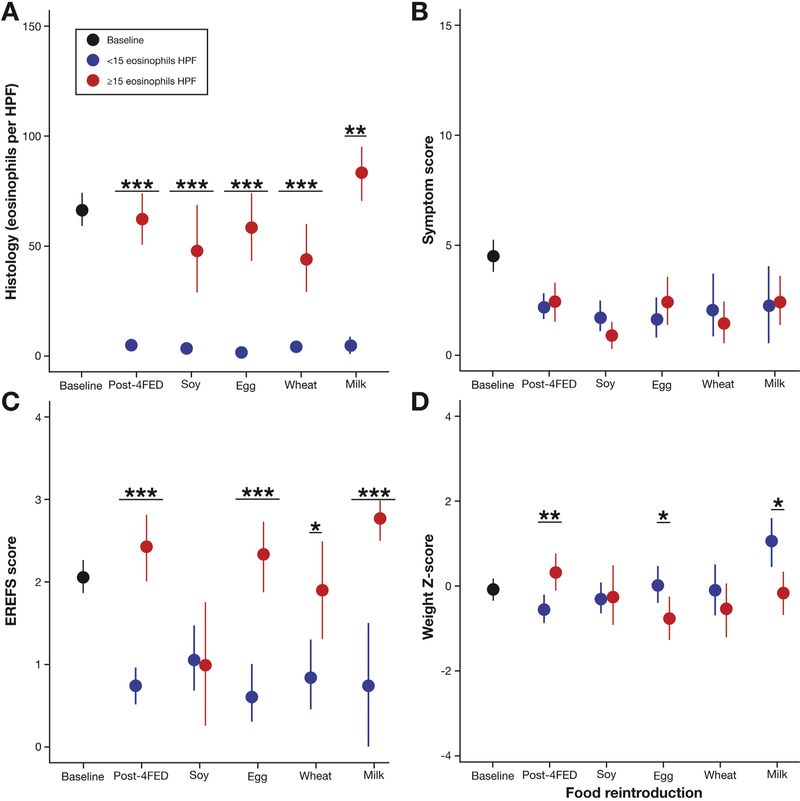
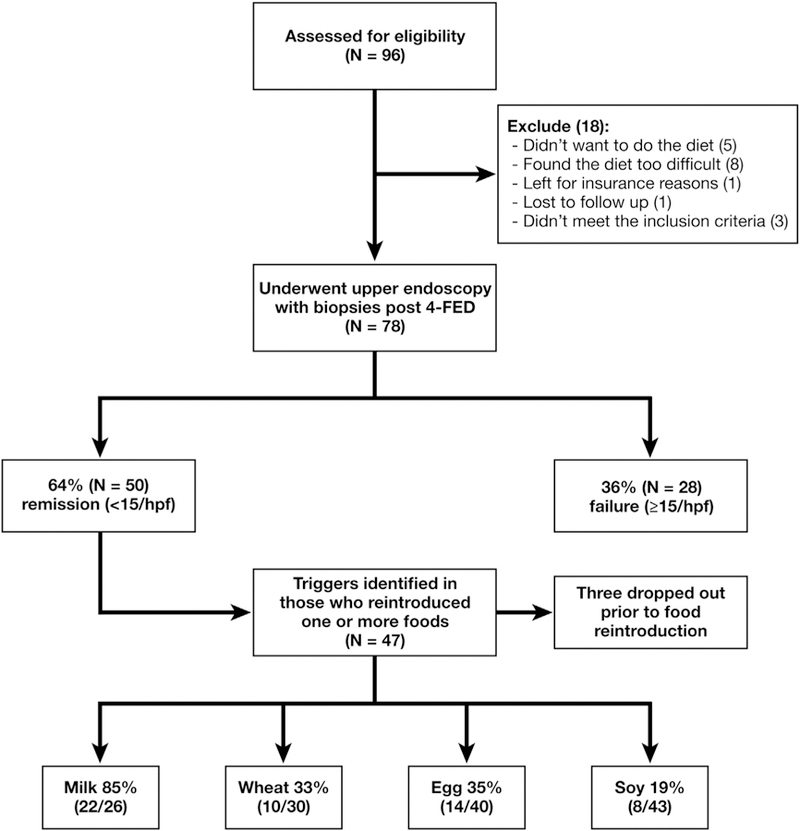
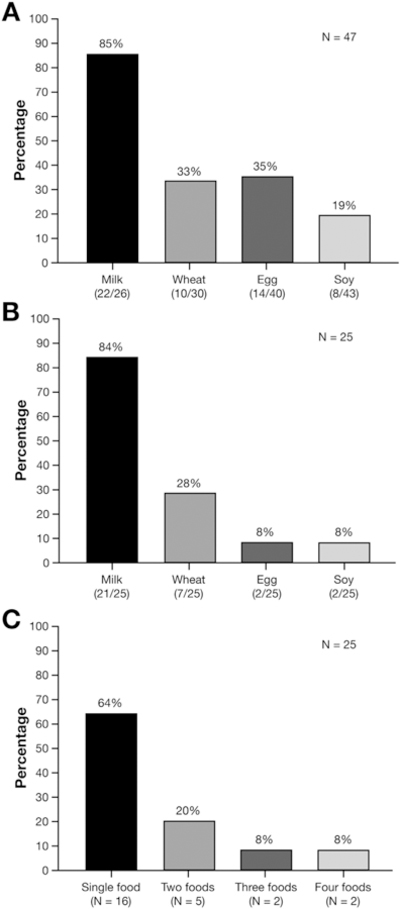
After 8 weeks on 4-food elimination diet, 50 subjects were in histologic remission (64%). The subjects' mean baseline clinical symptoms score was 4.5, which decreased to 2.3 after 8 weeks of 4-food elimination diet (P < .001). The mean endoscopic baseline score was 2.1, which decreased to 1.3 (P < .001). After food reintroduction, the most common food triggers that induced histologic inflammation were cow's milk (85%), egg (35%), wheat (33%), and soy (19%). One food trigger that induced recurrence of esophageal inflammation was identified in 62% of patients and cow's milk-induced EoE was present in 88% of these patients.
In a prospective study of children with EoE, 8 weeks of 4-food elimination diet induced clinical, endoscopic, and histologic remission in more than 60% of children with EoE. Although less restrictive than 6-food elimination diet, 4-food elimination diet was nearly as effective, and can be recommended as a treatment for children with EoE.
在大多数嗜酸细胞性食管炎(EoE)患儿和成人中,六食物剔除饮食可诱导缓解。在儿童中,仅剔除四种食物的经验性剔除是否有效尚未得到研究。我们对接受牛奶、小麦、鸡蛋和大豆饮食剔除的 EoE 患儿进行了一项前瞻性观察性结局研究。目的是评估该治疗方法在 EoE 中的临床、内镜和组织学疗效。
我们从 4 家医疗中心招募了符合共识指南诊断标准的 1-18 岁患儿。研究参与者(n=78)每日给予两次质子泵抑制剂,并进行基线食管胃十二指肠镜检查。告知患者剔除牛奶、小麦、鸡蛋和大豆。8 周后进行临床、内镜和组织学评估。应答者进行单一食物剔除 8 周,然后重复内镜检查以评估活动性疾病的复发情况。主要终点是组织学缓解(高倍镜视野下少于 15 个嗜酸性粒细胞)。次要终点包括症状和内镜改善以及确定与活动性组织学疾病相关的食物。
在进行 4 种食物剔除饮食 8 周后,50 名患者组织学缓解(64%)。患者的基线临床症状评分平均为 4.5,8 周 4 种食物剔除饮食后降至 2.3(P<0.001)。基线内镜评分平均为 2.1,降至 1.3(P<0.001)。在食物重新引入后,引起组织学炎症的最常见食物触发物是牛奶(85%)、鸡蛋(35%)、小麦(33%)和大豆(19%)。62%的患者中确定了 1 种食物触发物可诱导食管炎症复发,在这些患者中,88%的患者存在牛奶诱导的 EoE。
在一项对 EoE 患儿的前瞻性研究中,8 周的 4 种食物剔除饮食在超过 60%的 EoE 患儿中诱导了临床、内镜和组织学缓解。虽然比 6 种食物剔除饮食限制较少,但 4 种食物剔除饮食同样有效,可作为 EoE 患儿的治疗推荐。