Allen Luke Nelson
a Nuffield Department of Primary Care Health Sciences , University of Oxford , Oxford , UK.
Glob Health Action. 2017;10(1):1326687. doi: 10.1080/16549716.2017.1326687.
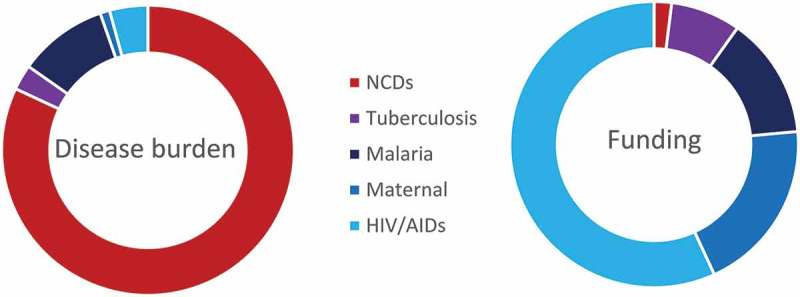
Non-communicable diseases (NCDs) (also known as socially transmitted diseases) were conspicuously absent from the Millennium Development Goals and seemed to miss out on the 'golden years' of health funding despite causing more death and disability than any other disease group worldwide. The share of 'development assistance for health' dedicated to NCDs has remained at 1-2% of the total since 2000. This level of funding is insufficient to attain the nine targets in the World Health Organization (WHO) Global Action Plan on NCDs. In 2015 the Sustainable Development Goals - which include the target of reducing premature NCD mortality by a third - were endorsed by 193 countries. Whilst this commitment is welcome, the same text stresses the primacy of domestic financing, which is currently dominated by out-of-pocket payments in low- and middle-income countries (LMICs). This paper presents the findings of the WHO Global Coordination Mechanism on NCDs financing working group. The group was convened to explore NCD financing options with an emphasis on LMICs. The main sources of available finance include taxation, loans, engagement with the private sector, impact investment and innovative financing mechanisms. There is a role for development assistance to increase in the interim as raising additional revenue from these sources will take time. In the medium term it may be appropriate for international NCD funding to remain low where LMICs successfully assume financial responsibility for preventing and controlling NCDs. Countries will have to manage blends of innovative and traditional funding sources, whilst finding ways to boost tax revenue for NCDs.
非传染性疾病(NCDs)(也被称为社会传播性疾病)在千年发展目标中明显缺失,并且尽管在全球范围内造成的死亡和残疾比其他任何疾病群体都多,但似乎错过了卫生资金投入的“黄金时期”。自2000年以来,用于非传染性疾病的“卫生发展援助”份额一直维持在总援助的1%-2%。这样的资金水平不足以实现世界卫生组织(WHO)非传染性疾病全球行动计划中的九个目标。2015年,193个国家认可了可持续发展目标,其中包括将非传染性疾病过早死亡率降低三分之一的目标。虽然这一承诺值得欢迎,但同一文本强调了国内融资的首要地位,而在低收入和中等收入国家(LMICs),目前国内融资主要由自费支付主导。本文介绍了WHO非传染性疾病融资全球协调机制工作组的调查结果。该工作组的召集目的是探索非传染性疾病的融资选择,重点是低收入和中等收入国家。可用资金的主要来源包括税收、贷款、与私营部门的合作、影响力投资和创新融资机制。在从这些来源筹集额外收入需要时间的过渡阶段,发展援助有增加的空间。从中期来看,如果低收入和中等收入国家成功承担起预防和控制非传染性疾病的财政责任,国际非传染性疾病资金保持在较低水平可能是合适的。各国将不得不管理创新和传统资金来源的组合,同时找到增加非传染性疾病税收收入的方法。