Rossouw Theresa, Tucker Joseph D, van Zyl Gert U, Sikwesi Kenly, Godfrey Catherine
Institute for Cellular and Molecular Medicine, Department of Immunology, University of Pretoria South Africa, Pretoria, Republic of South Africa.
Institute for Global Health and Infectious Diseases, UNC Chapel Hill, Chapel Hill, NC, USA.
J Int AIDS Soc. 2017 Jun 5;20(1):21521. doi: 10.7448/IAS.20.1.21521.
HIV eradication and remission research has largely taken place in high-income countries. In low- and middle-income countries (LMIC), there may be factors that have a substantial impact on the size of the latent HIV reservoir and the immunological response to infection. If a curative strategy is to be available to all HIV-infected individuals, these factors must be understood.
We use a scoping review to examine the literature on biological factors that may have an impact on HIV persistence in LMIC. Three databases were searched without date restrictions.
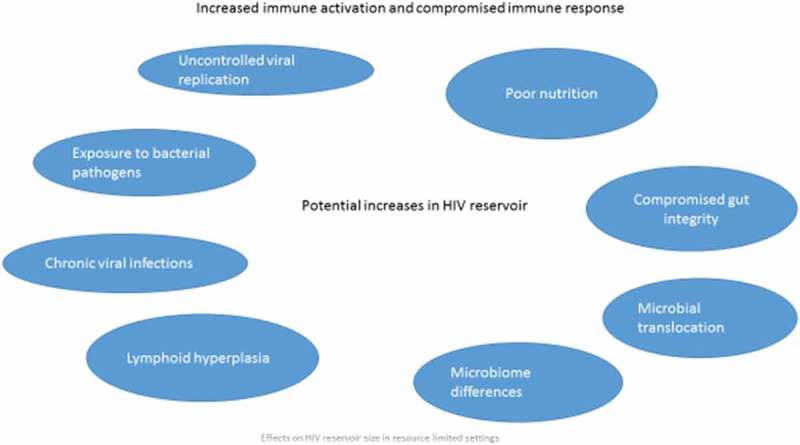
Uncontrolled viral replication and higher coinfection prevalence may alter the immunological milieu of individuals in LMIC and increase the size of the HIV reservoir. Differences in HIV subtype could also influence the measurement and size of the HIV reservoir. Immune activation may differ due to late presentation to care, presence of chronic infections, increased gut translocation of bacterial products and poor nutrition.
Research on HIV remission is urgently needed in LMIC. Research into chronic immune activation in resource poor environments, the immune response to infection, the mechanisms of HIV persistence and latency in different viral clades and the effect of the microbiological milieu must be performed. Geographic differences, which may be substantial and may delay access to curative strategies, should be identified.
艾滋病毒根除与缓解研究主要在高收入国家开展。在低收入和中等收入国家(LMIC),可能存在一些对潜伏性艾滋病毒储存库规模以及感染免疫反应有重大影响的因素。若要让所有艾滋病毒感染者都能获得治愈策略,就必须了解这些因素。
我们采用范围综述来审视关于可能影响艾滋病毒在低收入和中等收入国家持续存在的生物学因素的文献。检索了三个无日期限制的数据库。
不受控制的病毒复制和更高的合并感染患病率可能会改变低收入和中等收入国家个体的免疫环境,并增加艾滋病毒储存库的规模。艾滋病毒亚型差异也可能影响艾滋病毒储存库的测量和规模。由于就医延迟、存在慢性感染、细菌产物肠道易位增加以及营养状况不佳,免疫激活情况可能有所不同。
低收入和中等收入国家迫切需要开展艾滋病毒缓解研究。必须对资源匮乏环境中的慢性免疫激活、对感染的免疫反应、不同病毒分支中艾滋病毒持续存在和潜伏的机制以及微生物环境的影响进行研究。应确定可能很大且可能延迟获得治愈策略的地理差异。