Institute of Cardiovascular Disease, Ruijin hospital, Jiaotong University School of Medicine, Shanghai, 200025, China.
Department of Pediatrics, Ruijin Hospital, Shanghai Jiaotong University School of Medicine, Shanghai, 200025, China.
Sci Rep. 2017 Jun 12;7(1):3296. doi: 10.1038/s41598-017-03740-7.
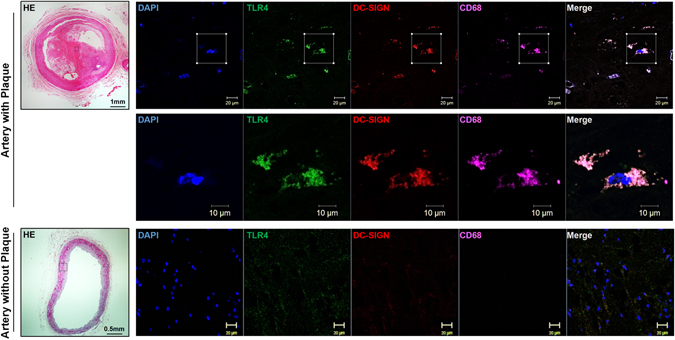
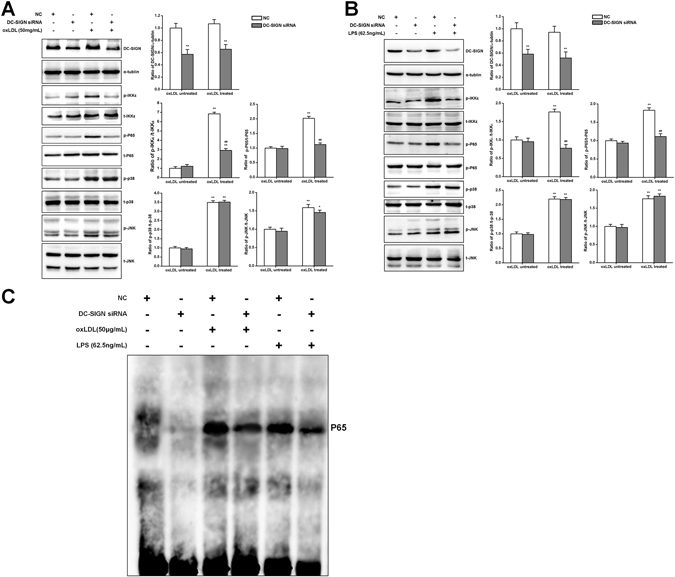
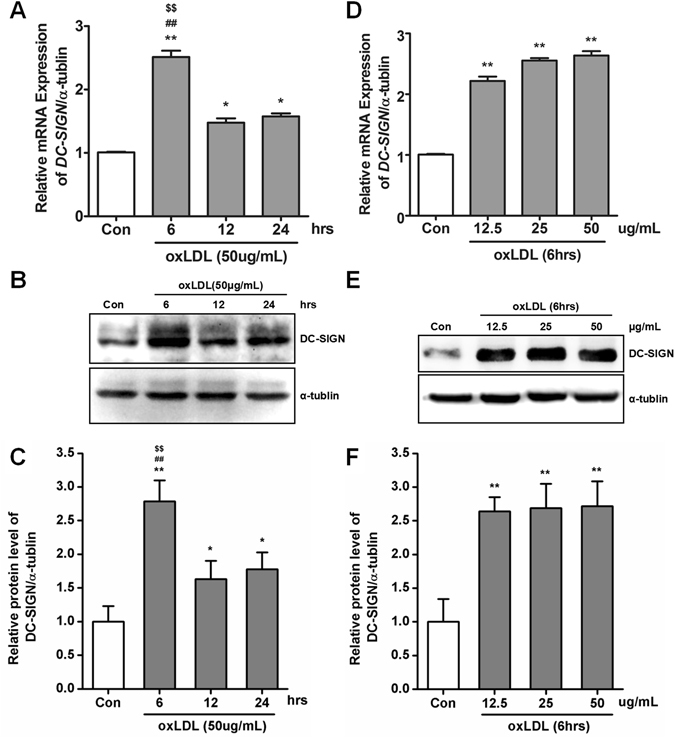
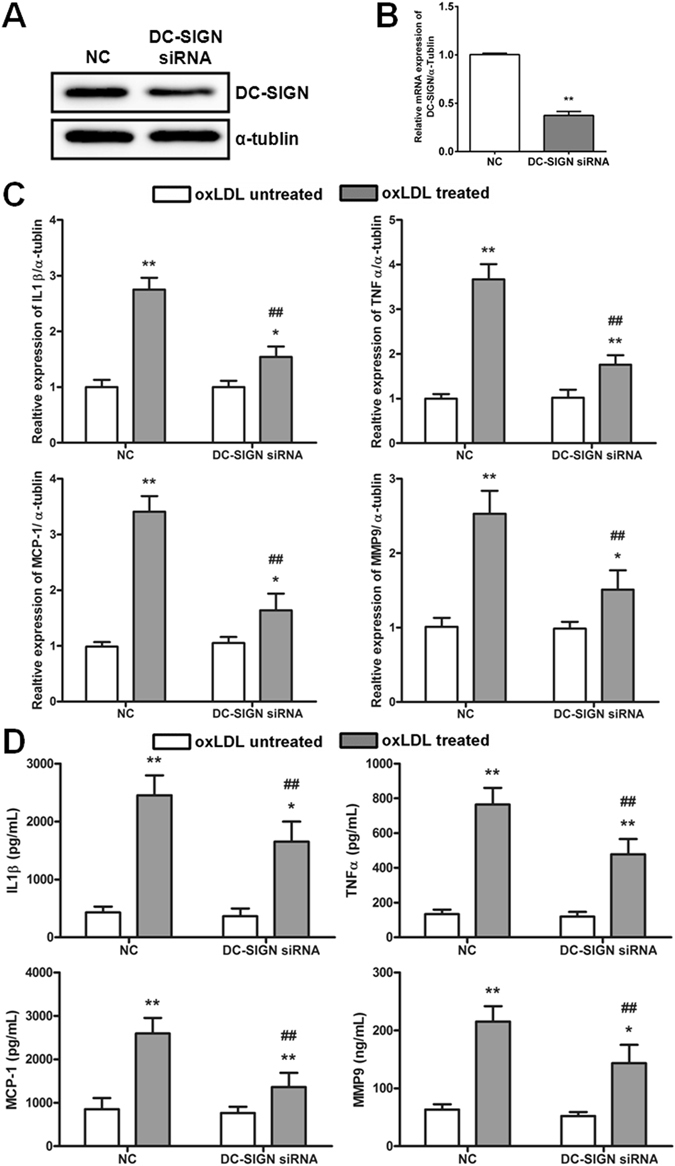
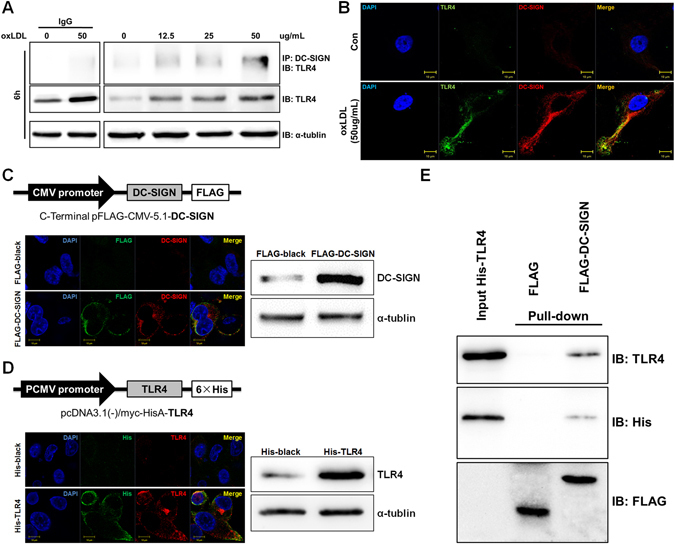
The regulation of inflammatory responses by innate immune receptors is recognized as a crucial step in the development of atherosclerosis, although the precise molecular mechanisms remain to be elucidated. This study focused on illustrating the roles of dendritic cell-specific intercellular adhesion molecule-3-grabbing non-integrin (DC-SIGN)- and Toll-like receptor 4 (TLR4)-regulated inflammatory responses in macrophages. We found that DC-SIGN expression levels were increased in macrophages of atherosclerotic plaques. Oxidized low-density lipoprotein (oxLDL) significantly enhanced DC-SIGN protein expression levels after a short-term exposure. Knockdown of DC-SIGN decreased expression and secretion of interleukin 1-β (IL1-β), monocyte chemo-attractant protein 1 (MCP-1), tumor necrosis factor-α (TNFα) and matrix metalloproteinase-9 (MMP-9). Immunofluorescence studies demonstrated that DC-SIGN and TLR4 co-localized in regions of the plaques. Moreover, DC-SIGN was co-expressed with TLR4 on the plasma membrane after oxLDL stimulation. The presence of an endogenous interaction and the results of the in vitro pull-down assays revealed that DC-SIGN binds directly with TLR4. We also present evidence that DC-SIGN mediates TLR4-regulated NFκB activation but not activation of p38 and JNK. Our results suggest an essential role of DC-SIGN/TLR4 signaling in macrophages in the pathogenesis of atherosclerosis.
先天免疫受体对炎症反应的调节被认为是动脉粥样硬化发生发展的关键步骤,尽管确切的分子机制仍有待阐明。本研究旨在阐明树突状细胞特异性细胞间黏附分子-3 抓取非整合素(DC-SIGN)和 Toll 样受体 4(TLR4)调节的炎症反应在巨噬细胞中的作用。我们发现动脉粥样硬化斑块中的巨噬细胞中 DC-SIGN 表达水平增加。氧化低密度脂蛋白(oxLDL)在短期暴露后显著增强 DC-SIGN 蛋白表达水平。DC-SIGN 敲低降低了白细胞介素 1-β(IL1-β)、单核细胞趋化蛋白 1(MCP-1)、肿瘤坏死因子-α(TNFα)和基质金属蛋白酶-9(MMP-9)的表达和分泌。免疫荧光研究表明,DC-SIGN 和 TLR4 在斑块区域共定位。此外,oxLDL 刺激后,DC-SIGN 与 TLR4 在质膜上共表达。内源性相互作用的存在和体外下拉测定的结果表明,DC-SIGN 与 TLR4 直接结合。我们还提供了证据表明,DC-SIGN 介导 TLR4 调节的 NFκB 激活,但不激活 p38 和 JNK。我们的研究结果表明,DC-SIGN/TLR4 信号在动脉粥样硬化发病机制中的巨噬细胞中起着重要作用。