Tahmasebibirgani Mohammad Javad, Maskani Reza, Behrooz Mohammad Ali, Zabihzadeh Mansour, Shahbazian Hojatollah, Fatahiasl Jafar, Chegeni Nahid
Ph.D. of Medical Physics, Professor, Department of Medical Physics, Faculty of Medicine, Ahvaz Jundishapur University of Medical Sciences, Ahvaz, Iran.
Ph.D. Candidate of Medical Physics, Student Research Committee, Ahvaz Jundishapur University of Medical Sciences, Ahvaz, Iran.
Electron Physician. 2017 Apr 25;9(4):4171-4179. doi: 10.19082/4171. eCollection 2017 Apr.
In radiotherapy, megaelectron volt (MeV) electrons are employed for treatment of superficial cancers. Magnetic fields can be used for deflection and deformation of the electron flow. A magnetic field is composed of non-uniform permanent magnets. The primary electrons are not mono-energetic and completely parallel. Calculation of electron beam deflection requires using complex mathematical methods. In this study, a device was made to apply a magnetic field to an electron beam and the path of electrons was simulated in the magnetic field using finite element method.
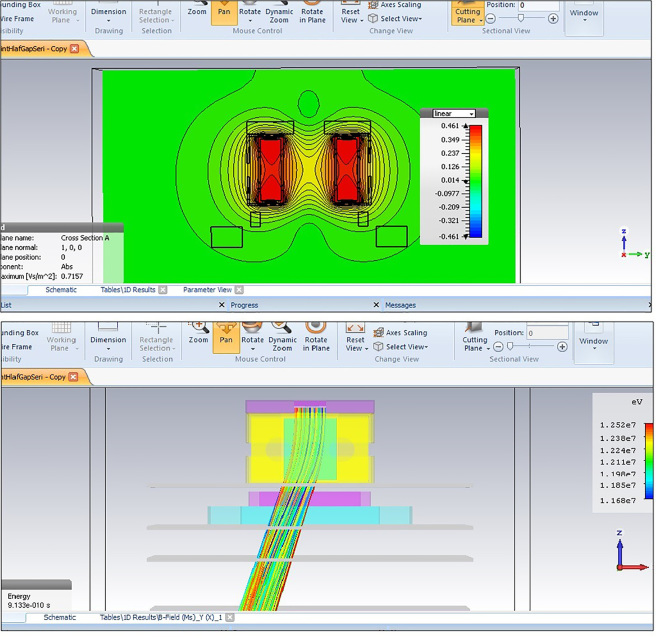
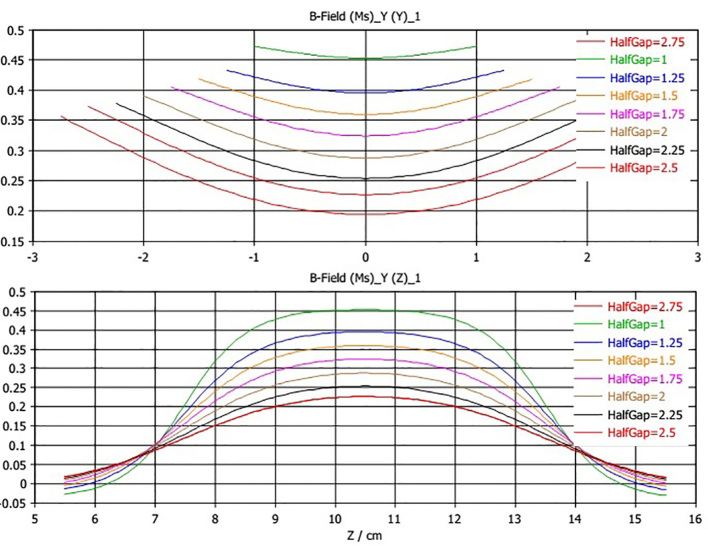
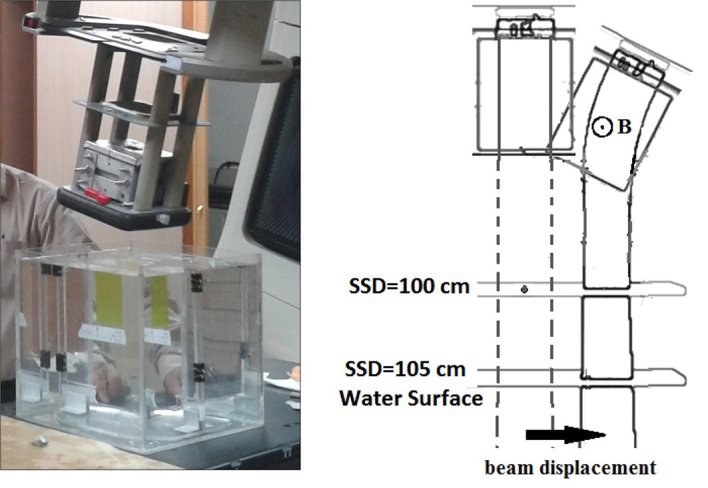
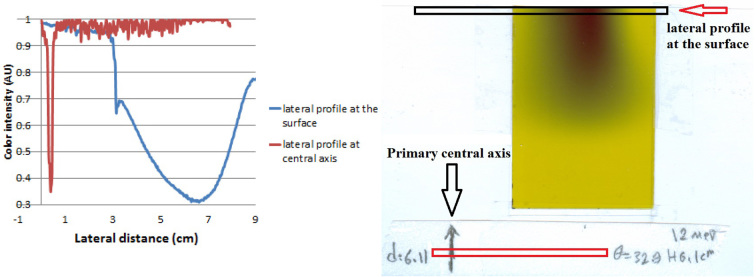
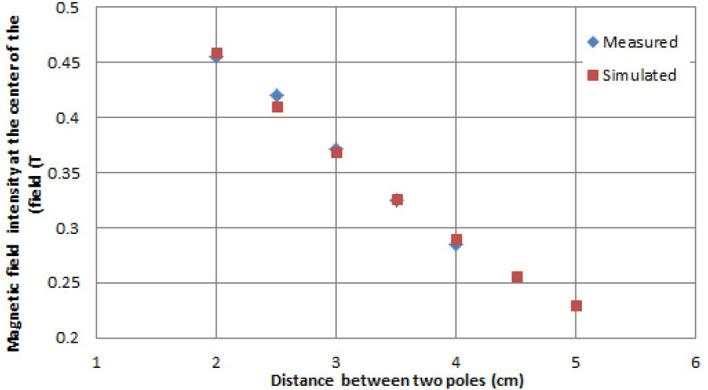
A mini-applicator equipped with two neodymium permanent magnets was designed that enables tuning the distance between magnets. This device was placed in a standard applicator of Varian 2100 CD linear accelerator. The mini-applicator was simulated in CST Studio finite element software. Deflection angle and displacement of the electron beam was calculated after passing through the magnetic field. By determining a 2 to 5cm distance between two poles, various intensities of transverse magnetic field was created. The accelerator head was turned so that the deflected electrons became vertical to the water surface. To measure the displacement of the electron beam, EBT2 GafChromic films were employed. After being exposed, the films were scanned using HP G3010 reflection scanner and their optical density was extracted using programming in MATLAB environment. Displacement of the electron beam was compared with results of simulation after applying the magnetic field.
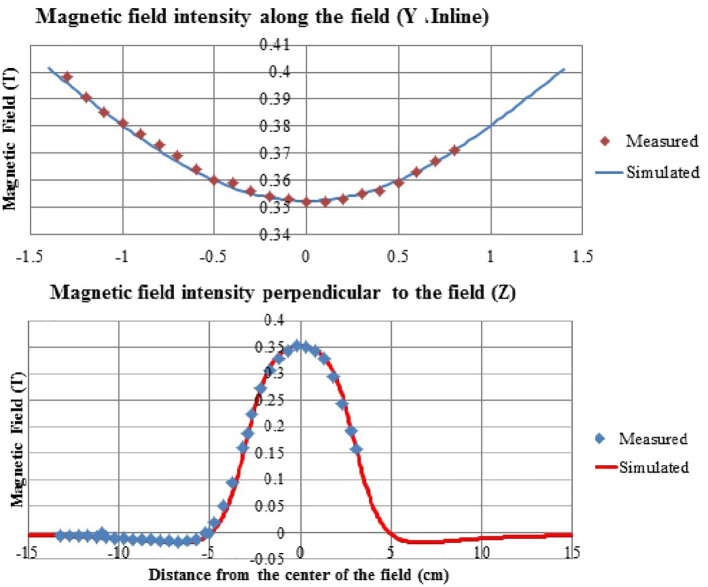
Simulation results of the magnetic field showed good agreement with measured values. Maximum deflection angle for a 12 MeV beam was 32.9° and minimum deflection for 15 MeV was 12.1°. Measurement with the film showed precision of simulation in predicting the amount of displacement in the electron beam.
A magnetic mini-applicator was made and simulated using finite element method. Deflection angle and displacement of electron beam were calculated. With the method used in this study, a good prediction of the path of high-energy electrons was made before they entered the body.
在放射治疗中,兆电子伏特(MeV)电子用于治疗浅表癌症。磁场可用于电子流的偏转和变形。磁场由非均匀永久磁铁组成。初级电子不是单能且完全平行的。电子束偏转的计算需要使用复杂的数学方法。在本研究中,制作了一种将磁场应用于电子束的装置,并使用有限元方法在磁场中模拟电子路径。
设计了一种配备两个钕永久磁铁的微型施源器,可调节磁铁之间的距离。该装置放置在Varian 2100 CD直线加速器的标准施源器中。在CST Studio有限元软件中对微型施源器进行模拟。计算电子束穿过磁场后的偏转角和位移。通过确定两极之间2至5厘米的距离,产生了不同强度的横向磁场。转动加速器机头,使偏转后的电子垂直于水面。为测量电子束的位移,使用了EBT2 GafChromic薄膜。曝光后,使用HP G3010反射扫描仪对薄膜进行扫描,并在MATLAB环境中通过编程提取其光学密度。将电子束的位移与施加磁场后的模拟结果进行比较。
磁场模拟结果与测量值吻合良好。12 MeV电子束的最大偏转角为32.9°,15 MeV电子束的最小偏转为12.1°。薄膜测量结果表明模拟在预测电子束位移量方面具有精度。
制作了一种磁性微型施源器并使用有限元方法进行模拟。计算了电子束的偏转角和位移。通过本研究中使用的方法,在高能电子进入人体之前对其路径进行了良好的预测。