Kim Min Jung, Chang Hyun Ha, Kim Sang Il, Kim Youn Jeong, Park Dae Won, Kang Chun, Kee Mee Kyung, Choi Ju Yeon, Kim Soo Min, Choi Bo Youl, Kim Woo Joo, Kim June Myung, Choi Jun Yong, Choi Young Hwa, Lee Jin Soo, Kim Shin Woo
Department of Internal Medicine, Kyungpook National University, Daegu, Korea.
Division of Infectious Diseases, Department of Internal Medicine, Seoul St. Mary's Hospital, College of Medicine, The Catholic University of Korea, Seoul, Korea.
Infect Chemother. 2017 Jun;49(2):101-108. doi: 10.3947/ic.2017.49.2.101. Epub 2017 Jun 1.
CD4+ cell counts reflect immunologic status of human immunodeficiency virus (HIV) patients. Recommended CD4+ cell counts for the initiation of highly active antiretroviral therapy (HAART) has increased over the past several years in various HIV treatment guidelines. We investigated the trend of CD4+ cell counts at diagnosis and treatment start using data from the Korea HIV/acquired immune deficiency syndrome (AIDS) Cohort Study.
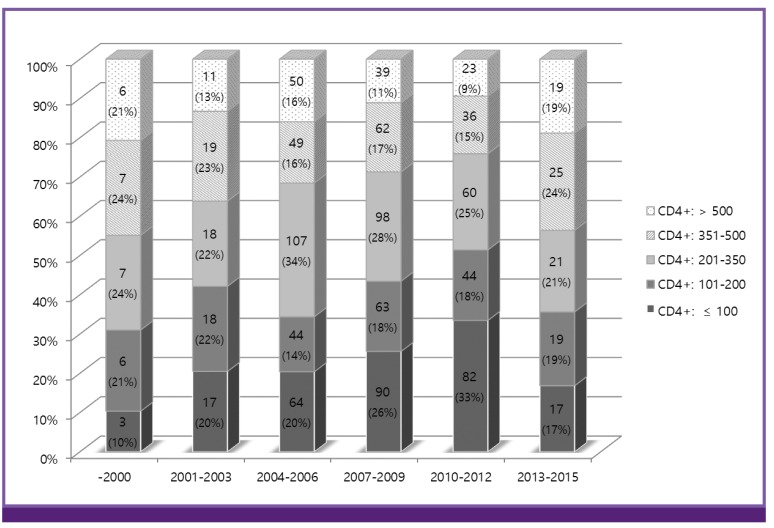
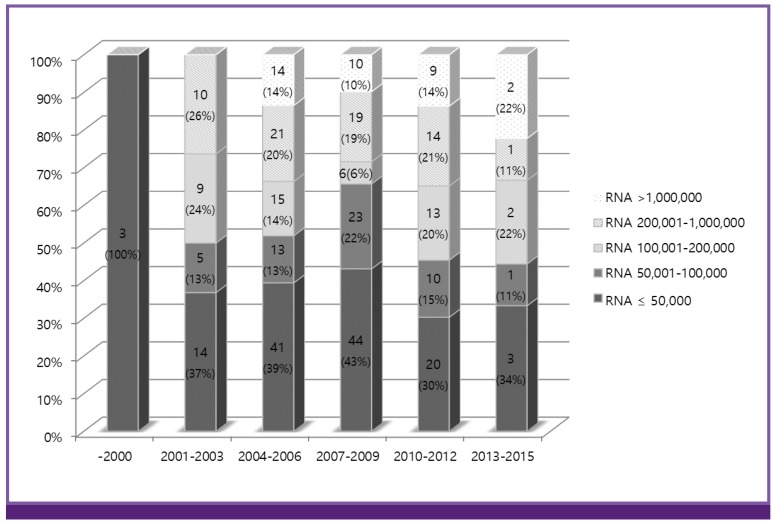
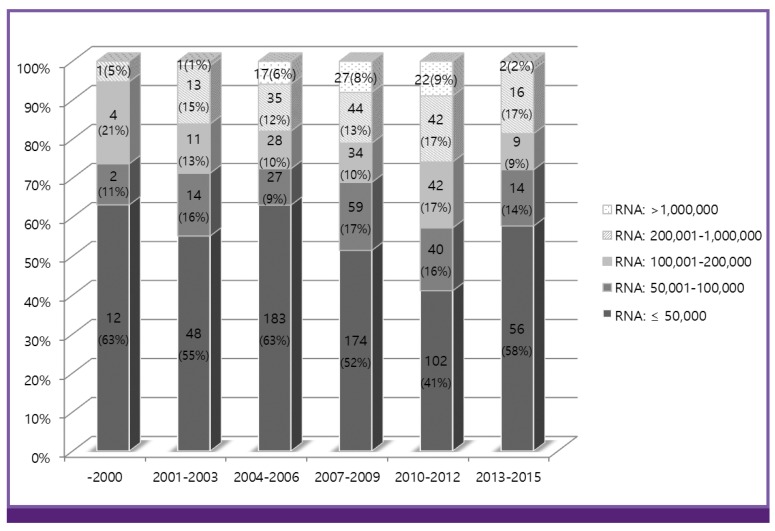
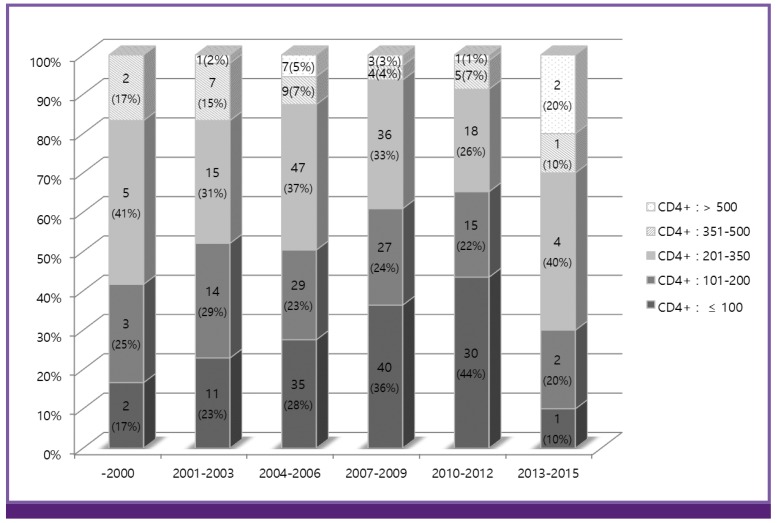
The Korea HIV/AIDS Cohort Study started in 2006 and enrolled HIV patients from 21 tertiary and secondary hospitals in South Korea. The data for CD4+ cell counts at diagnosis and HAART initiation from these HIV patients were analyzed by three-year time intervals and presented by number of CD4+ cells (≤100, 101-200, 201-350, 351-500 and >500 cells/mm³). The HIV-RNA titer at diagnosis and HAART initiation were presented by 3-year intervals by groups ≤50,000, 50,001-100,000, 100,001-200,000, 200,001-1,000,000, and >1,000,000 copies/mL.
Median values of CD4+ cell count and HIV-RNA titer at initial HIV diagnosis were 247 cells/mm³ and 394,955 copies/mL, respectively. At time of initiating HAART, median values of CD4+ cell count and HIV-RNA were 181 cells/mm³ and 83,500 copies/mL, respectively. Patients with low CD4+ cell count (CD4+ cell count ≤200 cells/mm³) at diagnosis (31-51%) and initiation of HAART accounted for the largest proportion (30-65%) over the three-year time intervals. This proportion increased until 2010-2012.
CD4+ cell count at initiation of HAART was found to be very low, and the increase in late initiation of HAART in recent years is of concern. We think that this increase is primarily due to an increasing proportion of late presenters. We recommend early detection of HIV patients and earlier start of HAART in order to treat and prevent spread of HIV infection.
CD4+细胞计数反映了人类免疫缺陷病毒(HIV)患者的免疫状态。在过去几年中,各种HIV治疗指南中推荐的开始高效抗逆转录病毒治疗(HAART)的CD4+细胞计数有所增加。我们利用韩国HIV/获得性免疫缺陷综合征(AIDS)队列研究的数据,调查了诊断和开始治疗时CD4+细胞计数的趋势。
韩国HIV/AIDS队列研究始于2006年,纳入了韩国21家三级和二级医院的HIV患者。对这些HIV患者诊断时和开始HAART时的CD4+细胞计数数据按三年时间间隔进行分析,并按CD4+细胞数量(≤100、101 - 200、201 - 350、351 - 500和>500个细胞/mm³)呈现。诊断时和开始HAART时的HIV-RNA滴度按三年时间间隔按≤50,000、50,001 - 100,000、100,001 - 200,000、200,001 - 1,000,000和>1,000,000拷贝/mL分组呈现。
初次HIV诊断时CD4+细胞计数和HIV-RNA滴度的中位数分别为247个细胞/mm³和394,955拷贝/mL。开始HAART时,CD4+细胞计数和HIV-RNA的中位数分别为181个细胞/mm³和83,500拷贝/mL。在三年时间间隔内,诊断时(31 - 51%)和开始HAART时CD4+细胞计数低(CD4+细胞计数≤200个细胞/mm³)的患者占比最大(30 - 65%)。这一比例在2010 - 2012年之前有所增加。
发现开始HAART时的CD4+细胞计数非常低,近年来HAART开始延迟的增加令人担忧。我们认为这种增加主要是由于晚期就诊者的比例增加。我们建议早期检测HIV患者并更早开始HAART,以治疗和预防HIV感染的传播。