Pacini Giovanni, Ahrén Bo
Metabolic Unit, Institute of Neuroscience (IN-CNR), Padova, Italy
Department of Clinical Sciences Lund, Lund University, Lund, Sweden.
Physiol Rep. 2017 Jun;5(11). doi: 10.14814/phy2.13280.
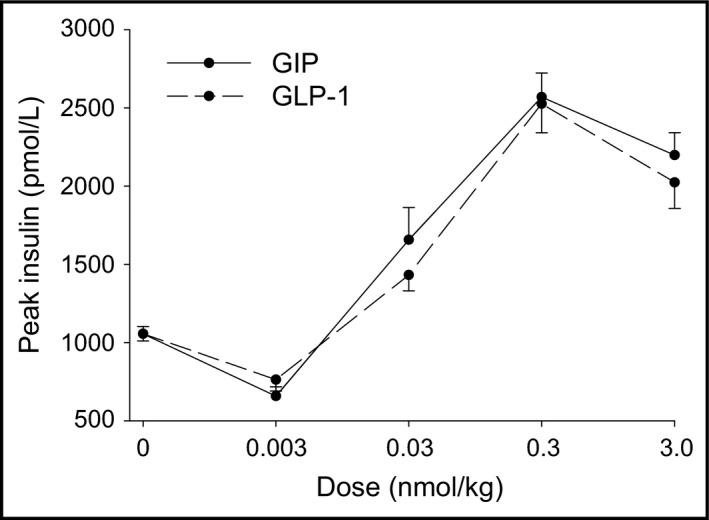
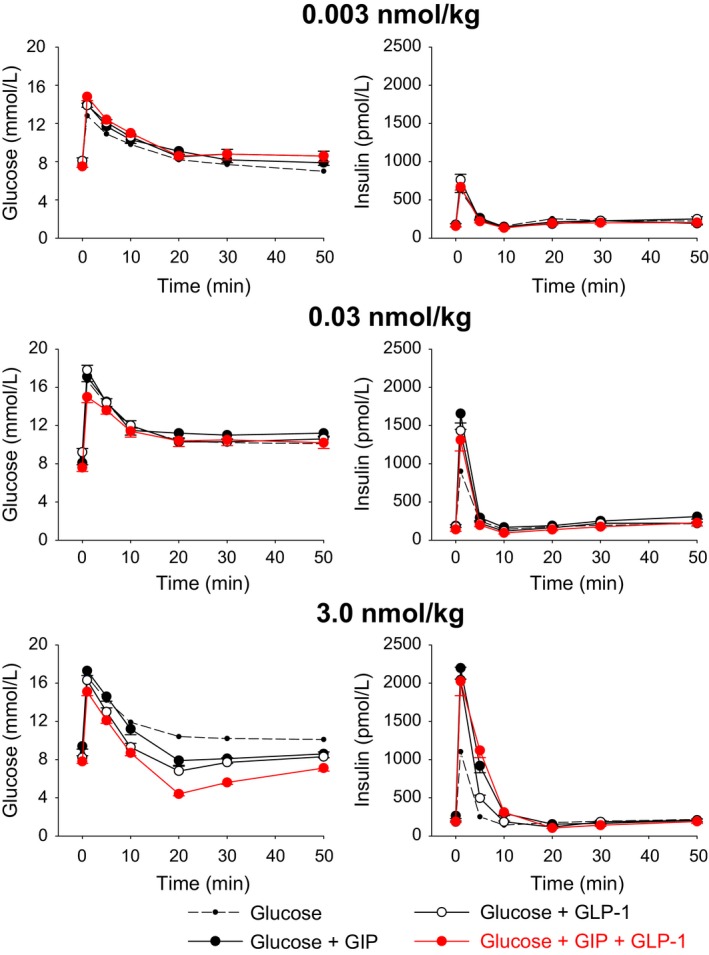
Glucagon-like peptide-1 (GLP-1) and glucose-dependent insulinotropic peptide (GIP) stimulate insulin secretion. They are both released after meal ingestion, and therefore they might cooperate in their actions. However, whether there is a cooperative action of the two incretins is not known. This study therefore investigated the effects on insulin secretion and glucose disappearance of GLP-1 and GIP when given together with intravenous glucose both alone and in combination in mice. Four different doses were used (0.003, 0.03, 0.3 and 3.0 nmol/kg), which ranged from subthreshold to maximal doses to stimulate first-phase insulin secretion as evident from initial dose-response studies. It was found that at 0.03 nmol/kg and higher doses, glucose-stimulated insulin secretion was augmented by both incretins. When they were given in combination, no further increase was observed, indicating no synergistic effect. Also, glucose disappearance rate was increased by 0.03 and 3.0 nmol/kg of the two incretins, both when they were given alone and in combination with, again, no synergy. Finally, glucose effectiveness (an index of noninsulin-mediated processes) was enhanced by the two incretins, in particular GIP We also found that insulin-dependent and insulin-independent mechanisms contributed 38% and 62%, respectively, to glucose tolerance after glucose alone; with GIP, the contribution by noninsulin-dependent processes was remarkably dominant and with GLP-1, insulin-dependent processes were prevailing. In conclusion, GIP and GLP-1 stimulate insulin secretion and glucose effectiveness in mice with no synergistic action, but with a dissociated contributory effector on glucose disposal: with GLP-1 being more active on insulin-dependent processes and GIP more active on noninsulin-dependent processes.
胰高血糖素样肽-1(GLP-1)和葡萄糖依赖性促胰岛素多肽(GIP)可刺激胰岛素分泌。它们均在进食后释放,因此可能在作用上相互协作。然而,这两种肠促胰岛素是否存在协同作用尚不清楚。因此,本研究在小鼠中探究了单独及联合静脉注射葡萄糖时,GLP-1和GIP对胰岛素分泌及葡萄糖清除的影响。使用了四种不同剂量(0.003、0.03、0.3和3.0 nmol/kg),从阈下剂量到最大剂量,以刺激第一相胰岛素分泌,这从最初的剂量反应研究中可以明显看出。结果发现,在0.03 nmol/kg及更高剂量时,两种肠促胰岛素均增强了葡萄糖刺激的胰岛素分泌。当它们联合使用时,未观察到进一步增加,表明无协同效应。此外,两种肠促胰岛素单独使用及联合使用时,0.03和3.0 nmol/kg剂量均提高了葡萄糖清除率,同样无协同作用。最后,两种肠促胰岛素,尤其是GIP增强了葡萄糖效能(非胰岛素介导过程的指标)。我们还发现,单独给予葡萄糖后,胰岛素依赖性和非胰岛素依赖性机制对葡萄糖耐量的贡献分别为38%和62%;使用GIP时,非胰岛素依赖性过程的贡献显著占主导,而使用GLP-1时,胰岛素依赖性过程占主导。总之,GIP和GLP-1刺激小鼠胰岛素分泌和葡萄糖效能,无协同作用,但对葡萄糖处置有不同的效应贡献:GLP-1对胰岛素依赖性过程更活跃,GIP对非胰岛素依赖性过程更活跃。