Centre for Menstrual Cycle and Ovulation Research, Division of Endocrinology, Department of Medicine, University of British Columbia; Vancouver Coastal Health Research Institute, Vancouver, Canada.
Women's Health Research Institute, Vancouver, Canada.
Sci Rep. 2017 Jun 13;7(1):3432. doi: 10.1038/s41598-017-03685-x.
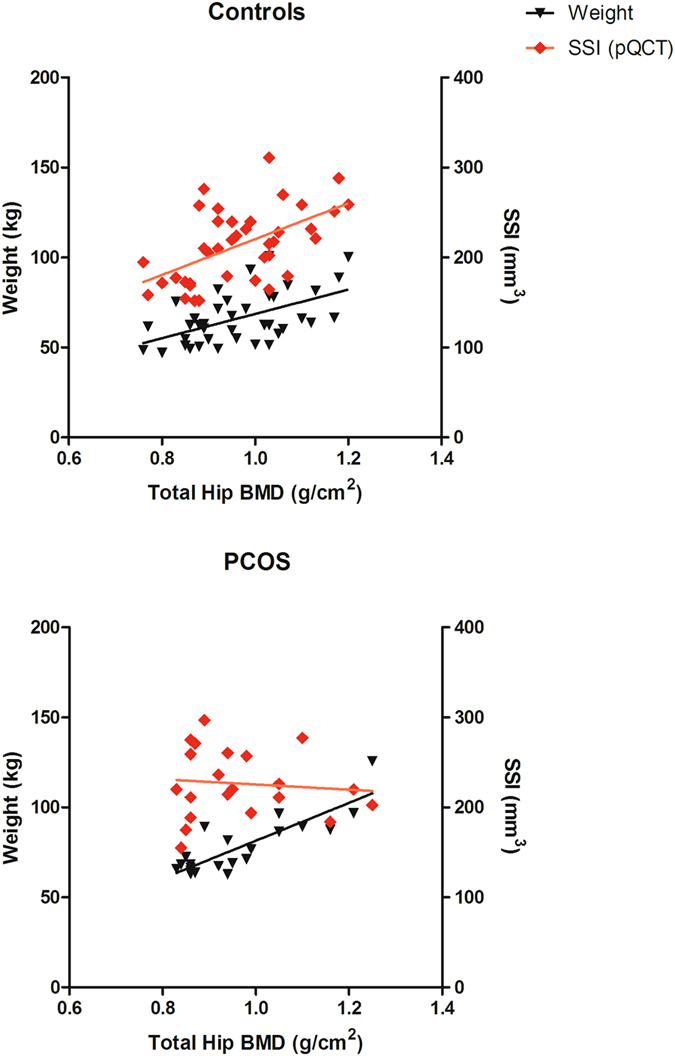
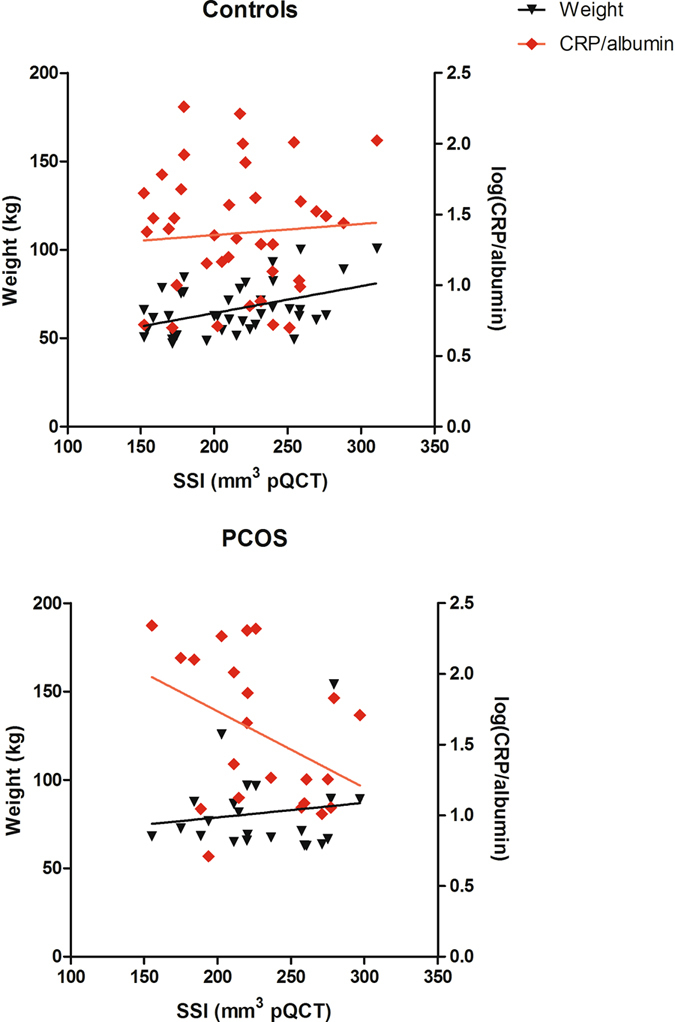
Chronic inflammation predisposes to poor bone health. Women with polycystic ovary syndrome (PCOS) experience androgen excess, ovulatory disturbances, insulin resistance, abdominal adiposity and chronic inflammation. Our objective was to investigate the relationships among bone health parameters, chronic subclinical inflammation and anthropometric measures in premenopausal women with and without PCOS. In 61 premenopausal women, 22 women with PCOS and 39 controls, we assessed bone parameters (total hip bone mineral density [BMD] by dual-energy X-ray absorptiometry and radius strength-strain index [SSI] by peripheral quantitative computed tomography), inflammation (C-reactive protein/albumin), oxidative stress (leukocyte telomere length, urinary 8-hydroxydeoxyguanosine); hemoglobin A1c; anthropometric measures (body mass index, waist-to-height ratio, cross-sectional muscle area). A diagnosis of PCOS negatively predicted (beta = -0.251, p = 0.022) hip BMD in a regression model including weight. In women with PCOS, inflammation, which was predicted by increased waist-to-height ratio and current use of oral contraceptives, attenuated the positive influences of increased weight and muscle mass on bone strength and was inversely associated with radial SSI (R = 0.25, p = 0.018). In conclusion, chronic subclinical inflammation may negatively impact bone physiology in women with PCOS. Strategies focused on reducing abdominal adiposity and avoiding medications that increase inflammation may counter this effect.
慢性炎症易导致骨骼健康不良。患有多囊卵巢综合征(PCOS)的女性会出现雄激素过多、排卵障碍、胰岛素抵抗、腹部肥胖和慢性炎症。我们的目的是研究绝经前患有和不患有 PCOS 的女性的骨骼健康参数、慢性亚临床炎症和人体测量学指标之间的关系。在 61 名绝经前女性中,22 名患有 PCOS,39 名对照组,我们评估了骨骼参数(双能 X 射线吸收法测定的总髋骨矿物质密度 [BMD]和外周定量计算机断层扫描测定的桡骨强度-应变指数 [SSI])、炎症(C 反应蛋白/白蛋白)、氧化应激(白细胞端粒长度、尿 8-羟基脱氧鸟苷);血红蛋白 A1c;人体测量学指标(体重指数、腰高比、横截面积肌肉量)。在包括体重的回归模型中,PCOS 的诊断(β=-0.251,p=0.022)负预测髋部 BMD。在患有 PCOS 的女性中,炎症可由腰高比增加和当前使用口服避孕药来预测,其减弱了体重和肌肉量增加对骨骼强度的积极影响,并且与桡骨 SSI 呈负相关(R=0.25,p=0.018)。总之,慢性亚临床炎症可能会对患有 PCOS 的女性的骨骼生理学产生负面影响。旨在减少腹部肥胖和避免增加炎症的药物的策略可能会抵消这种影响。