Setsu Toru, Tsuchiya Atsunori, Watanabe Takayuki, Nagoya Takuro, Ikarashi Satoshi, Hayashi Kazunao, Yokoyama Junji, Yamagiwa Satoshi, Terai Shuji
Division of Gastroenterology and Hepatology, Graduate School of Medical and Dental Science, Niigata University, Niigata, Japan.
Case Rep Gastroenterol. 2017 Mar 21;11(1):142-147. doi: 10.1159/000462969. eCollection 2017 Jan-Apr.
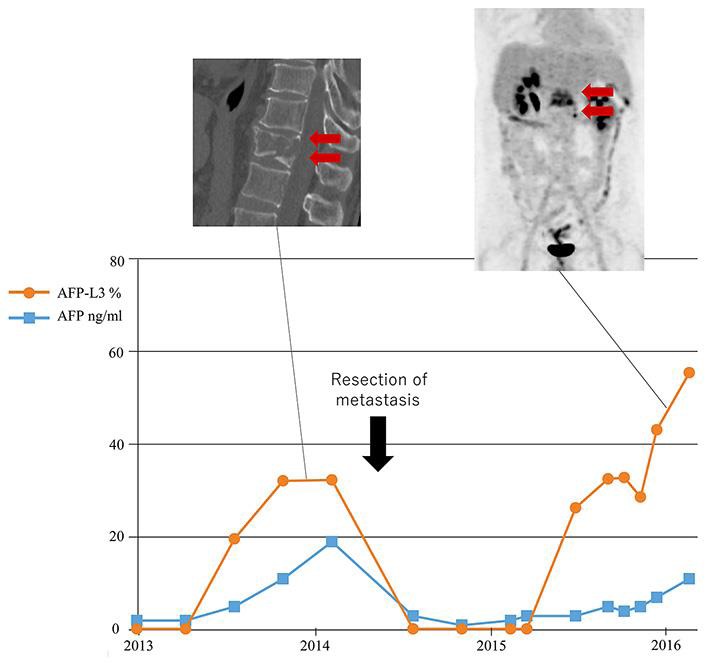
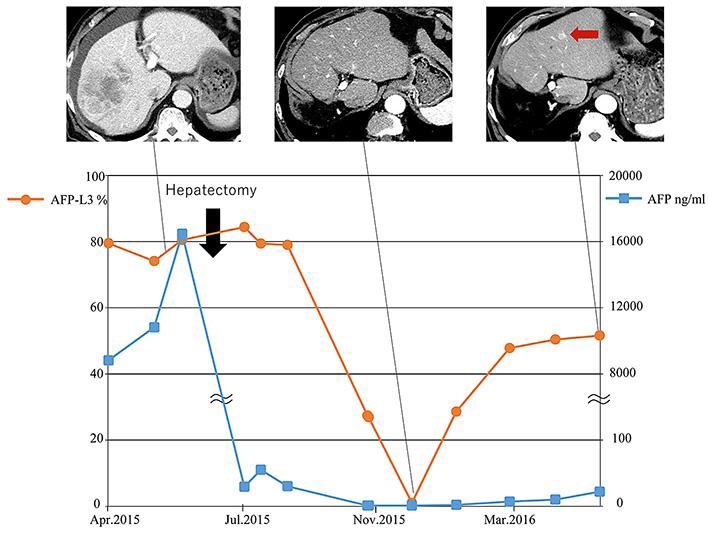
Alpha-fetoprotein (AFP)-L3 was originally reported as a hepatocellular carcinoma (HCC)-specific tumor marker, and recent accumulation of evidence has revealed that AFP-L3 frequency predicts the biological malignancy potential of HCC. However, AFP-L3 elevation from undetectable levels after curative treatment could not be discussed due to the difficulties of calculating AFP-L3 concentrations when serum AFP levels were low. Here, as a novel method, we used highly sensitive AFP-L3 frequency to predict HCC recurrence after curative treatment. Our cases illustrate that recognizing elevation of AFP-L3 from undetectable levels led to the early detection of recurrent HCC due to more careful surveillance.
甲胎蛋白异质体(AFP-L3)最初被报道为肝细胞癌(HCC)特异性肿瘤标志物,最近越来越多的证据表明,AFP-L3频率可预测HCC的生物学恶性潜能。然而,由于血清AFP水平较低时计算AFP-L3浓度存在困难,因此无法讨论根治性治疗后AFP-L3从不可检测水平升高的情况。在此,作为一种新方法,我们使用高灵敏度AFP-L3频率来预测根治性治疗后HCC的复发。我们的病例表明,由于更仔细的监测,识别AFP-L3从不可检测水平升高可导致复发性HCC的早期检测。