Li ChunYu, Chen YongPing, Chen XuePing, Wei QianQian, Cao Bei, Shang HuiFang
Department of Neurology, West China Hospital, Sichuan UniversityChengdu, China.
West China Brain Research Center, West China Hospital, Sichuan UniversityChengdu, China.
Front Mol Neurosci. 2017 May 30;10:160. doi: 10.3389/fnmol.2017.00160. eCollection 2017.
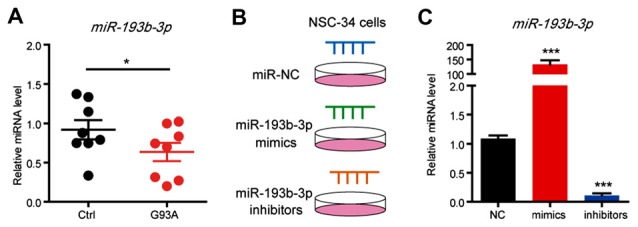
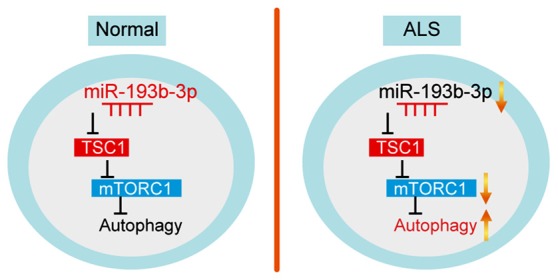
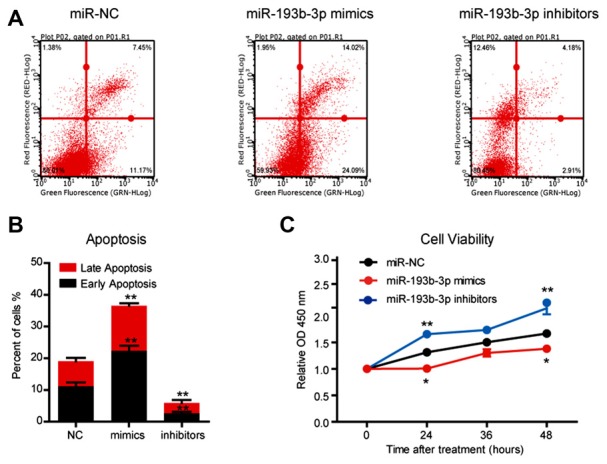
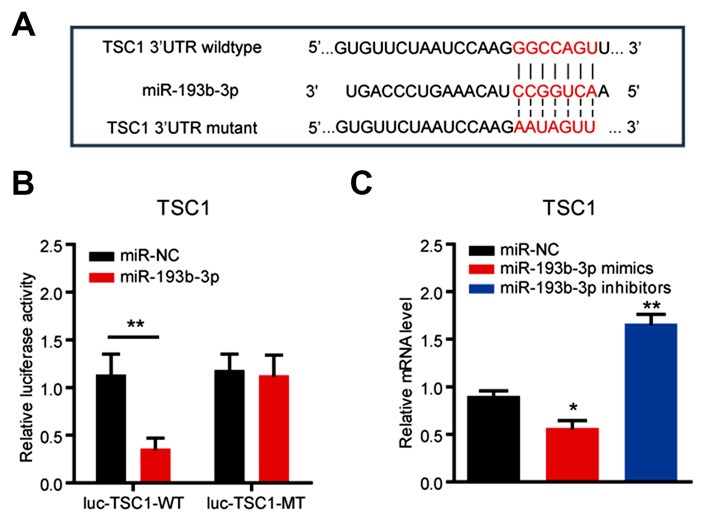
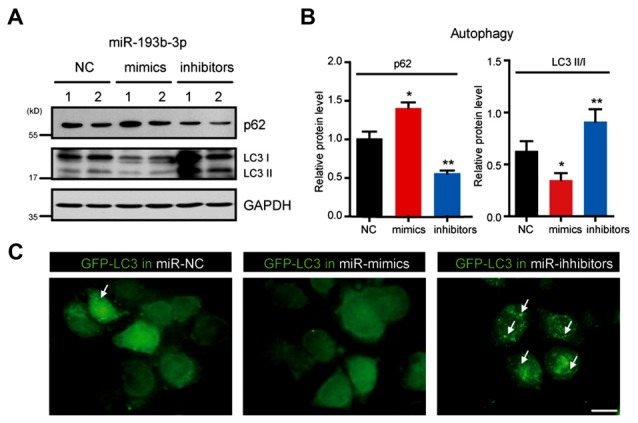
Amyotrophic lateral sclerosis (ALS) is a fatal neurodegenerative disease characterized by the death of upper and lower motor neurons. MicroRNAs (miRNAs) are reported to be closely related to the development of ALS. However, the precise functions of miRNAs in the pathogenesis of ALS remain largely unknown. In previous studies, we determined that was significantly downregulated in patients with sporadic ALS (sALS). Here, we observed that was downregulated in the SOD1 mouse model of ALS and promoted cell death in NSC-34 cells. We further found that directly targeted tuberous sclerosis 1 (TSC1) to regulate mechanistic target of rapamycin complex 1 (mTORC1) activity. Downregulation of led to TSC1 increase accompanied with mTORC1 inactivation, and . Moreover, downregulation of promoted protective autophagy and cell survival in NSC-34 cells. In contrast, upregulation of activated mTORC1 signaling, leading to inhibition of autophagy and promotion of cell death. Taken together, our study suggests that downregulation of is required for cell survival by targeting TSC1/mTOR signaling in NSC-34 cells and provides a novel target for improving the clinical therapy of ALS.
肌萎缩侧索硬化症(ALS)是一种致命的神经退行性疾病,其特征是上下运动神经元死亡。据报道,微小RNA(miRNA)与ALS的发展密切相关。然而,miRNA在ALS发病机制中的精确功能仍 largely未知。在先前的研究中,我们确定 在散发性ALS(sALS)患者中显著下调。在这里,我们观察到 在ALS的SOD1小鼠模型中下调,并促进NSC-34细胞中的细胞死亡。我们进一步发现 直接靶向结节性硬化症1(TSC1)以调节雷帕霉素复合物1(mTORC1)的活性。 的下调导致TSC1增加并伴有mTORC1失活,以及 。此外, 的下调促进了NSC-34细胞中的保护性自噬和细胞存活。相反, 的上调激活了mTORC1信号传导,导致自噬抑制和细胞死亡促进。综上所述,我们的研究表明,通过靶向NSC-34细胞中的TSC1/mTOR信号传导, 的下调是细胞存活所必需的,并为改善ALS的临床治疗提供了一个新的靶点。