Montañez Maria Isabel, Mayorga Cristobalina, Bogas Gador, Barrionuevo Esther, Fernandez-Santamaria Ruben, Martin-Serrano Angela, Laguna Jose Julio, Torres Maria José, Fernandez Tahia Diana, Doña Inmaculada
Research Laboratory, IBIMA-Regional University Hospital of Malaga-UMA, Málaga, Spain.
Andalusian Center for Nanomedicine and Biotechnology-BIONAND, Málaga, Spain.
Front Immunol. 2017 May 29;8:614. doi: 10.3389/fimmu.2017.00614. eCollection 2017.
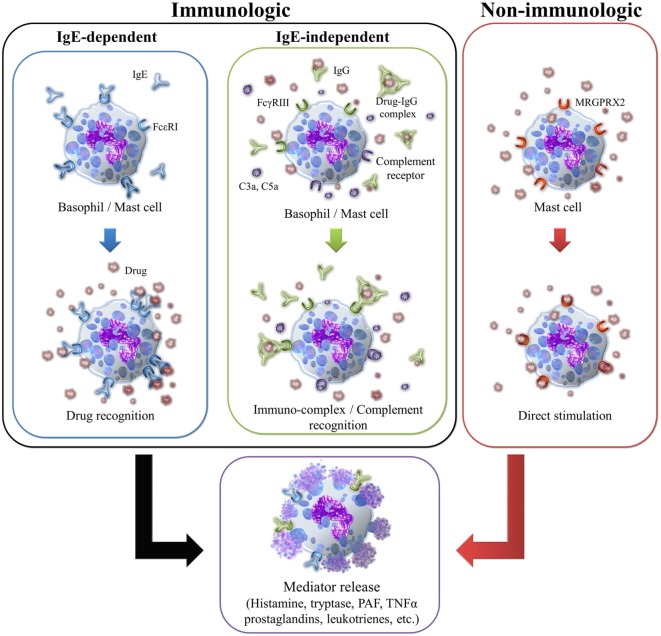
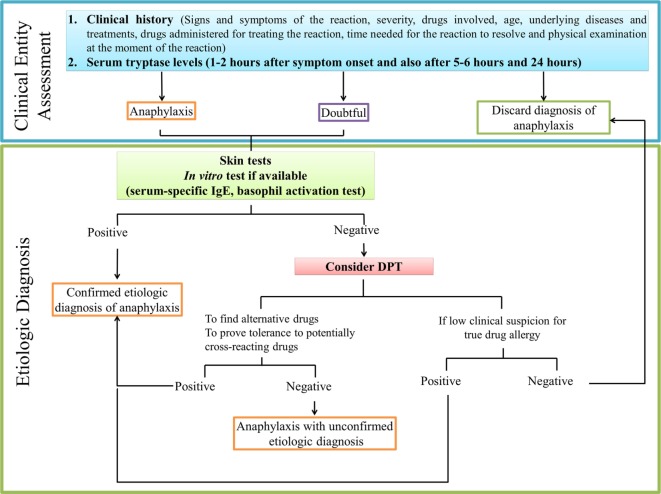
Anaphylaxis is an acute, life-threatening, multisystem syndrome resulting from the sudden release of mediators by mast cells and basophils. Although anaphylaxis is often under-communicated and thus underestimated, its incidence appears to have risen over recent decades. Drugs are among the most common triggers in adults, being analgesics and antibiotics the most common causal agents. Anaphylaxis can be caused by immunologic or non-immunologic mechanisms. Immunologic anaphylaxis can be mediated by IgE-dependent or -independent pathways. The former involves activation of Th2 cells and the cross-linking of two or more specific IgE (sIgE) antibodies on the surface of mast cells or basophils. The IgE-independent mechanism can be mediated by IgG, involving the release of platelet-activating factor, and/or complement activation. Non-immunological anaphylaxis can occur through the direct stimulation of mast cell degranulation by some drugs, inducing histamine release and leading to anaphylactic symptoms. Work-up of a suspected drug-induced anaphylaxis should include clinical history; however, this can be unreliable, and skin tests should also be used if available and validated. Drug provocation testing is not recommended due to the risk of inducing a harmful reaction. testing can help to confirm anaphylaxis by analyzing the release of mediators such as tryptase or histamine by mast cells. When immunologic mechanisms are suspected, serum-sIgE quantification or the use of the basophil activation test can help confirm the culprit drug. In this review, we will discuss multiple aspects of drug-induced anaphylaxis, including epidemiology, mechanisms, and diagnosis.
过敏反应是一种急性、危及生命的多系统综合征,由肥大细胞和嗜碱性粒细胞突然释放介质所致。尽管过敏反应常常未得到充分报告,因此被低估,但近几十年来其发病率似乎有所上升。药物是成人中最常见的诱因,其中镇痛药和抗生素是最常见的致病因素。过敏反应可由免疫或非免疫机制引起。免疫性过敏反应可通过IgE依赖或非依赖途径介导。前者涉及Th2细胞的激活以及肥大细胞或嗜碱性粒细胞表面两个或更多特异性IgE(sIgE)抗体的交联。IgE非依赖机制可由IgG介导,涉及血小板活化因子的释放和/或补体激活。非免疫性过敏反应可通过某些药物直接刺激肥大细胞脱颗粒,诱导组胺释放并导致过敏症状。对疑似药物性过敏反应的检查应包括临床病史;然而,这可能不可靠,如有可用且经过验证的皮肤试验也应使用。由于有诱发有害反应的风险,不建议进行药物激发试验。检测肥大细胞释放的介质(如类胰蛋白酶或组胺)有助于确诊过敏反应。当怀疑有免疫机制时,血清sIgE定量或使用嗜碱性粒细胞活化试验有助于确定致病药物。在本综述中,我们将讨论药物性过敏反应的多个方面,包括流行病学、机制和诊断。