McAninch Damian S, Heinaman Ashley M, Lang Cara N, Moss Kathryn R, Bassell Gary J, Rita Mihailescu Mihaela, Evans Timothy L
Department of Chemistry and Biochemistry, Duquesne University, 600 Forbes Avenue, Pittsburgh, Pennsylvania 15282, USA.
Department of Chemistry, University of Pittsburgh at Johnstown, Johnstown, Pennsylvania 15904, USA.
Mol Biosyst. 2017 Jul 25;13(8):1448-1457. doi: 10.1039/c7mb00070g.
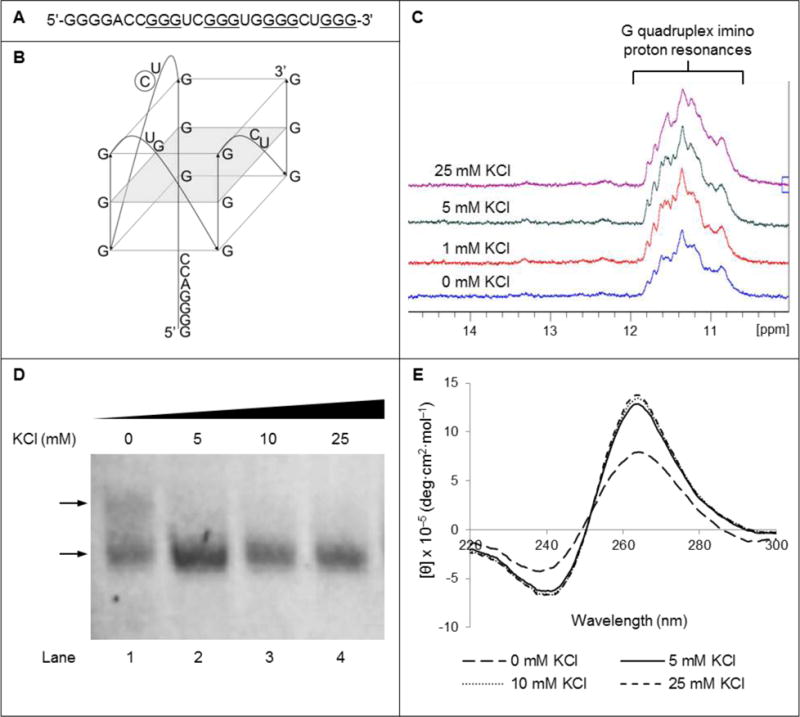
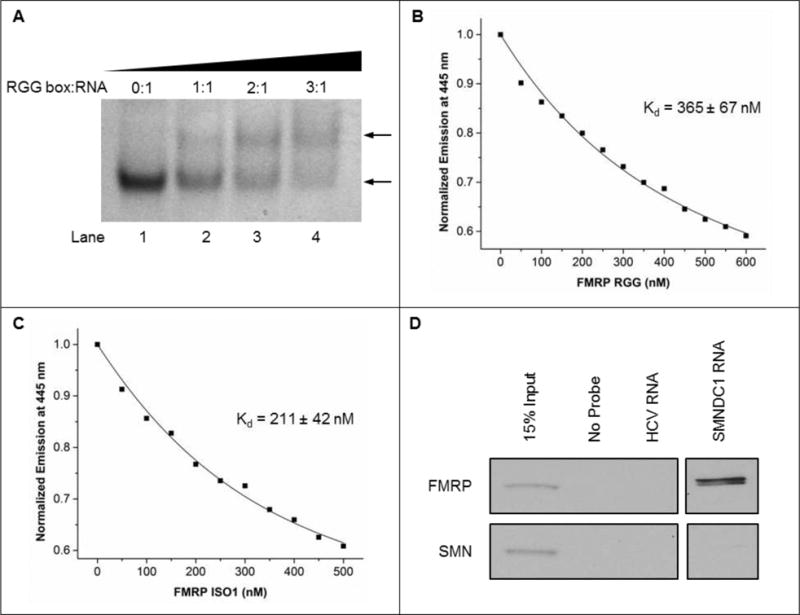
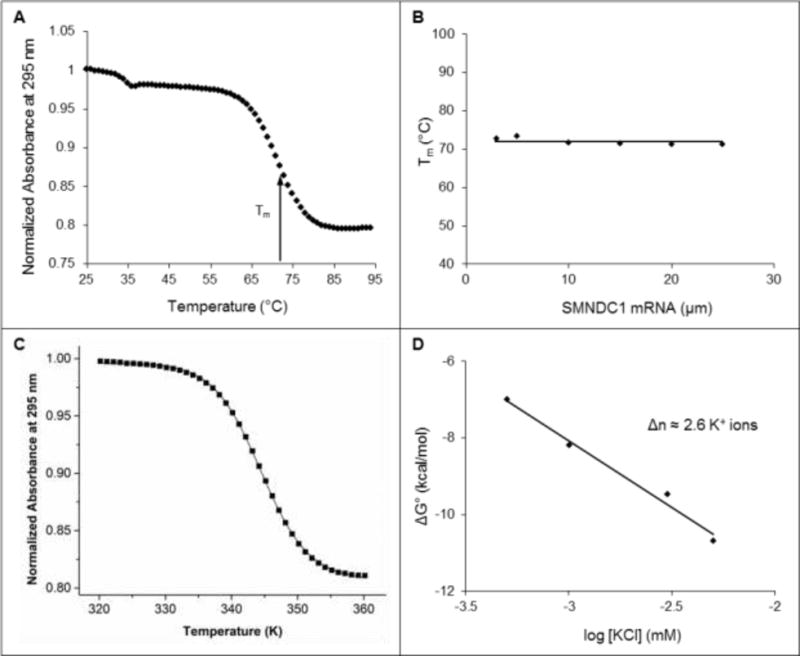
G quadruplex structures have been predicted by bioinformatics to form in the 5'- and 3'-untranslated regions (UTRs) of several thousand mature mRNAs and are believed to play a role in translation regulation. Elucidation of these roles has primarily been focused on the 3'-UTR, with limited focus on characterizing the G quadruplex structures and functions in the 5'-UTR. Investigation of the affinity and specificity of RNA binding proteins for 5'-UTR G quadruplexes and the resulting regulatory effects have also been limited. Among the mRNAs predicted to form a G quadruplex structure within the 5'-UTR is the survival motor neuron domain containing 1 (SMNDC1) mRNA, encoding a protein that is critical to the spliceosome. Additionally, this mRNA has been identified as a potential target of the fragile X mental retardation protein (FMRP), whose loss of expression leads to fragile X syndrome. FMRP is an RNA binding protein involved in translation regulation that has been shown to bind mRNA targets that form G quadruplex structures. In this study we have used biophysical methods to investigate G quadruplex formation in the 5'-UTR of SMNDC1 mRNA and analyzed its interactions with FMRP. Our results show that SMNDC1 mRNA 5'-UTR forms an intramolecular, parallel G quadruplex structure comprised of three G quartet planes, which is bound specifically by FMRP both in vitro and in mouse brain lysates. These findings suggest a model by which FMRP might regulate the translation of a subset of its mRNA targets by recognizing the G quadruplex structure present in their 5'-UTR, and affecting their accessibility by the protein synthesis machinery.
生物信息学预测在数千种成熟mRNA的5'和3'非翻译区(UTR)中会形成G-四链体结构,并且认为其在翻译调控中发挥作用。对这些作用的阐释主要集中在3'-UTR,而对5'-UTR中G-四链体结构和功能的表征关注有限。对RNA结合蛋白与5'-UTR G-四链体的亲和力和特异性及其产生的调控作用的研究也很有限。在预测在5'-UTR内形成G-四链体结构的mRNA中,有包含生存运动神经元结构域1(SMNDC1)的mRNA,它编码一种对剪接体至关重要的蛋白质。此外,该mRNA已被确定为脆性X智力低下蛋白(FMRP)的潜在靶标,其表达缺失会导致脆性X综合征。FMRP是一种参与翻译调控的RNA结合蛋白,已被证明可结合形成G-四链体结构的mRNA靶标。在本研究中,我们使用生物物理方法研究了SMNDC1 mRNA的5'-UTR中G-四链体的形成,并分析了其与FMRP的相互作用。我们的结果表明,SMNDC1 mRNA的5'-UTR形成了一个由三个G-四重平面组成的分子内平行G-四链体结构,该结构在体外和小鼠脑裂解物中均被FMRP特异性结合。这些发现提出了一个模型,即FMRP可能通过识别其mRNA靶标5'-UTR中存在的G-四链体结构,并影响蛋白质合成机制对其的可及性,来调节其一部分mRNA靶标的翻译。