Ertay Türkan, Sencan Eren Mine, Karaman Meral, Oktay Gülgün, Durak Hatice
Dokuz Eylül University Faculty of Medicine, Department of Nuclear Medicine, İzmir, Turkey.
Dokuz Eylül University Faculty of Medicine, Department of Clinical Microbiology, İzmir, Turkey.
Mol Imaging Radionucl Ther. 2017 Jun 1;26(2):47-52. doi: 10.4274/mirt.18291.
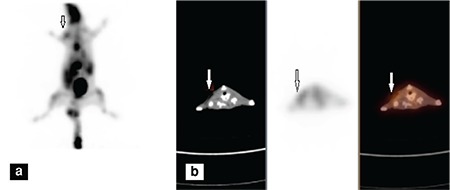
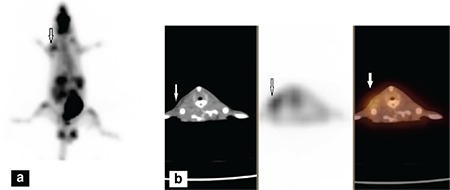
Detection/localization of infection and inflammation is important for the initiation of correct treatment as well as its maintenance. Nuclear medicine imaging methods play an important role in determining infection and inflammation. F-2'-deoxy-2-fluoro-d-glucose (F-FDG) positron emission tomography/computed tomography (PET/CT) is highly sensitive in such cases when used with tomographic cross-sections. In this study, the development and progression of infection and inflammation were monitored on rats by using F-FDG via PET/CT.
Sterile and infected abscesses were formed on rats using turpentine and S. aureus, respectively. For evaluation of the formation and progression of the abscess, F-FDG was injected into the rats and they were imaged by PET/CT at intervals of twenty-four hours for five days. Maximum standard uptake value (SUV) of F-FDG was calculated.
The highest activity involvement was seen on the first day of abscess formation. On the first day, SUV of the S. aureus abscess was 3.9±0.9 while in the sterile abscess SUV in the first day was 2.2±0.8. F-FDG uptake decreased day by day and it reached the background level on the fourth and fifth days. There were statistically significant differences between S. aureus and sterile abscess, and between sterile abscess and background activity in terms of SUV values during the first three days (p<0.05). On the fourth and fifth days, there was no statistically significant difference between S. aureus and sterile abscess, and between sterile abscess and background activity (p>0.05).
The results demonstrated that the SUV value for F-FDG can be useful in the early differentiation of sterile and infected abscess. In addition, F-FDG-PET imaging has the advantage of local availability of equipment and labeled agents leading rapid diagnosis of differentiation of infection and inflammation.
检测/定位感染和炎症对于正确治疗的启动及其维持至关重要。核医学成像方法在确定感染和炎症方面发挥着重要作用。2'-脱氧-2-氟-D-葡萄糖(F-FDG)正电子发射断层扫描/计算机断层扫描(PET/CT)在与断层横截面一起使用时,在这类病例中具有高度敏感性。在本研究中,通过PET/CT使用F-FDG对大鼠的感染和炎症的发展及进程进行监测。
分别使用松节油和金黄色葡萄球菌在大鼠身上形成无菌性和感染性脓肿。为了评估脓肿的形成和进程,将F-FDG注入大鼠体内,并在五天内每隔二十四小时通过PET/CT对它们进行成像。计算F-FDG的最大标准摄取值(SUV)。
在脓肿形成的第一天观察到最高的活性累及。第一天,金黄色葡萄球菌脓肿的SUV为3.9±0.9,而无菌性脓肿第一天的SUV为2.2±0.8。F-FDG摄取量逐日下降,并在第四天和第五天达到背景水平。在前三天,金黄色葡萄球菌脓肿与无菌性脓肿之间以及无菌性脓肿与背景活性之间在SUV值方面存在统计学显著差异(p<0.05)。在第四天和第五天,金黄色葡萄球菌脓肿与无菌性脓肿之间以及无菌性脓肿与背景活性之间没有统计学显著差异(p>0.05)。
结果表明,F-FDG的SUV值可有助于无菌性和感染性脓肿的早期鉴别。此外,F-FDG-PET成像具有设备和标记剂本地可获得的优势,可快速诊断感染和炎症的鉴别。