Rohner Fabian, Namaste Sorrel Ml, Larson Leila M, Addo O Yaw, Mei Zuguo, Suchdev Parminder S, Williams Anne M, Sakr Ashour Fayrouz A, Rawat Rahul, Raiten Daniel J, Northrop-Clewes Christine A
GroundWork, Fläsch, Switzerland;
Strengthening Partnerships, Results, and Innovations in Nutrition Globally, Arlington, VA.
Am J Clin Nutr. 2017 Jul;106(Suppl 1):372S-382S. doi: 10.3945/ajcn.116.142232. Epub 2017 Jun 14.
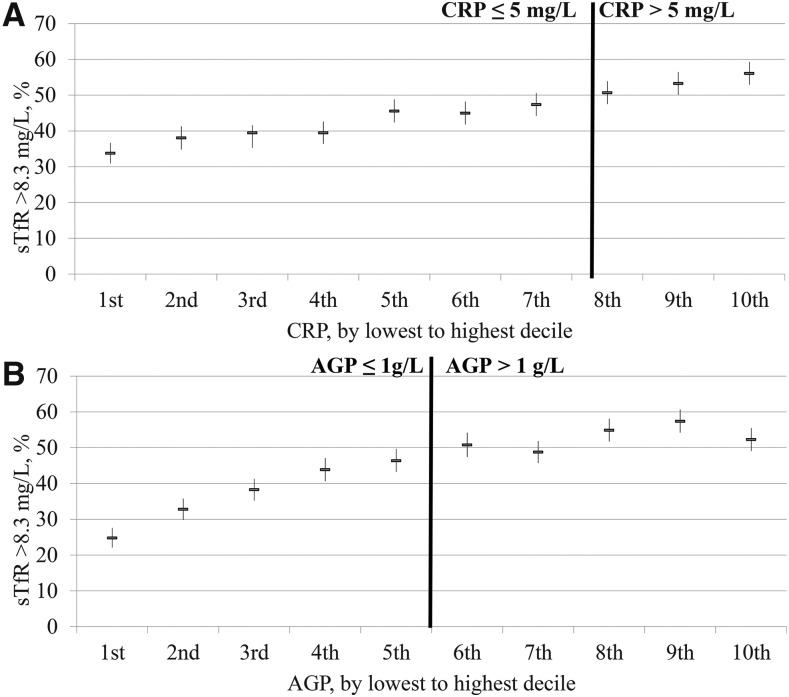
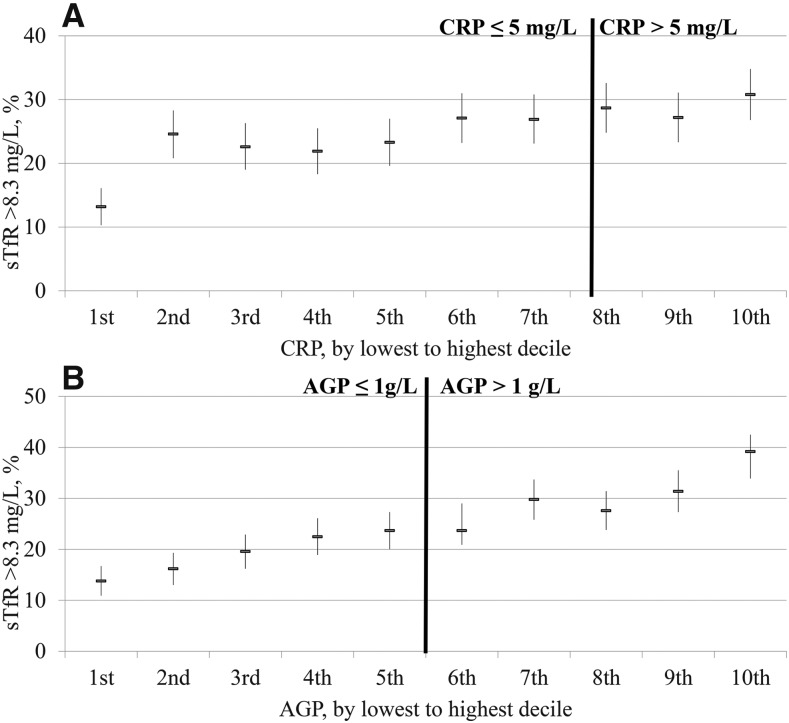
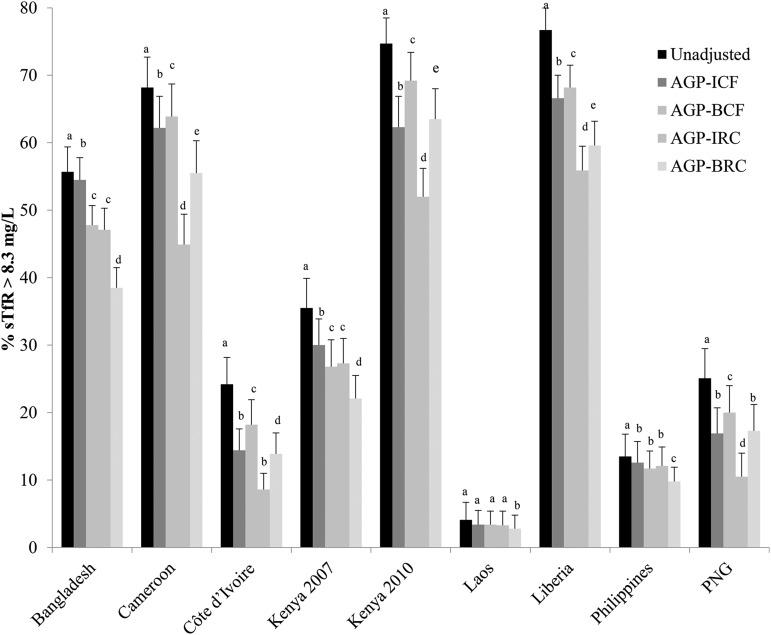
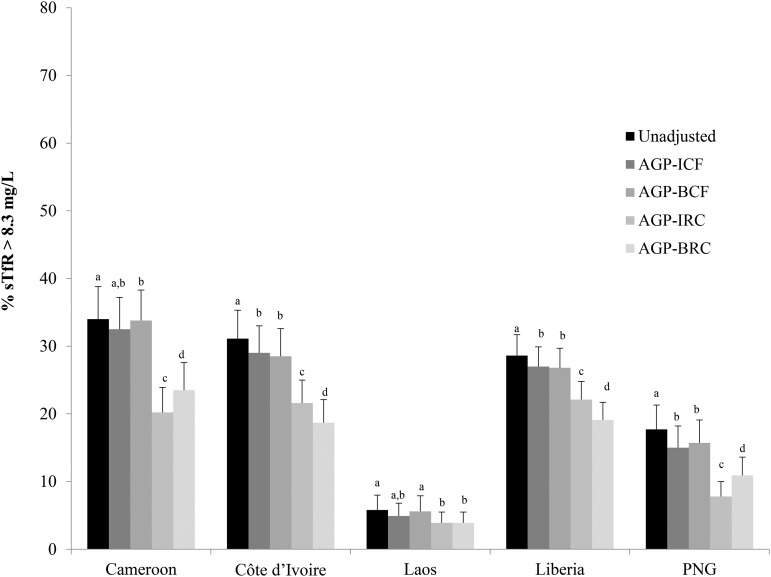
Iron deficiency is thought to be one of the most prevalent micronutrient deficiencies globally, but an accurate assessment in populations who are frequently exposed to infections is impeded by the inflammatory response, which causes iron-biomarker alterations. We assessed the relation between soluble transferrin receptor (sTfR) concentrations and inflammation and malaria in preschool children (PSC) (age range: 6-59 mo) and women of reproductive age (WRA) (age range: 15-49 y) and investigated adjustment algorithms to account for these effects. Cross-sectional data from the Biomarkers Reflecting the Inflammation and Nutritional Determinants of Anemia (BRINDA) project from 11,913 PSC in 11 surveys and from 11,173 WRA in 7 surveys were analyzed individually and combined with the use of a meta-analysis. The following 3 adjustment approaches were compared with estimated iron-deficient erythropoiesis (sTfR concentration >8.3 mg/L): ) the exclusion of individuals with C-reactive protein (CRP) concentrations >5 mg/L or α-1-acid glycoprotein (AGP) concentrations >1 g/L, ) the application of arithmetic correction factors, and ) the use of regression approaches. The prevalence of elevated sTfR concentrations incrementally decreased as CRP and AGP deciles decreased for PSC and WRA, but the effect was more pronounced for AGP than for CRP. Depending on the approach used to adjust for inflammation, the estimated prevalence of iron-deficient erythropoiesis decreased by 4.4-14.6 and 0.3-9.5 percentage points in PSC and WRA, respectively, compared with unadjusted values. The correction-factor approach yielded a more modest reduction in the estimated prevalence of iron-deficient erythropoiesis than did the regression approach. Mostly, adjustment for malaria in addition to AGP did not significantly change the estimated prevalence of iron-deficient erythropoiesis. sTfR may be useful to assess iron-deficient erythropoiesis, but inflammation influences its interpretation, and adjustment of sTfR for inflammation and malaria should be considered. More research is warranted to evaluate the proposed approaches in different settings, but this study contributes to the evidence on how and when to adjust sTfR for inflammation and malaria.
缺铁被认为是全球最普遍的微量营养素缺乏症之一,但在经常接触感染的人群中,炎症反应会导致铁生物标志物改变,从而阻碍了对缺铁情况的准确评估。我们评估了学龄前儿童(PSC,年龄范围:6 - 59个月)和育龄妇女(WRA,年龄范围:15 - 49岁)中可溶性转铁蛋白受体(sTfR)浓度与炎症及疟疾之间的关系,并研究了用于校正这些影响的算法。对来自“反映贫血的炎症和营养决定因素生物标志物”(BRINDA)项目的横断面数据进行了分析,这些数据来自11次调查中的11,913名PSC以及7次调查中的11,173名WRA,分析时先单独分析,然后通过荟萃分析进行合并。将以下3种校正方法与估计的缺铁性红细胞生成(sTfR浓度>8.3 mg/L)进行比较:(1)排除C反应蛋白(CRP)浓度>5 mg/L或α-1酸性糖蛋白(AGP)浓度>1 g/L的个体;(2)应用算术校正因子;(3)使用回归方法。随着PSC和WRA中CRP和AGP十分位数的降低,sTfR浓度升高的患病率逐渐下降,但AGP的影响比CRP更明显。根据用于校正炎症的方法不同,与未校正值相比,PSC和WRA中估计的缺铁性红细胞生成患病率分别降低了4.4 - 14.6和0.3 - 9.5个百分点。校正因子方法使估计的缺铁性红细胞生成患病率降低的幅度小于回归方法。大多数情况下,除了AGP之外再校正疟疾,并不会显著改变估计的缺铁性红细胞生成患病率。sTfR可能有助于评估缺铁性红细胞生成,但炎症会影响对其的解读,因此应考虑对sTfR进行炎症和疟疾方面的校正。有必要开展更多研究以评估在不同环境下所提出的方法,但本研究为有关如何以及何时对sTfR进行炎症和疟疾校正的证据提供了补充。