Yin Shuai, Chen Yuan, Lei Du, Sun Rui-Rui, Ma Ting-Ting, Feng Pei-Min, He Zhao-Xuan, Suo Xue-Ling, Ma Pei-Hong, Qu Yu-Zhu, Qiu Ke, Jing Miao-Miao, Gong Qi-Yong, Liang Fan-Rong, Chen Jiao, Zeng Fang
Acupuncture and Tuina School/The Third Affiliated Hospital, Chengdu University of Traditional Chinese Medicine, Chengdu, Sichuan Province, China.
First Affiliated Hospital of Henan University of Traditional Chinese Medicine, Zhengzhou, Henan Province, China.
Neural Regen Res. 2017 May;12(5):831-840. doi: 10.4103/1673-5374.206655.
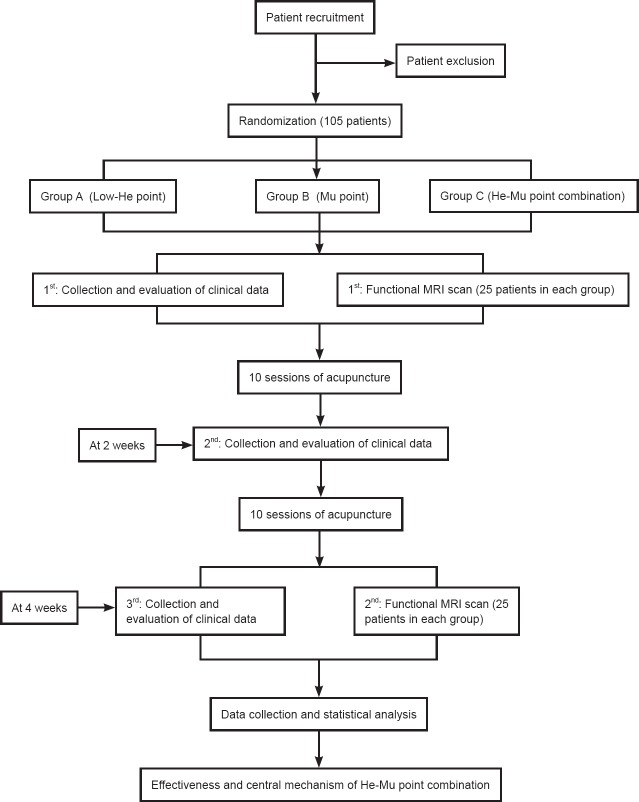
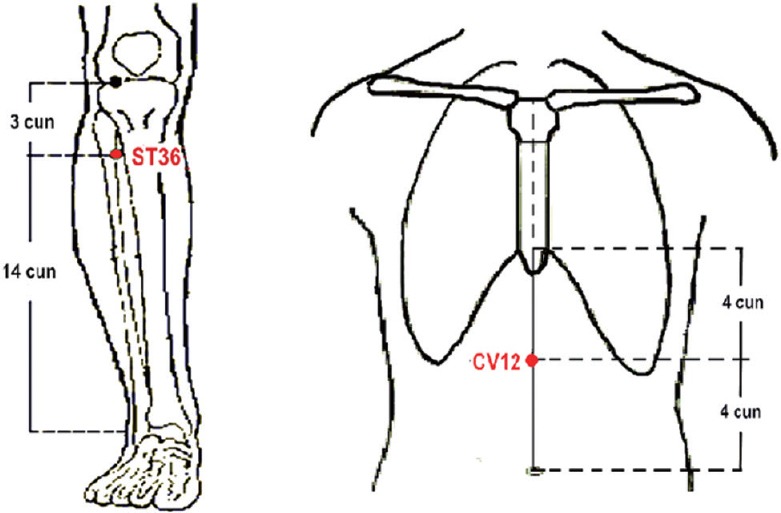
Acupuncture is widely used to treat functional dyspepsia with satisfactory outcomes. Combination of the He and Mu acupoints is commonly used and has a synergistic effect on functional dyspepsia; however, its underlying mechanisms remain unclear. Therefore, a randomized controlled parallel clinical trial is currently underway at Chengdu University of Traditional Chinese Medicine, China. This trial is designed to explore the efficacy of and central responses to the He-Mu point combination in patients with functional dyspepsia using functional magnetic resonance imaging. A total of 105 patients with functional dyspepsia will be allocated into 3 groups: the low-He point group (puncturing at (ST36)), Mu point group (puncturing at (CV12)), and He-Mu point combination group (puncturing at ST36 and CV12). Every participant will receive 20 sessions of manual acupuncture for 4 weeks. The needles will be inserted perpendicularly to a depth of 1 to 2 cun. The angle of rotation and twisting will range from 90 to 180 degrees, while lifting and thrusting will range from 0.3 to 0.5 cm. The various manipulations will be performed 60 to 90 times per minute. The needles will remain in place for 30 minutes, during which manipulation will be applied every 10 minutes. Magnetic resonance imaging will be performed before and after 20 sessions of acupuncture. The primary outcome is symptom improvement according to the Chinese version of the Nepean Dyspepsia Index. Secondary outcomes include the Leeds dyspepsia questionnaire, Self-Rating Anxiety Scale, Self-Rating Depression Scale, Beck Anxiety Inventory, Beck Depression Inventory, and visual analogue scale scores before and after 10 and 20 sessions of acupuncture. Needle sensation and adverse events will be used to assess the therapeutic effects. This study will promote more widespread awareness of the benefits of acupoint combination in the clinical setting and provide a further explanation of the neuromechanism by which acupuncture at the He-Mu point combination for functional dyspepsia. Registration: Chinese Clinical Trial Registry, ChiCTR-IOR-15006402.
针灸被广泛用于治疗功能性消化不良,疗效令人满意。合穴与募穴联合应用是治疗功能性消化不良的常用方法,且具有协同作用;然而,其潜在机制尚不清楚。因此,中国成都中医药大学目前正在进行一项随机对照平行临床试验。本试验旨在通过功能磁共振成像探讨合募配穴法对功能性消化不良患者的疗效及中枢反应。总共105例功能性消化不良患者将被分为3组:低合穴组(针刺足三里(ST36))、募穴组(针刺中脘(CV12))和合募配穴组(针刺足三里(ST36)和中脘(CV12))。每位参与者将接受为期4周、共20次的手动针刺治疗。针垂直刺入1至2寸深。捻转角度为90至180度,提插幅度为0.3至0.5厘米。各种手法每分钟施行60至90次。留针30分钟,期间每隔10分钟行针1次。在20次针刺前后进行磁共振成像检查。主要观察指标是根据中文版的内皮恩消化不良指数评估症状改善情况。次要观察指标包括利兹消化不良问卷、自评焦虑量表、自评抑郁量表、贝克焦虑量表、贝克抑郁量表,以及针刺10次和20次前后的视觉模拟量表评分。针刺感觉和不良事件将用于评估治疗效果。本研究将提高临床环境中对穴位配伍益处的更广泛认识,并进一步解释合募配穴法治疗功能性消化不良的神经机制。注册信息:中国临床试验注册中心,ChiCTR-IOR-15006402。