Amiri Hassan, Ghodrati Niloufar, Nikuyeh Mehrnaz, Shams-Vahdati Samad, Jalilzadeh-Binazar Mehran
Department of Emergency Medicine, Iran University of Medical Sciences, Tehran, Iran.
Department of Hematology and Oncology, Alborz University of Medical Sciences, Karaj, Iran.
Turk J Emerg Med. 2017 Jan 10;17(2):61-64. doi: 10.1016/j.tjem.2016.12.004. eCollection 2017 Jun.
One of the irritating features of migraine is emesis that can compromise taking oral medications. We designed this study to compare the effectiveness of granisetron and metoclopramide in reducing pain and treating emesis in migraine patients.
We included a total of 148 patients with migraine headache presenting to two referral hospitals in a prospective, double-blinded randomized controlled trial. We compared the effect of granisetron (2 mg intravenous) with metoclopramide (10 mg intravenous). Pain intensity and emesis episodes were recorded before drug administration, one, two and four 4 h after drug administration.
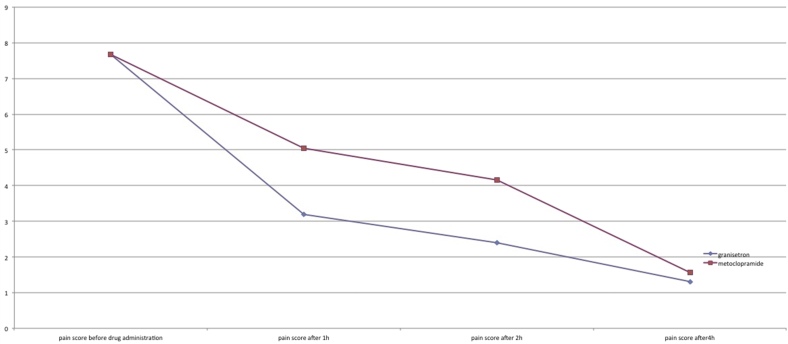
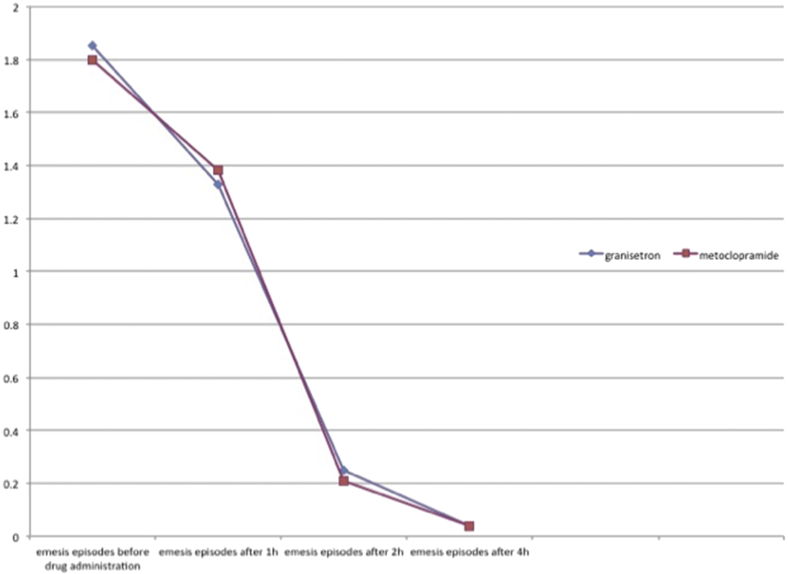
Of the 148 patients, 47 were male and 101 were female. 75 patients received granisetron and 73 metoclopramide. Mean pain intensity before the administration of the medications was 7.67 ± 1.30 in granisetron group and 7.68 ± 1.13 in metoclopramide group with an insignificant difference. Mean pain intensity at one, two, and 4 h after drug administration was 3.20 ± 1.37, 2.39 ± 1.28, and 1.31 ± 0.52 in granisetron group and 5.04 ± 1.77, 4.1 ± 1.8, and 1.56 ± 0.68 in metoclopramide group (P = 0.03). Mean emesis episodes before drug administration were 1.85 ± 0.81 and 1.80 ± 0.77 in granisetron and metoclopramide groups, respectively. These episodes were 1.33 ± 0.66, 0.25 ± 0.49, and 0.04 ± 0.19 in granisetron group and 1.38 ± 0.73, 0.21 ± 0.47, and 0.41 ± 0.19 in metoclopramide group at one, two, and 4 h after the drug administration (P = 0.7).
To came in conclusion, compared to metoclopramide, granisetron is a better choice in acute migraine ATTACK because it decreases the patients' pain as well as their emesis.
偏头痛令人苦恼的特征之一是呕吐,这可能会影响口服药物的服用。我们设计了这项研究,以比较格拉司琼和甲氧氯普胺在减轻偏头痛患者疼痛和治疗呕吐方面的效果。
我们在一项前瞻性、双盲随机对照试验中纳入了两家转诊医院共148例偏头痛患者。我们比较了格拉司琼(静脉注射2毫克)和甲氧氯普胺(静脉注射10毫克)的效果。在给药前、给药后1小时、2小时和4小时记录疼痛强度和呕吐发作次数。
148例患者中,男性47例,女性101例。75例患者接受格拉司琼治疗,73例接受甲氧氯普胺治疗。格拉司琼组给药前的平均疼痛强度为7.67±1.30,甲氧氯普胺组为7.68±1.13,差异无统计学意义。格拉司琼组给药后1小时、2小时和4小时的平均疼痛强度分别为3.20±1.37、2.39±1.28和1.31±0.52,甲氧氯普胺组分别为5.04±1.77、4.1±1.8和1.56±0.68(P=0.03)。格拉司琼组和甲氧氯普胺组给药前的平均呕吐发作次数分别为1.85±0.81和1.80±0.77。给药后1小时、2小时和4小时,格拉司琼组的这些发作次数分别为1.33±0.66、0.25±0.49和0.04±0.19,甲氧氯普胺组分别为1.38±0.73、0.21±0.47和0.41±0.19(P=0.7)。
总之,与甲氧氯普胺相比,格拉司琼在急性偏头痛发作时是更好的选择,因为它能减轻患者的疼痛和呕吐。