Stefani Mariane M A, Avanzi Charlotte, Bührer-Sékula Samira, Benjak Andrej, Loiseau Chloé, Singh Pushpendra, Pontes Maria A A, Gonçalves Heitor S, Hungria Emerith M, Busso Philippe, Piton Jérémie, Silveira Maria I S, Cruz Rossilene, Schetinni Antônio, Costa Maurício B, Virmond Marcos C L, Diorio Suzana M, Dias-Baptista Ida M F, Rosa Patricia S, Matsuoka Masanori, Penna Maria L F, Cole Stewart T, Penna Gerson O
Tropical Pathology and Public Health Institute, Federal University of Goiás, Goiania, Goiás, Brazil.
Global Health Institute, École Polytechnique Fédérale de Lausanne, Switzerland.
PLoS Negl Trop Dis. 2017 Jun 15;11(6):e0005598. doi: 10.1371/journal.pntd.0005598. eCollection 2017 Jun.
Since leprosy is both treated and controlled by multidrug therapy (MDT) it is important to monitor recurrent cases for drug resistance and to distinguish between relapse and reinfection as a means of assessing therapeutic efficacy. All three objectives can be reached with single nucleotide resolution using next generation sequencing and bioinformatics analysis of Mycobacterium leprae DNA present in human skin.
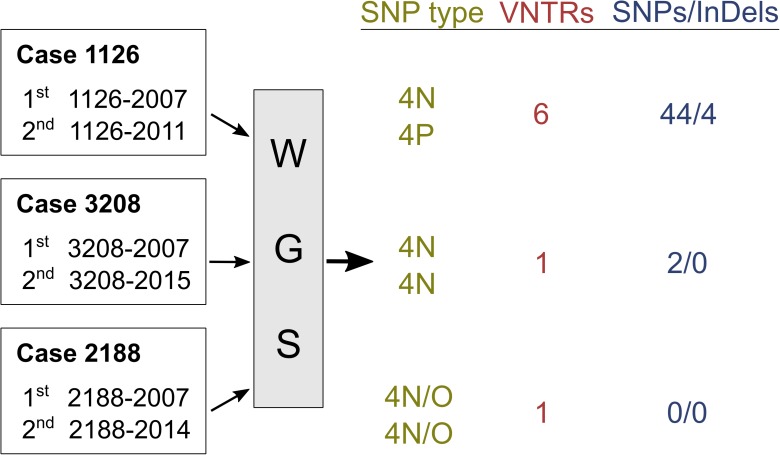
DNA was isolated by means of optimized extraction and enrichment methods from samples from three recurrent cases in leprosy patients participating in an open-label, randomized, controlled clinical trial of uniform MDT in Brazil (U-MDT/CT-BR). Genome-wide sequencing of M. leprae was performed and the resultant sequence assemblies analyzed in silico.
In all three cases, no mutations responsible for resistance to rifampicin, dapsone and ofloxacin were found, thus eliminating drug resistance as a possible cause of disease recurrence. However, sequence differences were detected between the strains from the first and second disease episodes in all three patients. In one case, clear evidence was obtained for reinfection with an unrelated strain whereas in the other two cases, relapse appeared more probable.
CONCLUSIONS/SIGNIFICANCE: This is the first report of using M. leprae whole genome sequencing to reveal that treated and cured leprosy patients who remain in endemic areas can be reinfected by another strain. Next generation sequencing can be applied reliably to M. leprae DNA extracted from biopsies to discriminate between cases of relapse and reinfection, thereby providing a powerful tool for evaluating different outcomes of therapeutic regimens and for following disease transmission.
由于麻风病采用多药联合疗法(MDT)进行治疗和控制,监测复发病例的耐药情况以及区分复发和再感染以评估治疗效果非常重要。通过对人类皮肤中存在的麻风分枝杆菌DNA进行新一代测序和生物信息学分析,能够以单核苷酸分辨率实现这三个目标。
采用优化的提取和富集方法,从参与巴西统一多药联合疗法开放标签随机对照临床试验(U-MDT/CT-BR)的麻风病患者的三例复发病例样本中分离DNA。对麻风分枝杆菌进行全基因组测序,并对所得序列组装进行计算机分析。
在所有三例病例中,均未发现对利福平、氨苯砜和氧氟沙星耐药的突变,因此排除了耐药性作为疾病复发可能原因的可能性。然而,在所有三名患者的首次和第二次发病菌株之间均检测到序列差异。在一例病例中,获得了明确的证据表明感染了无关菌株,而在另外两例病例中,复发的可能性似乎更大。
结论/意义:这是首次使用麻风分枝杆菌全基因组测序揭示,留在流行地区的已治疗和治愈的麻风病患者可能会被另一种菌株再次感染。新一代测序可以可靠地应用于从活检组织中提取的麻风分枝杆菌DNA,以区分复发和再感染病例,从而为评估治疗方案的不同结果以及追踪疾病传播提供一个强大的工具。