Department of Forest Protection, Forest Research Institute, Sękocin Stary, Braci Leśnej 3, 05-090, Raszyn, Poland.
Department of Forest Ecology, Forest Research Institute, Sękocin Stary, Braci Leśnej 3, 05-090, Raszyn, Poland.
J Ethnobiol Ethnomed. 2017 Jun 15;13(1):36. doi: 10.1186/s13002-017-0163-x.
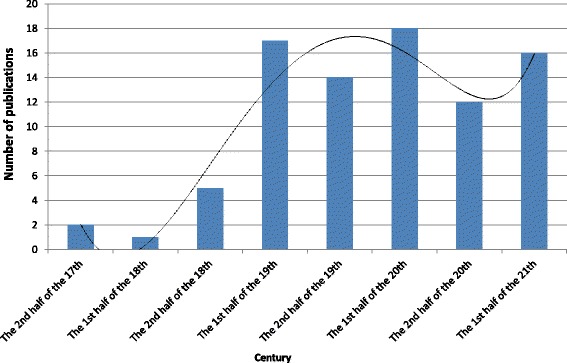
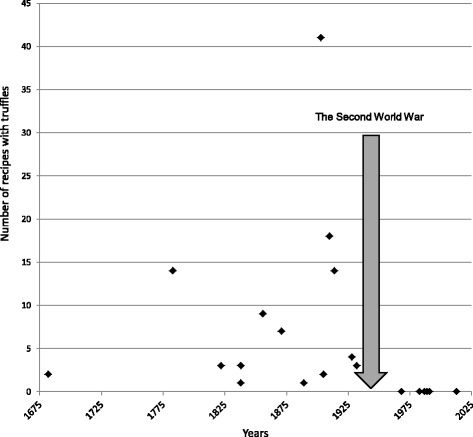
The use of truffles in Poland has a long tradition, yet due to some historical aspects, this knowledge was lost. Currently, truffles and truffle orchards are again receiving attention, and thanks to, e.g., historical data, they have solid foundations to be established. Publications relating to truffles between 1661 and 2017 were searched for in international and national databases, such as the database of PhD theses, Google Scholar, and catalogues of the National Library of Poland, the Jagiellonian Digital Library, the University Library of J. Giedroyc in Bialystok and the Lower Silesian Digital Library (DBC). A very meticulous survey of the literature on truffles showed that truffles have been known since at least 1661. In the 18th century, the fungi were considered a non-timber forest product. It is interesting to mention the impact of Polish Count Michał Jan Borch in understanding the nature of truffles. The whitish truffle (Tuber borchii) is named after him. The greatest number of publications regarding truffles can be observed at the first half of the 19th and 20th centuries. The fungi were present not only in cookbooks but also in scientific literature, and aspects of their ecology and medicinal use are considered. The "dark ages" for truffles, mainly for social reasons, occurred after the Second World War. In tough times, when Poland was under Soviet communist control (1945-1989), truffles as a luxurious product have been completely forgotten. However, at the end of the 20th century, truffles started receiving attention in Polish society. Yet, the real awakening began in the first decade of the twenty-first century when the first truffle orchards were established. One of them has already produced the first fruit bodies of summer truffle (Tuber aestivum). Truffles have been present in Polish culture for centuries. Their renaissance indicates the need for fostering sustainable agroforestry-centred initiatives aimed at helping truffle growers in growing the precious fungi and thus meeting market demands.
波兰使用松露已有悠久的历史,但由于某些历史因素,相关知识一度失传。如今,松露和松露果园再次受到关注,并且得益于历史数据等因素,它们有了坚实的基础得以建立。在国际和国家数据库中,如博士论文数据库、谷歌学术和波兰国家图书馆、雅盖隆大学数字图书馆、比亚韦斯托克 J.Giedroyc 大学图书馆和下西里西亚数字图书馆的目录,搜索了 1661 年至 2017 年期间与松露相关的出版物。对松露文献的细致调查表明,松露至少从 1661 年就已为人所知。在 18 世纪,这些真菌被视为非木材森林产品。有趣的是,波兰伯爵米哈乌·扬·博尔奇(Michał Jan Borch)对松露性质的理解产生了影响。这种灰白色的松露(Tuber borchii)就是以他的名字命名的。可以看到,19 世纪上半叶和 20 世纪发表了最多关于松露的论文。这些真菌不仅出现在食谱中,也出现在科学文献中,考虑了它们的生态学和药用方面。松露的“黑暗时代”主要是由于社会原因,发生在第二次世界大战之后。在困难时期,当波兰处于苏联共产主义控制之下(1945-1989 年),作为奢侈品的松露完全被遗忘。然而,在 20 世纪末,松露开始在波兰社会受到关注。然而,真正的觉醒始于 21 世纪的第一个十年,当时建立了第一批松露果园。其中一个已经生产出了第一批夏季松露(Tuber aestivum)的子实体。几个世纪以来,松露一直存在于波兰文化中。它们的复兴表明,需要促进以可持续农林为中心的倡议,帮助松露种植者种植珍贵的真菌,从而满足市场需求。