Gomo Gjermund, Mattisson Jenny, Hagen Bjørn Roar, Moa Pål Fossland, Willebrand Tomas
Nord University, 8049, Bodø, Norway.
Norwegian Institute for Nature Research (NINA), 7484, Trondheim, Norway.
BMC Ecol. 2017 Jun 15;17(1):22. doi: 10.1186/s12898-017-0132-1.
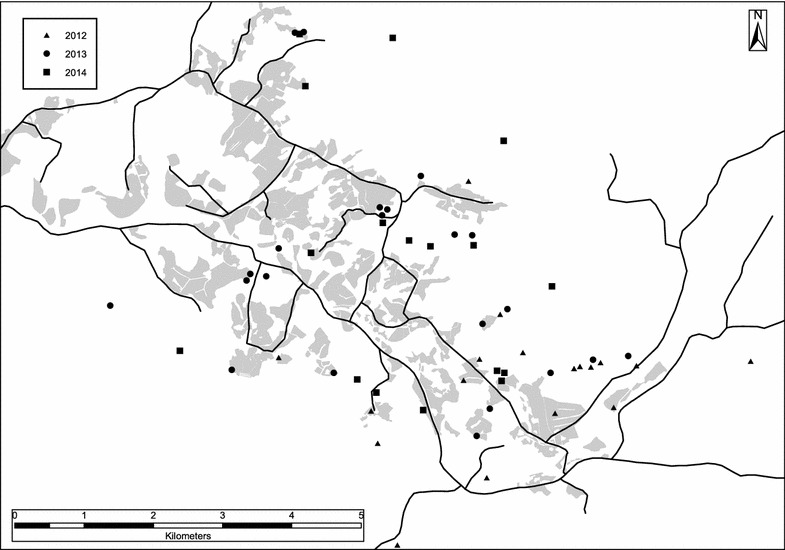
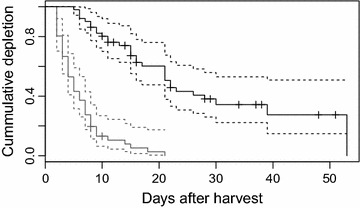
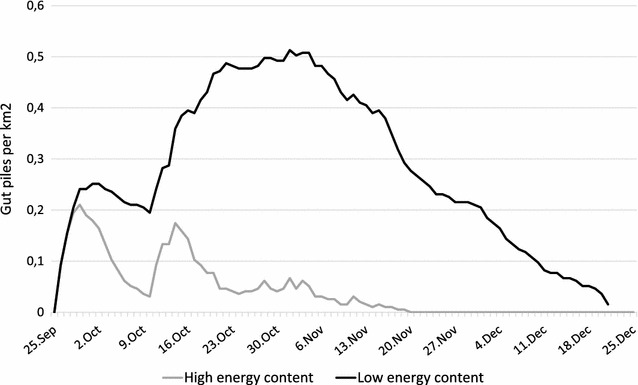
Human food subsidies can provide predictable food sources in large quantities for wildlife species worldwide. In the boreal forest of Fennoscandia, gut piles from moose (Alces alces) harvest provide a potentially important food source for a range of opportunistically scavenging predators. Increased populations of predators can negatively affect threatened or important game species. As a response to this, restrictions on field dressing of moose are under consideration in parts of Norway. However, there is a lack of research to how this resource is utilized. In this study, we used camera-trap data from 50 gut piles during 1043 monitoring days. We estimated depletion of gut piles separately for parts with high and low energy content, and used these results to scale up gut pile density in the study area. We identified scavenger species and analyzed the influences of gut pile quality and density on scavenging behavior of mammals and corvids (family Corvidae).
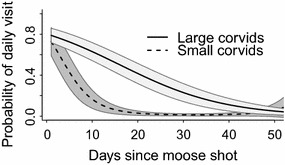
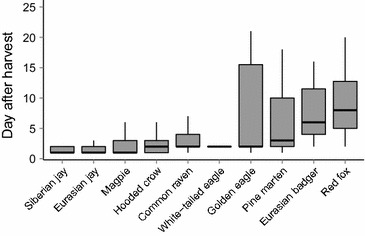
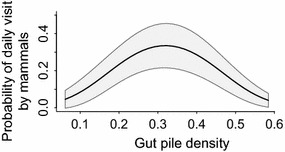
Main scavengers were corvids and red fox (Vulpes vulpes). Parts with high energy content were rapidly consumed, mainly by corvids that were present at all gut piles shortly after the remains were left at the kill site. Corvid presence declined with days since harvest, reflecting reduction in gut pile quality over time independent of gut pile density. Mammals arrived 7-8 days later at the gut piles than corvids, and their presence depended only on gut pile density with a peak at intermediate densities. The decline at high gut pile densities suggest a saturation effect, which could explain accumulation of gut pile parts with low energy content.
This study shows that remains from moose harvest can potentially be an important food resource for scavengers, as it was utilized to a high degree by many species. This study gives novel insight into how energy content and density of resources affect scavenging patterns among functional groups of scavengers.
人类的食物补贴能够为全球的野生动物物种提供大量可预测的食物来源。在斯堪的纳维亚半岛的北方森林中,驼鹿(驼鹿属)屠宰后的内脏堆为一系列机会性觅食的食肉动物提供了潜在的重要食物来源。食肉动物数量的增加可能会对受威胁或重要的猎物物种产生负面影响。对此,挪威部分地区正在考虑对驼鹿的野外屠宰进行限制。然而,关于这种资源是如何被利用的,目前还缺乏研究。在本研究中,我们在1043个监测日期间,使用了来自50个内脏堆的相机陷阱数据。我们分别估计了高能量含量部分和低能量含量部分内脏堆的消耗情况,并利用这些结果来扩大研究区域内内脏堆的密度。我们识别了食腐动物物种,并分析了内脏堆质量和密度对哺乳动物和鸦科(鸦科)食腐行为的影响。
主要的食腐动物是鸦科和赤狐(赤狐属)。高能量含量的部分被迅速消耗,主要是被鸦科动物消耗,它们在尸体留在屠宰现场后不久就出现在所有内脏堆处。鸦科动物的出现随着屠宰后的天数而减少,这反映了随着时间的推移,内脏堆质量的下降,而与内脏堆密度无关。哺乳动物比鸦科动物晚7 - 8天到达内脏堆,它们的出现仅取决于内脏堆密度,在中等密度时达到峰值。高内脏堆密度时的下降表明存在饱和效应,这可以解释低能量含量内脏堆部分的积累。
本研究表明,驼鹿屠宰后的残骸可能是食腐动物的重要食物资源,因为许多物种都高度利用了它。这项研究为资源的能量含量和密度如何影响食腐动物功能群之间的食腐模式提供了新的见解。