Gomo Gjermund, Rød-Eriksen Lars, Andreassen Harry P, Mattisson Jenny, Odden Morten, Devineau Olivier, Eide Nina E
Faculty of Applied Ecology, Agricultural Sciences and Biotechnology (Fac. Appl. Ecol.) Inland Norway University of Applied Sciences (INN) Koppang Norway.
Norwegian Institute for Nature Research (NINA) Trondheim Norway.
Ecol Evol. 2020 Sep 25;10(23):12860-12869. doi: 10.1002/ece3.6834. eCollection 2020 Dec.
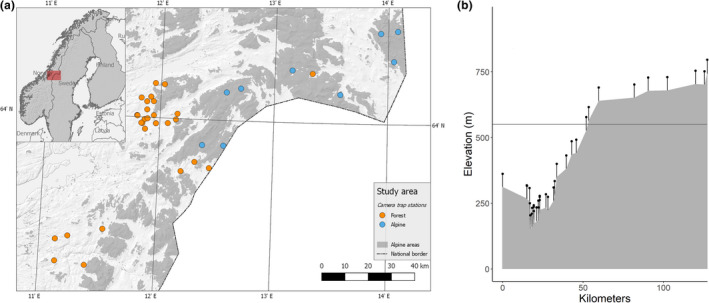
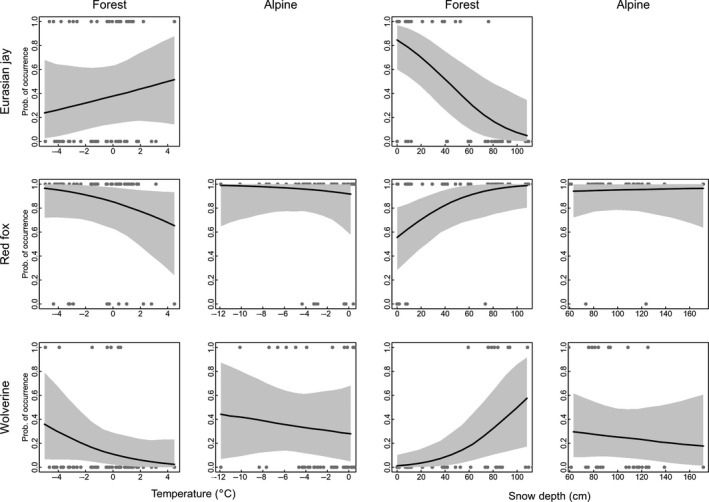
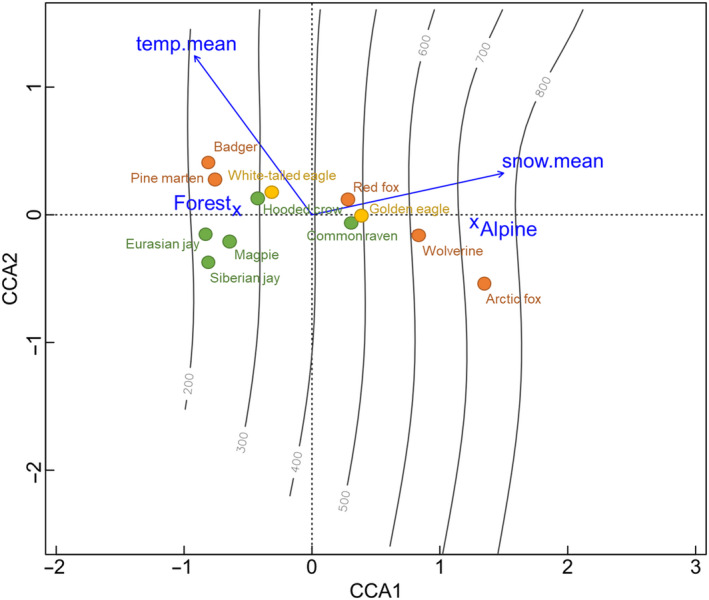
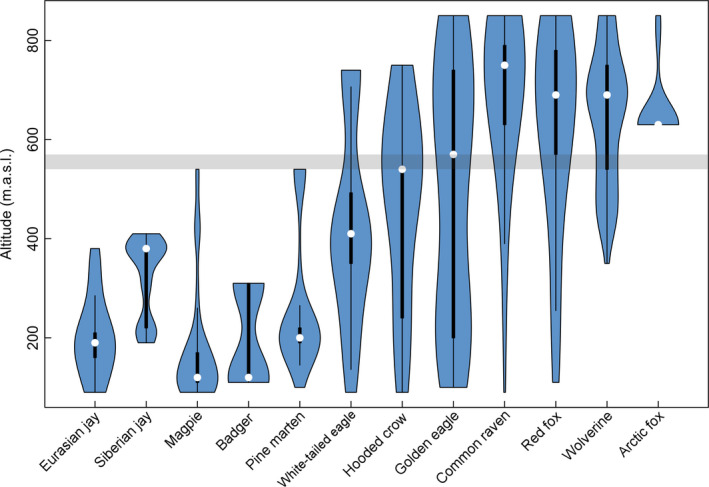
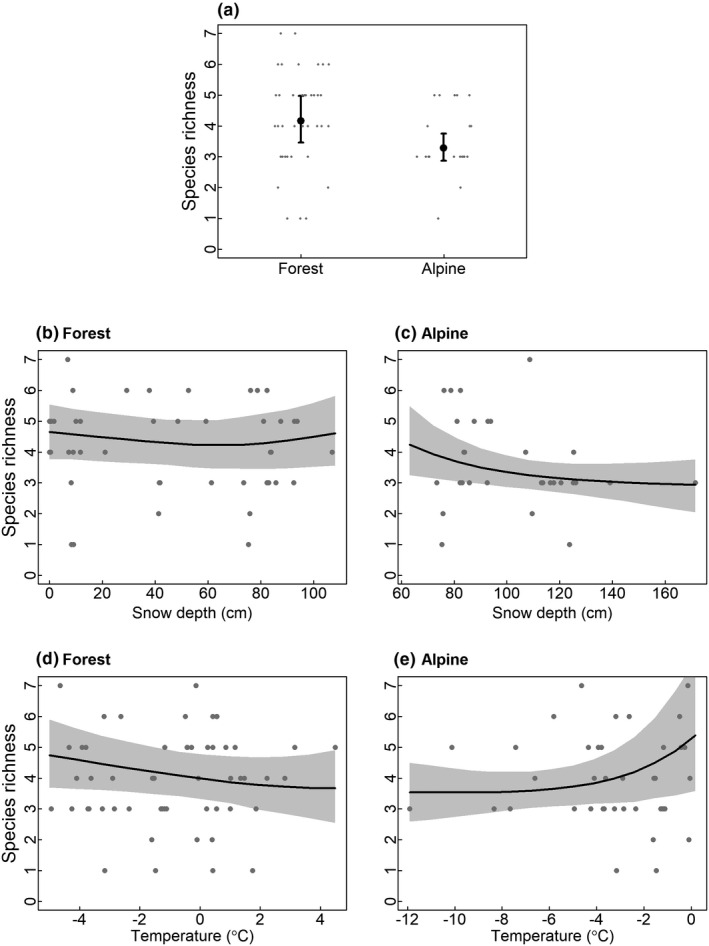
Scavengers can have strong impacts on food webs, and awareness of their role in ecosystems has increased during the last decades. In our study, we used baited camera traps to quantify the structure of the winter scavenger community in central Scandinavia across a forest-alpine continuum and assess how climatic conditions affected spatial patterns of species occurrences at baits. Canonical correspondence analysis revealed that the main habitat type (forest or alpine tundra) and snow depth was main determinants of the community structure. According to a joint species distribution model within the HMSC framework, species richness tended to be higher in forest than in alpine tundra habitat, but was only weakly associated with temperature and snow depth. However, we observed stronger and more diverse impacts of these covariates on individual species. Occurrence at baits by habitat generalists (red fox, golden eagle, and common raven) typically increased at low temperatures and high snow depth, probably due to increased energetic demands and lower abundance of natural prey in harsh winter conditions. On the contrary, occurrence at baits by forest specialists (e.g., Eurasian jay) tended to decrease in deep snow, which is possibly a consequence of reduced bait detectability and accessibility. In general, the influence of environmental covariates on species richness and occurrence at baits was lower in alpine tundra than in forests, and habitat generalists dominated the scavenger communities in both forest and alpine tundra. Following forecasted climate change, altered environmental conditions are likely to cause range expansion of boreal species and range contraction of typical alpine species such as the arctic fox. Our results suggest that altered snow conditions will possibly be a main driver of changes in species community structure.
食腐动物对食物网可能产生强烈影响,在过去几十年里,人们对它们在生态系统中作用的认识有所提高。在我们的研究中,我们使用了带饵的相机陷阱来量化斯堪的纳维亚半岛中部森林 - 高山连续体上冬季食腐动物群落的结构,并评估气候条件如何影响诱饵处物种出现的空间格局。典范对应分析表明,主要栖息地类型(森林或高山冻原)和积雪深度是群落结构的主要决定因素。根据HMSC框架内的联合物种分布模型,森林中的物种丰富度往往高于高山冻原栖息地,但与温度和积雪深度的关联较弱。然而,我们观察到这些协变量对单个物种的影响更强且更多样化。广适性物种(赤狐、金雕和小嘴乌鸦)在诱饵处的出现率通常在低温和高积雪深度时增加,这可能是由于在严酷的冬季条件下能量需求增加和天然猎物数量减少所致。相反,森林特化物种(如欧亚松鸦)在深雪中在诱饵处的出现率往往会下降,这可能是诱饵可探测性和可达性降低的结果。总体而言,环境协变量对高山冻原中物种丰富度和在诱饵处出现率的影响低于森林,广适性物种在森林和高山冻原的食腐动物群落中都占主导地位。随着预测的气候变化,环境条件的改变可能会导致北方物种的分布范围扩大,以及北极狐等典型高山物种的分布范围收缩。我们的结果表明,积雪条件的改变可能是物种群落结构变化的主要驱动因素。