Wang Emily A, Redmond Nicole, Dennison Himmelfarb Cheryl R, Pettit Becky, Stern Marc, Chen Jue, Shero Susan, Iturriaga Erin, Sorlie Paul, Diez Roux Ana V
Department of Internal Medicine, School of Medicine, Yale University, New Haven, Connecticut.
National Heart, Lung, and Blood Institute, National Institutes of Health, Bethesda, Maryland.
J Am Coll Cardiol. 2017 Jun 20;69(24):2967-2976. doi: 10.1016/j.jacc.2017.04.040.
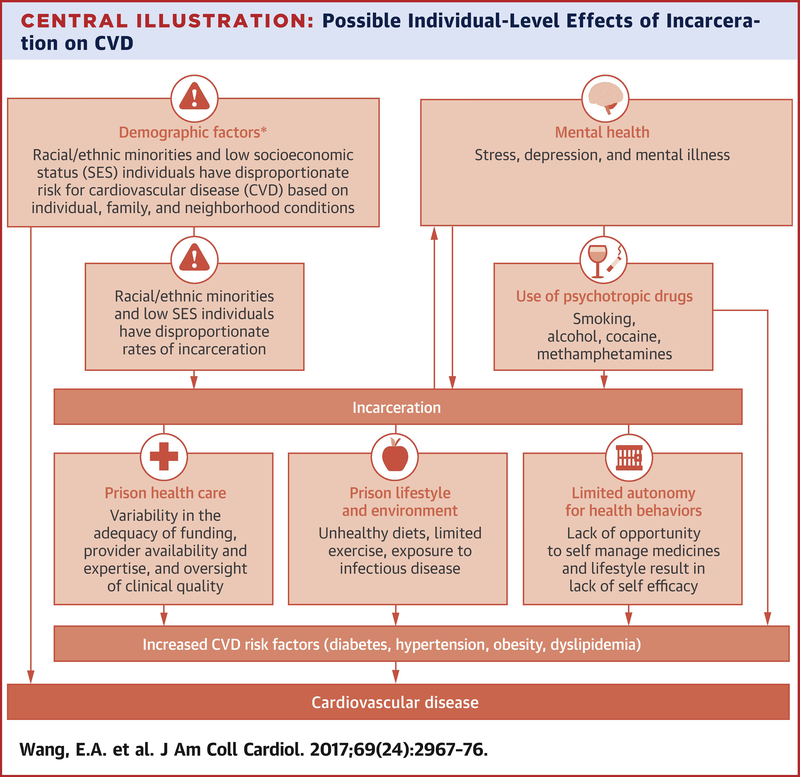
Currently, 2.2 million individuals are incarcerated, and more than 11 million have been released from U.S. correctional facilities. Individuals with a history of incarceration are more likely to be of racial and ethnic minority populations, poor, and have higher rates of cardiovascular risk factors, especially smoking and hypertension. Cardiovascular disease is a leading cause of death among incarcerated individuals, and those recently released have a higher risk of being hospitalized and dying of cardiovascular disease compared with the general population, even after accounting for differences in racial identity and socioeconomic status. In this review, the authors: 1) present information on the cardiovascular health of justice-involved populations, and unique prevention and care conditions in correctional facilities; 2) identify knowledge gaps; and 3) propose promising areas for research to improve the cardiovascular health of this population. An Executive Summary of a National Heart, Lung, and Blood Institute workshop on this topic is available.
目前,有220万人被监禁,超过1100万人已从美国惩教机构获释。有监禁史的人更有可能属于少数种族和族裔群体,经济贫困,且心血管危险因素的发生率更高,尤其是吸烟和高血压。心血管疾病是被监禁者死亡的主要原因,与普通人群相比,即使在考虑种族身份和社会经济地位差异之后,最近获释的人因心血管疾病住院和死亡的风险也更高。在这篇综述中,作者:1)介绍了涉及司法人群的心血管健康情况以及惩教机构中独特的预防和护理条件;2)确定知识差距;3)提出有前景的研究领域,以改善这一人群的心血管健康。可获取美国国立心肺血液研究所关于该主题研讨会的执行摘要。