Douglass Laurie M, Heeren Timothy C, Stafstrom Carl E, DeBassio William, Allred Elizabeth N, Leviton Alan, O'Shea T Michael, Hirtz Deborah, Rollins Julie, Kuban Karl
Department of Pediatrics and Neurology, Boston Medical Center, Boston, Massachusetts.
Department of Biostatistics, Boston University School of Public Health, Boston, Massachusetts.
Pediatr Neurol. 2017 Aug;73:13-19. doi: 10.1016/j.pediatrneurol.2017.05.009. Epub 2017 May 18.
We evaluated the incidence of seizures and epilepsy in the first decade of life among children born extremely premature (less than 28 weeks' gestation).
In a prospective, multicenter, observational study, 889 of 966 eligible children born in 2002 to 2004 were evaluated at two and ten years for neurological morbidity. Complementing questionnaire data to determine a history of seizures, all caregivers were interviewed retrospectively for postneonatal seizures using a validated seizure screen followed by a structured clinical interview by a pediatric epileptologist. A second pediatric epileptologist established an independent diagnosis based on recorded responses of the interview. A third epileptologist determined the final diagnosis when evaluators disagreed (3%). Life table survival methods were used to estimate seizure incidence through ten years.
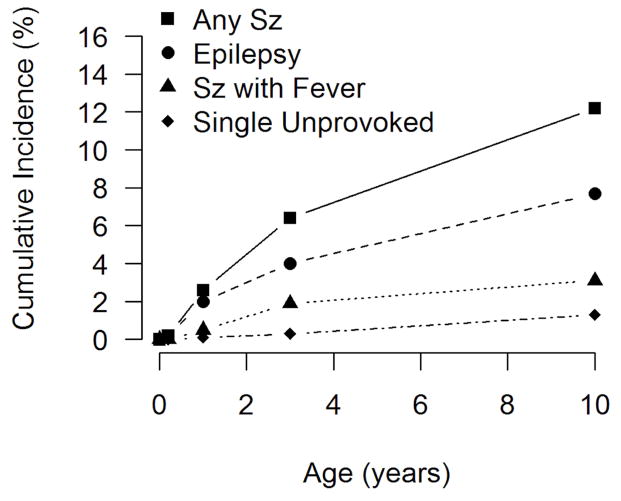
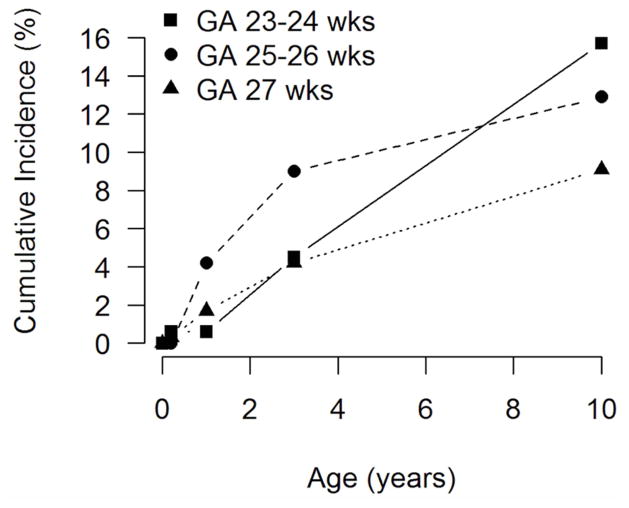
By age ten years, 12.2% (95% confidence interval: 9.8, 14.5) of children had experienced one or more seizures, 7.6% (95% confidence interval: 5.7, 9.5) had epilepsy, 3.2% had seizure with fever, and 1.3% had a single, unprovoked seizure. The seizure incidence increased with decreasing gestational age. In more than 75% of children with seizures, onset was after one year of age. Seizure incidence was comparable in both sexes. Two-thirds of those with epilepsy had other neurological disorders. One third of children with epilepsy were not recorded on the medical history questionnaire.
The incidence of epilepsy through age ten years among children born extremely premature is approximately 7- to 14-fold higher than the 0.5% to 1% lifetime incidence reported in the general pediatric population. Seizures in this population are under-recognized, and possibly underdiagnosed, by parents and providers.
我们评估了极早产儿(孕周小于28周)出生后第一个十年内癫痫发作和癫痫的发生率。
在一项前瞻性、多中心观察性研究中,对2002年至2004年出生的966名符合条件的儿童中的889名在2岁和10岁时进行了神经疾病评估。为补充问卷数据以确定癫痫发作史,所有照料者均接受回顾性访谈,采用经过验证的癫痫筛查方法评估出生后癫痫发作情况,随后由儿科癫痫专家进行结构化临床访谈。另一位儿科癫痫专家根据访谈记录的回答做出独立诊断。当评估者意见不一致时(3%),由第三位癫痫专家确定最终诊断。采用生命表生存方法估计10年内的癫痫发作发生率。
到10岁时,12.2%(95%置信区间:9.8,14.5)的儿童经历过一次或多次癫痫发作,7.6%(95%置信区间:5.7,9.5)患有癫痫,3.2%有发热性癫痫发作,1.3%有单次无诱因癫痫发作。癫痫发作发生率随孕周减小而增加。超过75%的癫痫发作儿童发病于1岁以后。癫痫发作发生率在男女两性中相当。三分之二的癫痫患儿患有其他神经疾病。三分之一的癫痫患儿在病史问卷中未被记录。
极早产儿到10岁时癫痫的发生率比普通儿科人群报告的终生发生率0.5%至1%高出约7至14倍。该人群中的癫痫发作未得到家长和医疗服务提供者的充分认识,可能也未得到充分诊断。