Programme in Emerging Infectious Diseases, Duke-NUS Medical School, Singapore, 169857, Singapore.
Duke University School of Medicine, Durham, NC, 27710, USA.
Sci Rep. 2017 Jun 15;7(1):3594. doi: 10.1038/s41598-017-03932-1.
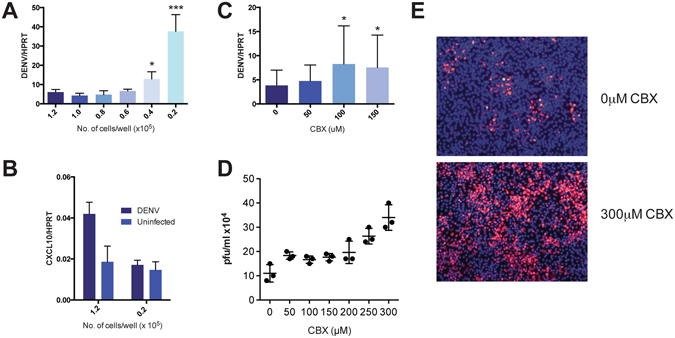
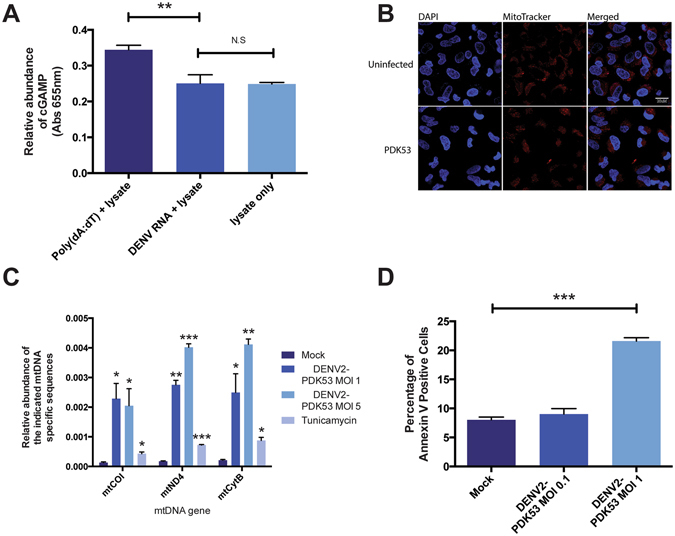
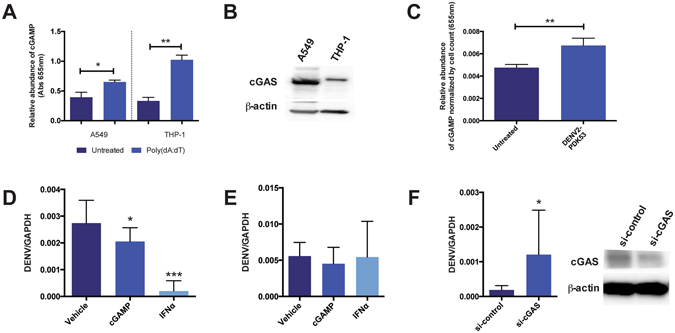
Cyclic GMP-AMP synthetase (cGAS) is a DNA-specific cytosolic sensor, which detects and initiates host defense responses against microbial DNA. It is thus curious that a recent study identified cGAS as playing important roles in inhibiting positive-sense single-stranded RNA (+ssRNA) viral infection, especially since RNA is not known to activate cGAS. Using a dengue virus serotype 2 (DENV-2) vaccine strain (PDK53), we show that infection creates an endogenous source of cytosolic DNA in infected cells through the release of mitochondrial DNA (mtDNA) to drive the production of cGAMP by cGAS. Innate immune responses triggered by cGAMP contribute to limiting the spread of DENV to adjacent uninfected cells through contact dependent gap junctions. Our result thus supports the notion that RNA virus indirectly activates a DNA-specific innate immune signaling pathway and highlights the breadth of the cGAS-induced antiviral response.
环鸟苷酸-腺苷酸合成酶(cGAS)是一种 DNA 特异性胞质传感器,可检测并启动宿主防御反应以抵抗微生物 DNA。因此,最近的一项研究发现 cGAS 在抑制正链单链 RNA(+ssRNA)病毒感染中发挥重要作用,这令人好奇,因为 RNA 并不能激活 cGAS。我们使用登革热病毒血清型 2(DENV-2)疫苗株(PDK53)表明,感染通过释放线粒体 DNA(mtDNA)在感染细胞中产生内源性胞质 DNA,从而驱动 cGAS 产生 cGAMP。cGAMP 引发的先天免疫反应有助于通过依赖接触的间隙连接限制 DENV 向相邻未感染细胞的扩散。因此,我们的结果支持了 RNA 病毒间接激活 DNA 特异性先天免疫信号通路的观点,并强调了 cGAS 诱导的抗病毒反应的广泛程度。