Suri Navreet, Voordouw Johanna, Voordouw Gerrit
Petroleum Microbiology Research Group, Department of Biological Sciences, University of Calgary, CalgaryAB, Canada.
Front Microbiol. 2017 May 31;8:956. doi: 10.3389/fmicb.2017.00956. eCollection 2017.
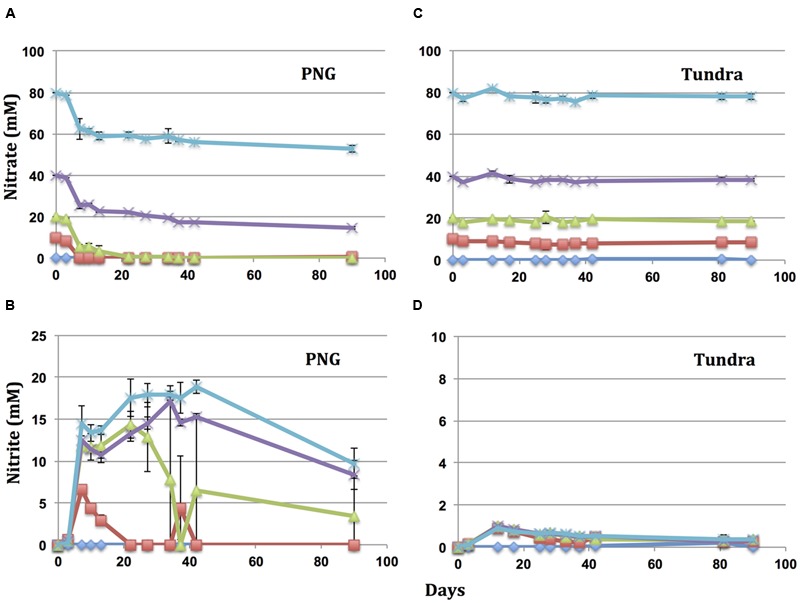
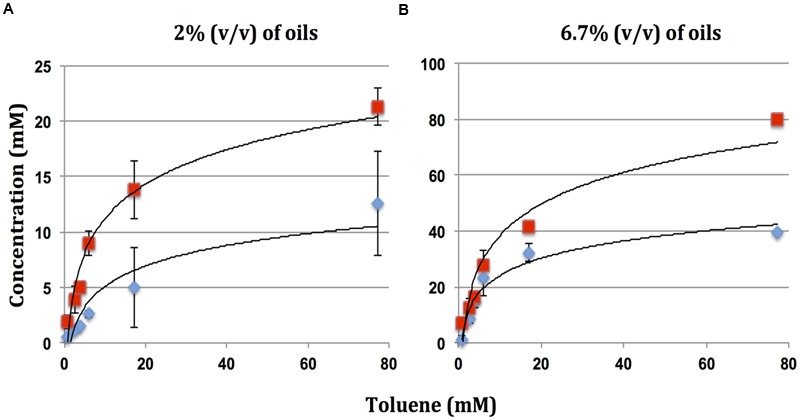
The injection of nitrate is one of the most commonly used technologies to impact the sulfur cycle in subsurface oil fields. Nitrate injection enhances the activity of nitrate-reducing bacteria, which produce nitrite inhibiting sulfate-reducing bacteria (SRB). Subsequent reduction of nitrate to di-nitrogen (N) alleviates the inhibition of SRB by nitrite. It has been shown for the Medicine Hat Glauconitic C (MHGC) field, that alkylbenzenes especially toluene are important electron donors for the reduction of nitrate to nitrite and N. However, the rate and extent of reduction of nitrate to nitrite and of nitrite to nitrogen have not been studied for multiple oil fields. Samples of light oil (PNG, CPM, and Tundra), light/heavy oil (Gryphon and Obigbo), and of heavy oil (MHGC) were collected from locations around the world. The maximum concentration of nitrate in the aqueous phase, which could be reduced in microcosms inoculated with MHGC produced water, increased with the toluene concentration in the oil phase. PNG, Gryphon, CPM, Obigbo, MHGC, and Tundra oils had 77, 17, 5.9, 4.0, 2.6, and 0.8 mM toluene, respectively. In incubations with 49 ml of aqueous phase and 1 ml of oil these were able to reduce 22.2, 12.3, 7.9, 4.6, 4.0, and 1.4 mM of nitrate, respectively. Nitrate reduced increased to 35 ± 4 mM upon amendment of all these oils with 570 mM toluene prior to incubation. Souring control by nitrate injection requires that the nitrate is directed toward oxidation of sulfide, not toluene. Hence, the success of nitrate injections will be inversely proportional to the toluene content of the oil. Oil composition is therefore an important determinant of the success of nitrate injection to control souring in a particular field.
注入硝酸盐是影响地下油田硫循环最常用的技术之一。注入硝酸盐可增强硝酸盐还原菌的活性,这些细菌产生的亚硝酸盐会抑制硫酸盐还原菌(SRB)。随后硝酸盐还原为氮气(N)可减轻亚硝酸盐对硫酸盐还原菌的抑制作用。已证明,在梅迪辛哈特海绿石C(MHGC)油田中,烷基苯尤其是甲苯是硝酸盐还原为亚硝酸盐和氮气的重要电子供体。然而,尚未对多个油田中硝酸盐还原为亚硝酸盐以及亚硝酸盐还原为氮气的速率和程度进行研究。从世界各地采集了轻质油(巴布亚新几内亚、CPM和苔原)、轻质/重质油(狮鹫和奥比博)以及重质油(MHGC)的样品。在用MHGC产出水接种的微观世界中,水相中可被还原的硝酸盐最大浓度随油相中甲苯浓度的增加而增加。巴布亚新几内亚、狮鹫、CPM、奥比博、MHGC和苔原油中甲苯含量分别为77、17、5.9、4.0、2.6和0.8 mM。在49毫升水相和1毫升油的培养中,它们分别能够还原22.2、12.3、7.9、4.6、4.0和1.4 mM的硝酸盐。在培养前用570 mM甲苯对所有这些油进行改性后,硝酸盐还原量增加到35±4 mM。通过注入硝酸盐进行的防酸处理要求硝酸盐用于硫化物的氧化,而不是甲苯。因此,注入硝酸盐的成功率将与油中的甲苯含量成反比。所以,油的成分是特定油田中注入硝酸盐控制酸化成功与否的重要决定因素。