Nguyen Phuong H, DiGirolamo Ann M, Gonzalez-Casanova Ines, Pham Hoa, Hao Wei, Nguyen Hieu, Truong Truong V, Nguyen Son, Harding Kimberly B, Reinhart Gregory A, Martorell Reynaldo, Ramakrishnan Usha
International Food Policy Research Institute, Washington, DC, USA.
Thai Nguyen University of Pharmacy and Medicine, Thai Nguyen, Vietnam.
BMC Womens Health. 2017 Jun 17;17(1):44. doi: 10.1186/s12905-017-0401-3.
Micronutrient malnutrition has been associated with maternal depressive symptoms (MDS), but little is known about the effects of preconceptional micronutrient supplementation. This paper examined the effects of preconceptional micronutrient supplementation on MDS during pregnancy and postpartum.
We used data from a double-blind controlled trial (PRECONCEPT) in which 5011 Vietnamese women were randomized to receive weekly supplements containing either a) multiple micronutrients (MM) b) iron and folic acid (IFA) or c) folic acid (FA) until conception (n = 1813). Maternal mental health was assessed using the Center for Epidemiologic Studies Depression Scale (CES-D) at baseline (preconception), and the Edinburgh Postnatal Depression Scale (EPDS) during pregnancy and 3 months postpartum. Elevated MDS was defined as EPDS score ≥ 4. All group comparisons were done using ANOVA or chi-square tests of proportions intention to treat and per protocol analyses (women consumed supplements ≥26 weeks before conception). We also conducted stratified analyses by preconception CES-D scores, underweight, or anemia status using generalized linear models.
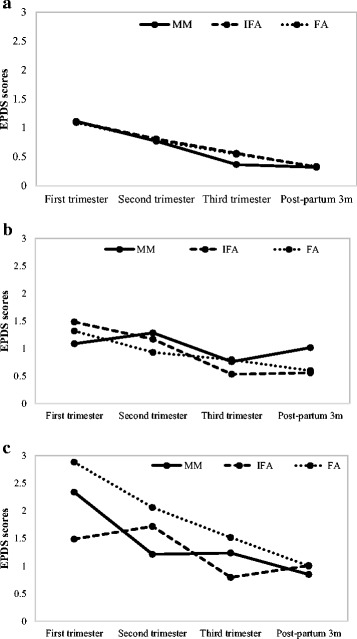
Baseline CES-D scores were similar across treatment groups. The proportion of women experiencing elevated MDS was 11.3, 8.1 and 4.9% at first, second and third trimesters of pregnancy, respectively, and 3.6% at 3 mo postpartum. Mean EPDS scores at first (1.5 ± 2.7), second (1.1 ± 2.4), and third trimester of pregnancy (0.7 ± 2.0) and early postpartum (0.6 ± 1.8) were low and did not differ by treatment group. However, among women in the highest tertile of CES-D scores at preconception, mean EPDS scores in the first and second trimesters of pregnancy were lower in the MM and IFA groups compared to FA only (P < 0.05).
Weekly preconceptional micronutrient supplements containing iron did not improve depression measures relative to folic acid alone among all women, but may have benefitted women who were at risk for depression.
The trial was registered retrospectively at ClinicalTrials.Gov as NCT01665378 on August 13, 2012.
微量营养素营养不良与产妇抑郁症状(MDS)有关,但关于孕前补充微量营养素的影响知之甚少。本文研究了孕前补充微量营养素对孕期和产后MDS的影响。
我们使用了一项双盲对照试验(PRECONCEPT)的数据,其中5011名越南女性被随机分为三组,分别每周接受以下补充剂,直至受孕:a)多种微量营养素(MM);b)铁和叶酸(IFA);c)叶酸(FA)(n = 1813)。在基线(孕前)使用流行病学研究中心抑郁量表(CES-D)评估产妇心理健康状况,并在孕期和产后3个月使用爱丁堡产后抑郁量表(EPDS)进行评估。MDS升高定义为EPDS评分≥4。所有组间比较均采用方差分析或卡方检验进行意向性分析和符合方案分析(女性在受孕前≥26周服用补充剂)。我们还使用广义线性模型按孕前CES-D评分、体重过轻或贫血状况进行分层分析。
各治疗组的基线CES-D评分相似。孕期第一、第二和第三个月出现MDS升高的女性比例分别为11.3%、8.1%和4.9%,产后3个月为3.6%。孕期第一个月(1.5±2.7)、第二个月(1.1±2.4)、第三个月(0.7±2.0)和产后早期(0.6±1.8)的平均EPDS评分较低,且各治疗组之间无差异。然而,在孕前CES-D评分处于最高三分位数的女性中,与仅服用叶酸组相比,MM组和IFA组在孕期第一和第二个月的平均EPDS评分较低(P<0.05)。
对于所有女性,相对于仅服用叶酸,每周孕前补充含铁的微量营养素并不能改善抑郁指标,但可能对有抑郁风险的女性有益。
该试验于2012年8月13日在ClinicalTrials.Gov上进行回顾性注册,注册号为NCT01665378。