Xiang Wei, Zhang Baoyun, Lv Fenglin, Feng Guangde, Chen Long, Yang Fang, Zhang Ke, Cao Chunyu, Wang Pingqing, Chu Mingxing
College of Bioengineering, Chongqing University, Chongqing, 400030, China.
Sichuan TQLS Animal Husbandry Science and Technology Co.,LTD, City, Mianyang, Sichuan, 621000, China.
Reprod Biol Endocrinol. 2017 Jun 17;15(1):46. doi: 10.1186/s12958-017-0264-3.
The regulation of gonadotropin synthesis and release by gonadotropin-releasing hormone (GnRH) plays an essential role in the neuroendocrine control of reproduction. However, the mechanisms underlying gonadotropin regulation by GnRH pulse frequency and amplitude are still ambiguous. This study aimed to explore the molecular mechanisms and biological pathways associated with gonadotropin synthesis by GnRH pulse frequencies and amplitudes.
Using GSE63251 datasets downloaded from the Gene Expression Omnibus (GEO), differentially expressed genes (DEGs) were screened by comparing the RNA expression from the GnRH pulse group, the GnRH tonic group and the control group. Pathway enrichment analyses of DEGs was performed, followed by protein-protein interaction (PPI) network construction. Furthermore, sub-network modules were constructed by ClusterONE and GO function and pathways analysed by DAVID. In addition, the relationship between the metabolic pathways and the GnRH pathway was verified in vitro.
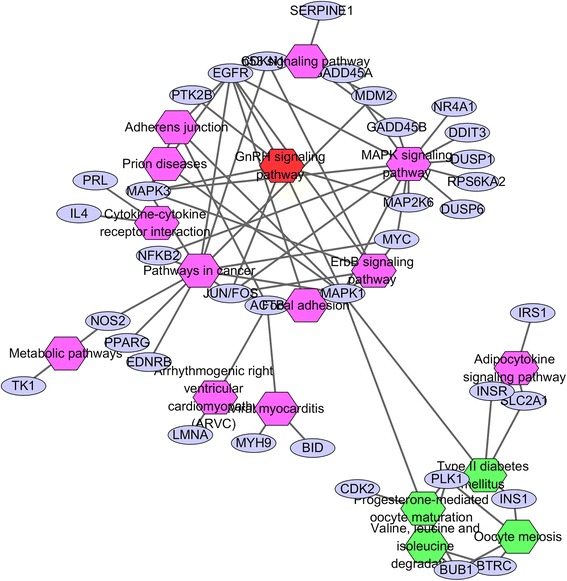
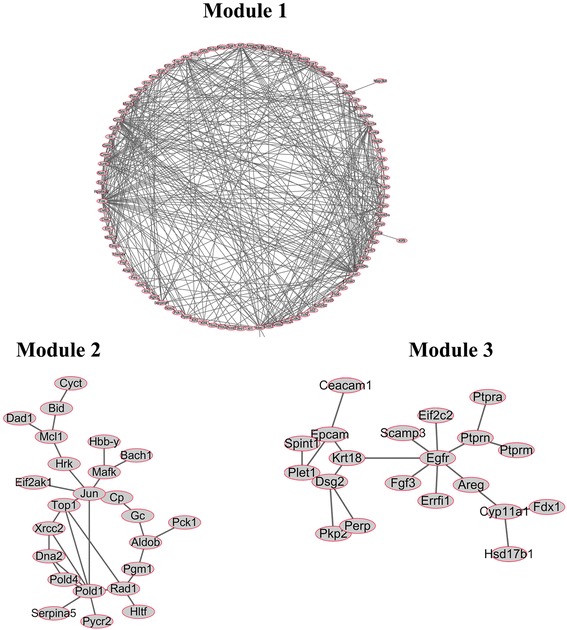
In total, 531 common DEGs were identified in GnRH groups, including 290 up-regulated and 241 down-regulated genes. DEGs predominantly enriched in 16 Kyoto Encyclopedia of Genes and Genomes (KEGG) pathways, including 11 up-regulated pathways (signallingsignallingmetabolic pathways, signallingand GnRH signalling pathway) and 5 down-regulated pathways (type II diabetes mellitus). Moreover, FBJ osteosarcoma oncogene (FOS) and jun proto-oncogene (JUN) had higher connectivity degrees in the PPI network. Three modules in the PPI were identified with ClusterONE. The genes in module 1 were significantly enriched in five pathways, including signallingthe insulin resistance and GnRH signalling pathway. The genes in modules 2 and 3 were mainly enriched in metabolic pathways and steroid hormone biosynthesis, respectively. Finally, knockdown leptin receptor (LEPR) and insulin receptor (INSR) reversed the GnRH-modulated metabolic related-gene expression.
The present study revealed the involvement of GnRH in the regulation of gonadotropin biosynthesis and metabolism in the maintenance of reproduction, achieved by bioinformatics analyses. This, indicates that the GnRH signalling pathway played a central linkings role in reproductive function and metabolic balance. In addition, the present study identified the difference response between GnRH pulse and GnRH tone, indicated that abnormal GnRH pulse and amplitude may cause disease, which may provide an improved understanding of the GnRH pathway and a new insight for disease diagnosis and treatment.
促性腺激素释放激素(GnRH)对促性腺激素合成与释放的调节在生殖的神经内分泌控制中起着至关重要的作用。然而,GnRH脉冲频率和幅度对促性腺激素调节的潜在机制仍不明确。本研究旨在探索与GnRH脉冲频率和幅度介导的促性腺激素合成相关的分子机制和生物学途径。
使用从基因表达综合数据库(GEO)下载的GSE63251数据集,通过比较GnRH脉冲组、GnRH持续性刺激组和对照组的RNA表达来筛选差异表达基因(DEG)。对DEG进行通路富集分析,随后构建蛋白质-蛋白质相互作用(PPI)网络。此外,通过ClusterONE构建子网模块,并通过DAVID分析GO功能和通路。另外,在体外验证代谢途径与GnRH途径之间的关系。
在GnRH组中总共鉴定出531个常见的DEG,包括290个上调基因和241个下调基因。DEG主要富集在16条京都基因与基因组百科全书(KEGG)通路中,包括11条上调通路(信号代谢通路、信号和GnRH信号通路)和5条下调通路(II型糖尿病)。此外,FBJ骨肉瘤癌基因(FOS)和原癌基因jun(JUN)在PPI网络中具有较高的连接度。用ClusterONE在PPI中鉴定出三个模块。模块1中的基因在五条通路中显著富集,包括胰岛素抵抗信号通路和GnRH信号通路。模块2和3中的基因分别主要富集在代谢途径和类固醇激素生物合成中。最后,敲低瘦素受体(LEPR)和胰岛素受体(INSR)可逆转GnRH调节的代谢相关基因表达。
本研究通过生物信息学分析揭示了GnRH参与促性腺激素生物合成和代谢的调节以维持生殖功能。这表明GnRH信号通路在生殖功能和代谢平衡中起核心连接作用。此外,本研究确定了GnRH脉冲和GnRH持续性刺激之间的差异反应,表明异常的GnRH脉冲和幅度可能导致疾病,这可能为深入了解GnRH途径以及疾病诊断和治疗提供新的见解。