Chira Sergiu, Gulei Diana, Hajitou Amin, Zimta Alina-Andreea, Cordelier Pierre, Berindan-Neagoe Ioana
Research Center for Functional Genomics, Biomedicine, and Translational Medicine, "Iuliu Hatieganu" University of Medicine and Pharmacy, Cluj-Napoca, Cluj 400377, Romania.
MedFuture Research Center for Advanced Medicine, "Iuliu Hatieganu" University of Medicine and Pharmacy, Cluj-Napoca, Cluj 400377, Romania.
Mol Ther Nucleic Acids. 2017 Jun 16;7:211-222. doi: 10.1016/j.omtn.2017.04.001. Epub 2017 Apr 8.
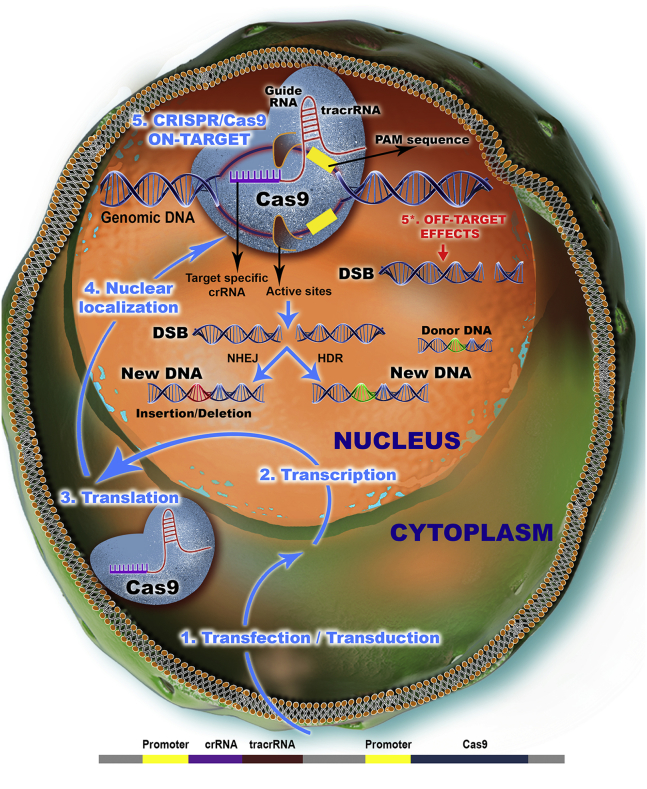
With the expansion of the microbiology field of research, a new genome editing tool arises from the biology of bacteria that holds the promise of achieving precise modifications in the genome with a simplicity and versatility that surpasses previous genome editing methods. This new technique, commonly named CRISPR/Cas9, led to a rapid expansion of the biomedical field; more specifically, cancer characterization and modeling have benefitted greatly from the genome editing capabilities of CRISPR/Cas9. In this paper, we briefly summarize recent improvements in CRISPR/Cas9 design meant to overcome the limitations that have arisen from the nuclease activity of Cas9 and the influence of this technology in cancer research. In addition, we present challenges that might impede the clinical applicability of CRISPR/Cas9 for cancer therapy and highlight future directions for designing CRISPR/Cas9 delivery systems that might prove useful for cancer therapeutics.
随着微生物学研究领域的扩展,一种源自细菌生物学的新型基因组编辑工具应运而生,它有望以超越以往基因组编辑方法的简便性和多功能性实现基因组的精确修饰。这项新技术通常被称为CRISPR/Cas9,它推动了生物医学领域的迅速发展;更具体地说,癌症特征分析和建模从CRISPR/Cas9的基因组编辑能力中受益匪浅。在本文中,我们简要总结了CRISPR/Cas9设计方面的最新改进,这些改进旨在克服因Cas9核酸酶活性产生的局限性以及该技术在癌症研究中的影响。此外,我们还提出了可能阻碍CRISPR/Cas9用于癌症治疗临床应用的挑战,并强调了设计可能对癌症治疗有用的CRISPR/Cas9递送系统的未来方向。