Ye Ling, Jiang Tao, Shao Huanzhang, Zhong Lin, Wang Zhaowen, Liu Yuan, Tang Huamei, Qin Bingyu, Zhang Xiaoqing, Fan Junwei
Department of General Surgery, Shanghai General Hospital, Shanghai Jiao Tong University School of Medicine, Shanghai 200080, China.
Department of Anal-Colorectal Surgery, General Hospital of Ningxia Medical University, Yinchuan 750004, China.
Mol Ther Nucleic Acids. 2017 Jun 16;7:453-464. doi: 10.1016/j.omtn.2017.05.006. Epub 2017 May 12.
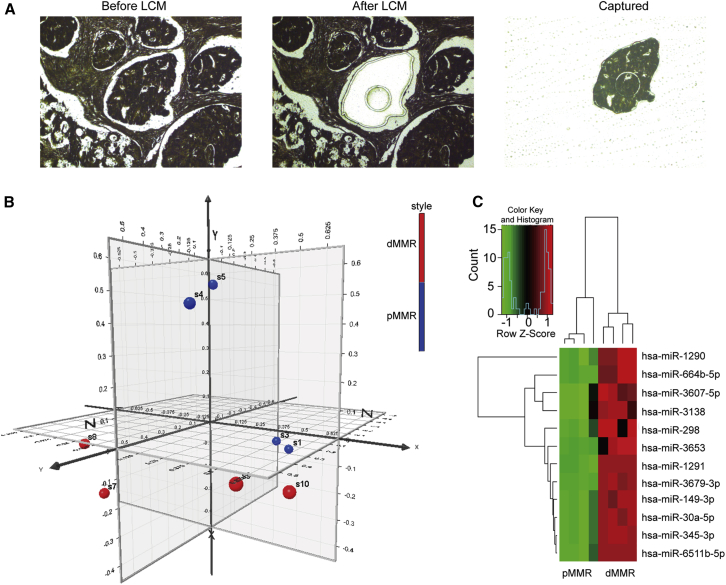
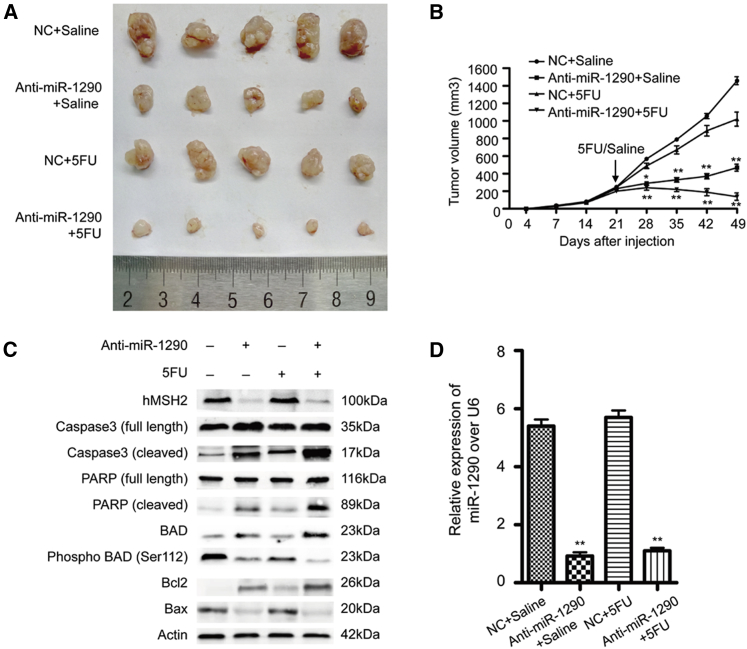
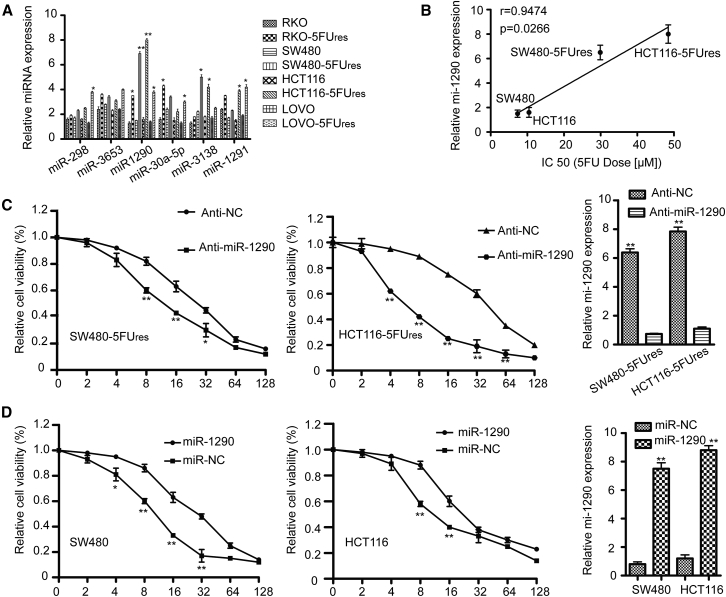
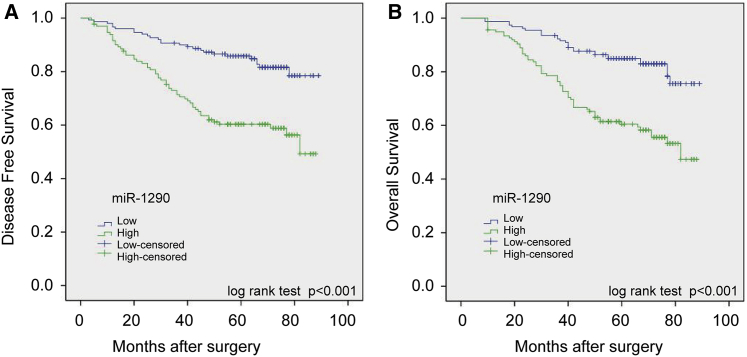
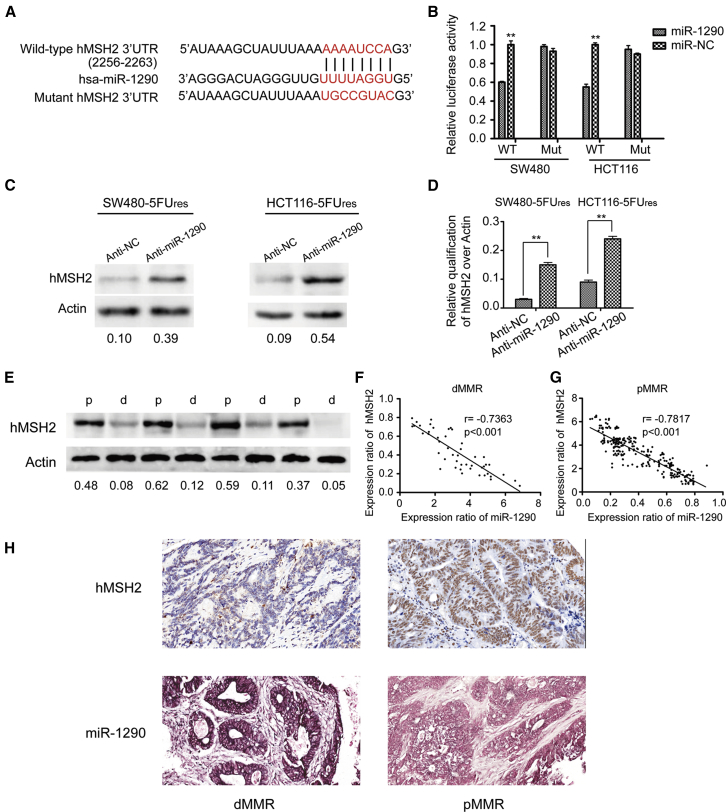
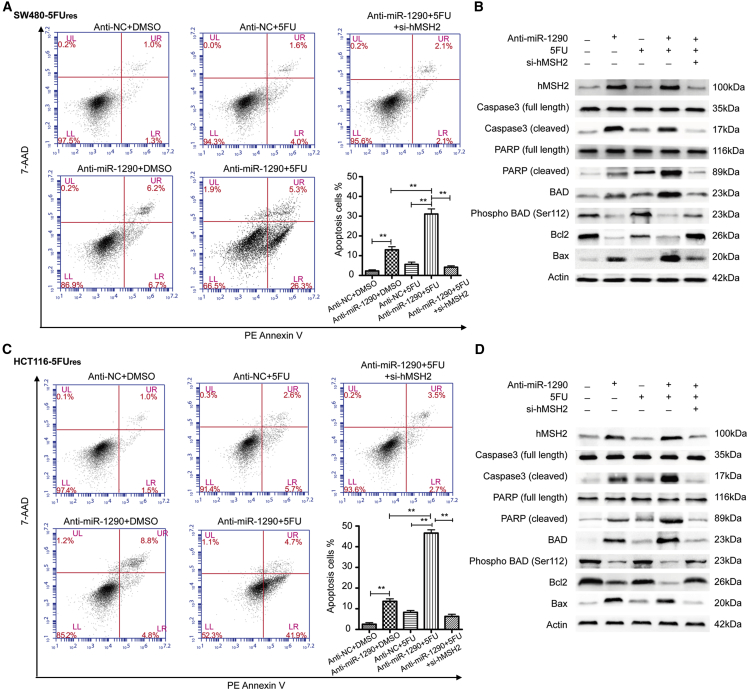
5-Fluorouracil (5FU)-based adjuvant therapy is the first-line therapy for treating stage II and III colon cancer after surgery. However, its therapeutic efficacy is limited because of chemoresistance, especially in deficient mismatch repair (dMMR) colon cancer. Here, we first used laser capture microdissection to obtain purified cells from four dMMR and four proficient mismatch repair (pMMR) colon cancer tissues. Second, microRNA (miRNA) microarray chips were used to identify miRNAs that are differentially expressed between these two classes of tumors. Third, we analyzed their differential expression by qRT-PCR in a panel of 5-FU-resistant colon cancer cell lines. We identified that miR-1290 was one of the most upregulated miRNAs in both dMMR colon cancer tissues and 5-FU-resistant cells. We also found that miR-1290 was positively correlated with dMMR status and predicted poor prognosis in stage II and III colon cancer patients who received 5-FU-based chemotherapy. Furthermore, we demonstrated that inhibition of the expression of miR-1290 enhanced sensitivity to 5-FU treatment in vitro and in tumor xenografts in vivo by direct targeting hMSH2. Our study indicates that miR-1290 may become a promising biomarker of dMMR colon cancer and predicts the prognosis of stage II and III patients who receive 5-FU-based adjuvant therapy.
基于5-氟尿嘧啶(5FU)的辅助治疗是II期和III期结肠癌术后的一线治疗方法。然而,由于化疗耐药性,其治疗效果有限,尤其是在错配修复缺陷(dMMR)的结肠癌中。在此,我们首先使用激光捕获显微切割技术从四个dMMR和四个错配修复功能正常(pMMR)的结肠癌组织中获取纯化细胞。其次,使用微小RNA(miRNA)微阵列芯片来鉴定这两类肿瘤之间差异表达的miRNA。第三,我们通过qRT-PCR分析了它们在一组5-氟尿嘧啶耐药结肠癌细胞系中的差异表达。我们发现miR-1290是dMMR结肠癌组织和5-氟尿嘧啶耐药细胞中上调最显著的miRNA之一。我们还发现miR-1290与dMMR状态呈正相关,并预测接受基于5-氟尿嘧啶化疗的II期和III期结肠癌患者预后不良。此外,我们证明抑制miR-1290的表达可通过直接靶向hMSH2增强体外和体内肿瘤异种移植模型对5-氟尿嘧啶治疗的敏感性。我们的研究表明,miR-1290可能成为dMMR结肠癌的一个有前景的生物标志物,并预测接受基于5-氟尿嘧啶辅助治疗的II期和III期患者的预后。