Huda Saif, Waters Patrick, Woodhall Mark, Leite Maria Isabel, Jacobson Leslie, De Rosa Anna, Maestri Michelangelo, Ricciardi Roberta, Heckmann Jeannine M, Maniaol Angelina, Evoli Amelia, Cossins Judy, Hilton-Jones David, Vincent Angela
Nuffield Department of Clinical Neurosciences (S.H., P.W., M.W., M.I.L., L.J., J.C., D.H.-J., A.V.), University of Oxford, UK; Department of Clinical and Experimental Medicine (A.D.R., M.M., R.R.), Neurology Unit, Pisa, Italy; Division of Neurology (J.M.H.), University of Cape Town, South Africa; Oslo University Hospital (A.M.), Norway; and Department of Neuroscience (A.E.), Catholic University, Rome, Italy.
Neurol Neuroimmunol Neuroinflamm. 2017 Jun 5;4(4):e357. doi: 10.1212/NXI.0000000000000357. eCollection 2017 Jul.
To increase the detection of MuSK-Abs using a CBA and test their pathogenicity.
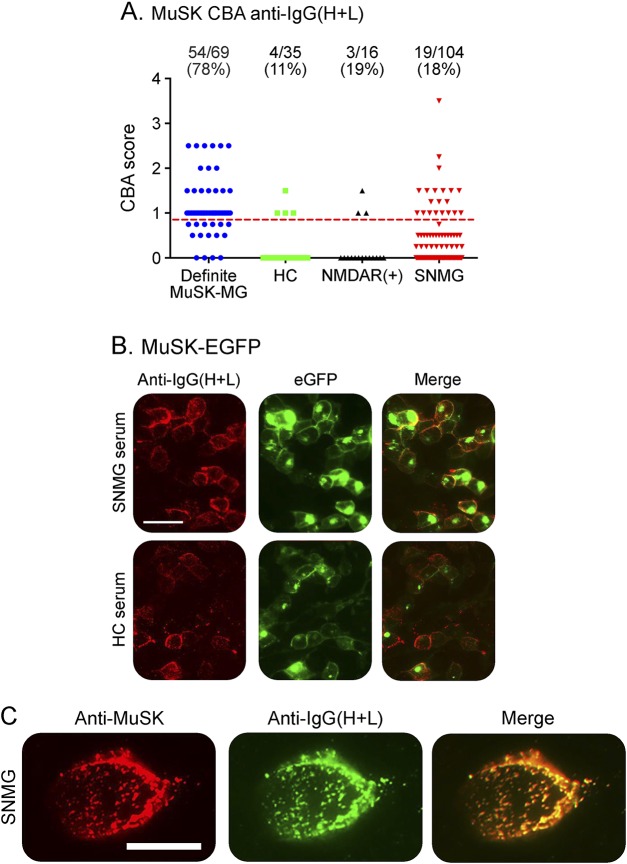
Sera from 69 MuSK-RIA-positive patients with myasthenia gravis (MG) (Definite MuSK-MG), 169 patients negative for MuSK-RIA and AChR-RIA (seronegative MG, SNMG), 35 healthy individuals (healthy controls, HCs), and 16 NMDA receptor-Ab-positive (NMDAR-Ab) disease controls were tested for binding to MuSK on a CBA using different secondary antibodies.
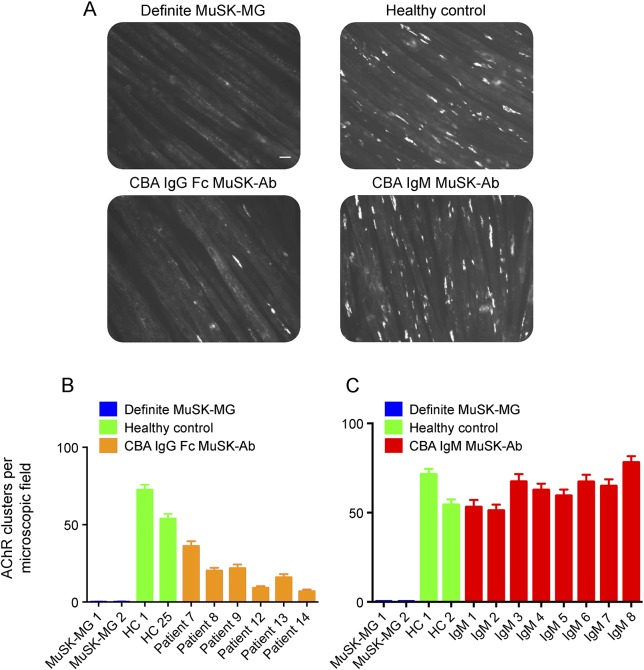
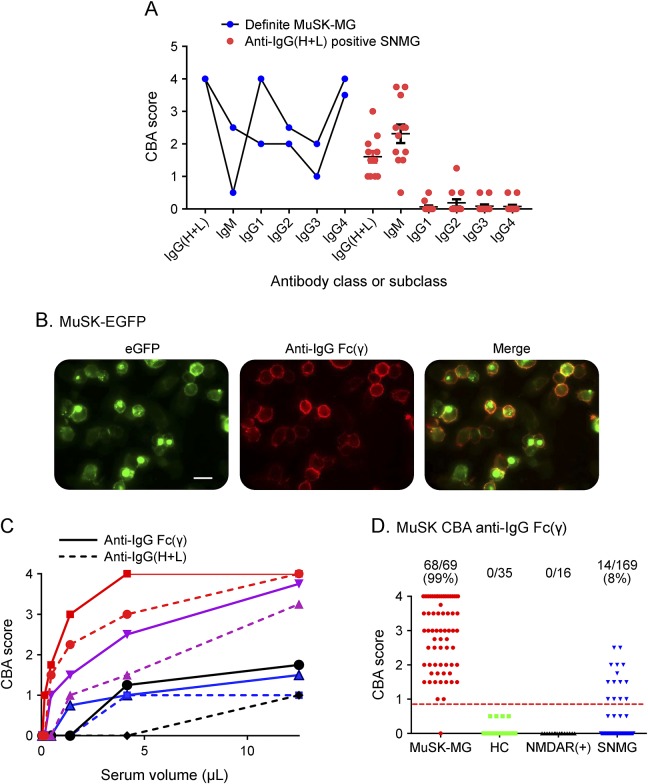
Initially, in addition to 18% of SNMG sera, 11% of HC and 19% of NMDAR-Ab sera showed positive binding to MuSK-transfected cells; this low specificity was due to anti-IgG(H+L) detection of IgM bound nonspecifically to MuSK. Using an IgG Fc gamma-specific secondary antibody, MuSK-Abs were detected by CBA in 68/69 (99%) of Definite MuSK-MG, 0/35 HCs, 0/16 NMDAR-Ab, and 14/169 (8%) of SNMG sera, providing increased sensitivity with high specificity. The RIA-negative, CBA-positive MuSK-IgG sera, but not IgM-MuSK-binding sera, reduced agrin-induced AChR clustering in C2C12 myotubes, qualitatively similar to RIA-positive MuSK-Abs.
An IgG-specific MuSK-CBA can reliably detect IgG MuSK-Abs and increase sensitivity. In the MuSK-CBA, IgG specificity is essential. The positive sera demonstrated pathogenic potential in the in vitro AChR-clustering assay, although less effective than Definite MuSK-MG sera, and the patients had less severe clinical disease. Use of IgG-specific secondary antibodies may improve the results of other antibody tests.
This study provides Class III evidence that an IgG-specific MuSK-CBA identifies patients with MG.
采用CBA法提高MuSK抗体(MuSK-Abs)的检测率并检测其致病性。
使用不同的二抗,通过CBA法检测69例MuSK放射免疫分析(RIA)阳性的重症肌无力(MG)患者(确诊的MuSK-MG)、169例MuSK-RIA和乙酰胆碱受体RIA(AChR-RIA)均阴性的患者(血清阴性MG,SNMG)、35名健康个体(健康对照,HCs)以及16例N-甲基-D-天冬氨酸受体抗体(NMDAR-Ab)阳性的疾病对照血清与MuSK的结合情况。
最初,除18%的SNMG血清外,11%的HC血清和19%的NMDAR-Ab血清显示与MuSK转染细胞有阳性结合;这种低特异性是由于抗IgG(H+L)检测到非特异性结合MuSK的IgM。使用IgG Fcγ特异性二抗,通过CBA法在68/69(99%)的确诊MuSK-MG、0/35 HCs、0/16 NMDAR-Ab以及14/169(8%)的SNMG血清中检测到MuSK-Abs,提高了敏感性且特异性高。RIA阴性、CBA阳性的MuSK-IgG血清,而非IgM-MuSK结合血清,可减少聚集蛋白诱导的C2C12肌管中AChR聚集,在质量上与RIA阳性的MuSK-Abs相似。
IgG特异性MuSK-CBA能可靠地检测IgG MuSK-Abs并提高敏感性。在MuSK-CBA中,IgG特异性至关重要。阳性血清在体外AChR聚集试验中显示出致病潜力,尽管不如确诊的MuSK-MG血清有效,且患者临床疾病较轻。使用IgG特异性二抗可能会改善其他抗体检测的结果。
本研究提供了III类证据,即IgG特异性MuSK-CBA可识别MG患者。