Chen Qian, Cai Dongge, Li Mu, Wu Xiaoling
Department of Obstetrics and Gynecology, The Second Affiliated Hospital of Xi'an Jiaotong University, Xi'an, Shaanxi 710004, P.R. China.
Oncol Rep. 2017 Aug;38(2):767-774. doi: 10.3892/or.2017.5724. Epub 2017 Jun 15.
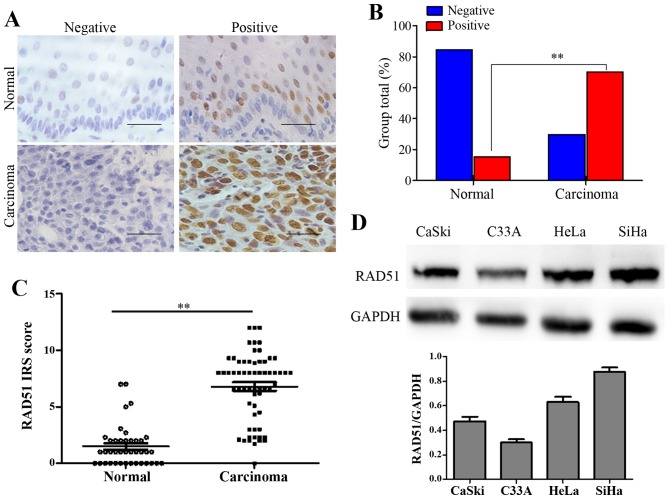
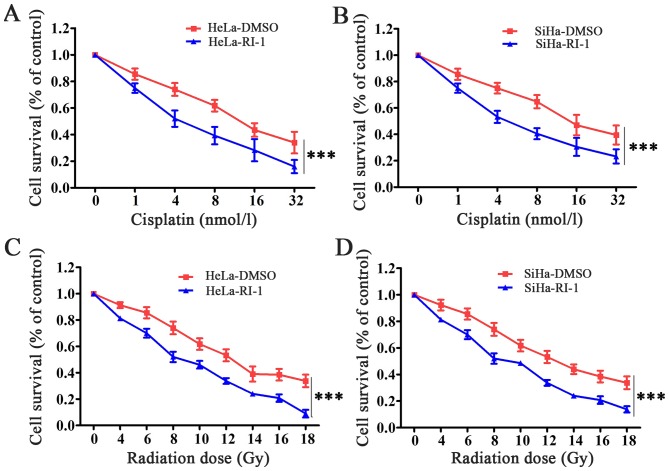
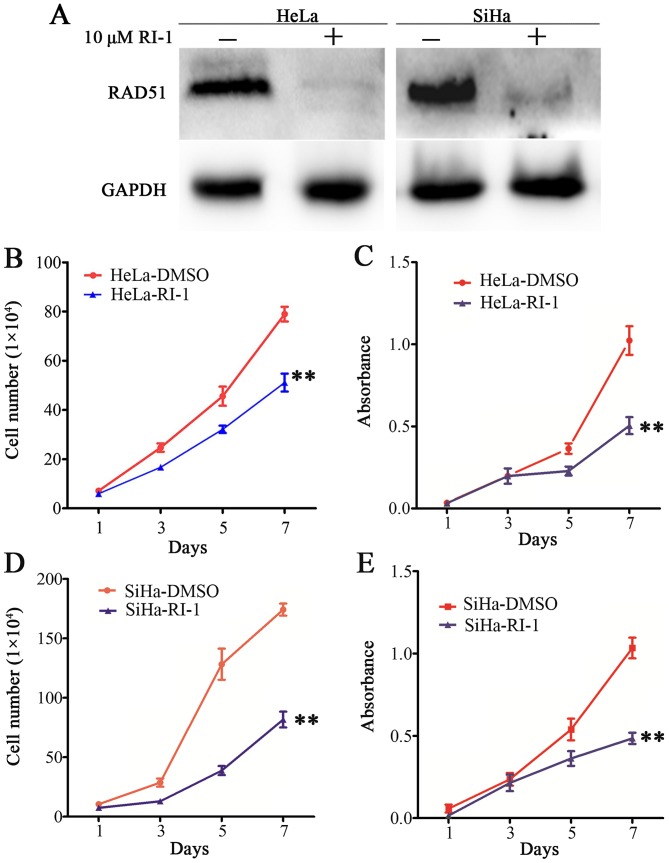
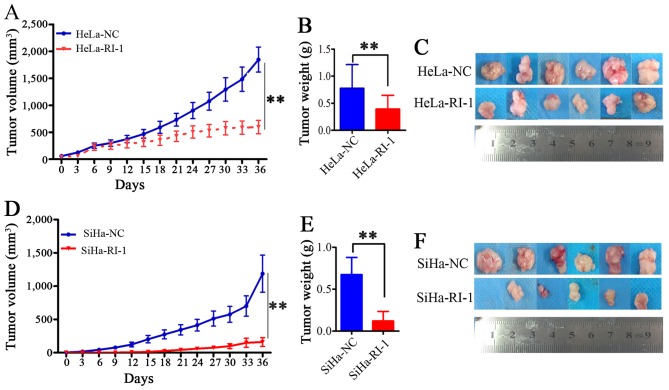
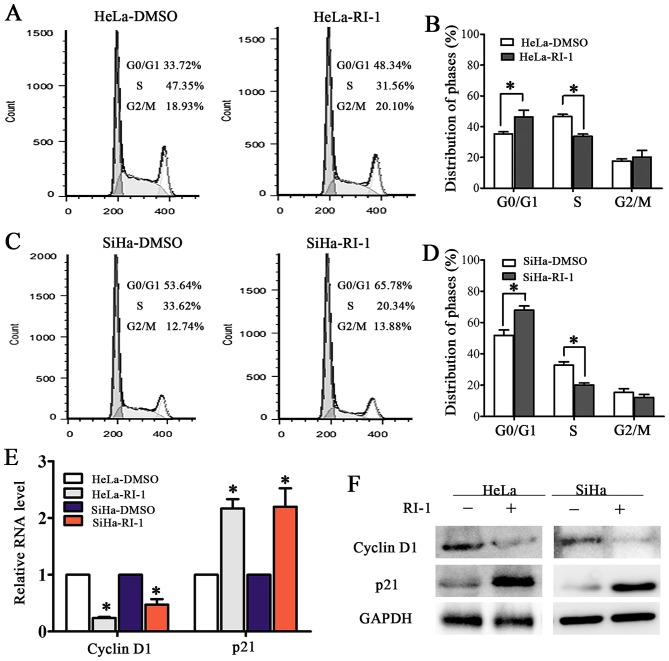
RAD51 is one of the pivotal enzymes for DNA double-strand break (DSB) repair by the homologous recombination (HR) pathway, which implies it as a promising and novel target for cancer therapy. Recent findings have indicated RAD51 protein is overexpressed in a variety of tumors. The high-expression of RAD51 is related to poor prognosis. RAD51 is involved in the repair of DNA damage and the generation of genetic diversity by an evolutionarily conserved mechanism. However, the exact mechanism of Rad51 in the progression of cervical cancer remains unclear. RI-1 is a small molecule that inhibits the central recombination protein RAD51. In this study, we found that RAD51 was highly expressed in invasive squamous cervical cancer (SCC). The administration of RI-1 inhibited cell growth in vitro and reduced growth of tumor xenografts in vivo with cervical cancer cells (HeLa and SiHa). Further investigation suggested that RAD51 protein significantly promoted the cell cycle transition from the G0/G1 to S phase. In addition, the inhibition of RAD51 reduced the level of the cell cycle related protein cyclin D1, but increased the levels of p21 mRNA and protein. As a DNA DSB repair enzyme, the expression of RAD51 in tumor cells possibly affects their sensitivity to anti-cancer agents. Additionally, in experiments using cisplatin and ionizing radiation, RI-1 treated cervical cancer cells, HeLa and SiHa, were sensitized to a greater extent than the untreated control. Thus, HR inhibition of RAD51 may provide yet another mechanism of therapeutic target for the chemosensitization and radiosensitization of cervical cancer with RI-1. Collectively, our data demonstrated for the first time that inhibition of RAD51 suppressed the cervical cancer cell proliferation and the growth of cervical cancer xenografts by attenuating cell cycle transition, which could be a functional link between RAD51 and cyclin D1 and p21.
RAD51是通过同源重组(HR)途径进行DNA双链断裂(DSB)修复的关键酶之一,这表明它是一种有前景的新型癌症治疗靶点。最近的研究发现表明,RAD51蛋白在多种肿瘤中过度表达。RAD51的高表达与预后不良有关。RAD51通过一种进化保守机制参与DNA损伤修复和遗传多样性的产生。然而,Rad51在宫颈癌进展中的具体机制仍不清楚。RI-1是一种抑制中心重组蛋白RAD51的小分子。在本研究中,我们发现RAD51在浸润性宫颈鳞状细胞癌(SCC)中高表达。给予RI-1可抑制体外细胞生长,并减少体内宫颈癌细胞(HeLa和SiHa)肿瘤异种移植的生长。进一步研究表明,RAD51蛋白显著促进细胞周期从G0/G1期向S期转变。此外,抑制RAD51可降低细胞周期相关蛋白细胞周期蛋白D1的水平,但增加p21 mRNA和蛋白的水平。作为一种DNA DSB修复酶,RAD51在肿瘤细胞中的表达可能影响其对抗癌药物的敏感性。此外,在使用顺铂和电离辐射的实验中,RI-1处理的宫颈癌细胞HeLa和SiHa比未处理的对照更敏感。因此,抑制RAD51的HR可能为RI-1对宫颈癌的化学增敏和放射增敏提供另一种治疗靶点机制。总的来说,我们的数据首次证明,抑制RAD51可通过减弱细胞周期转变来抑制宫颈癌细胞增殖和宫颈癌异种移植的生长,这可能是RAD51与细胞周期蛋白D1和p21之间的功能联系。