Kogure Yasunori, Kataoka Keisuke
Department of Pathology and Tumor Biology, Graduate School of Medicine, Kyoto University, Kyoto, Japan.
Division of Molecular Oncology, National Cancer Center Research Institute, Tokyo, Japan.
Cancer Sci. 2017 Sep;108(9):1719-1725. doi: 10.1111/cas.13303. Epub 2017 Jul 29.
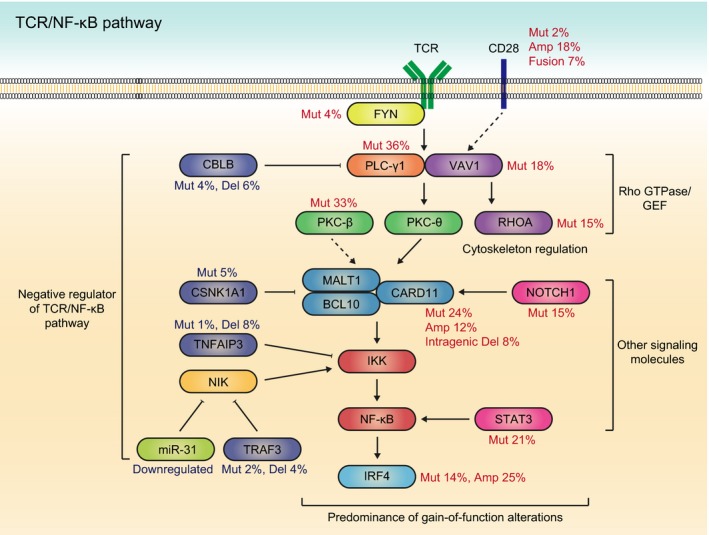
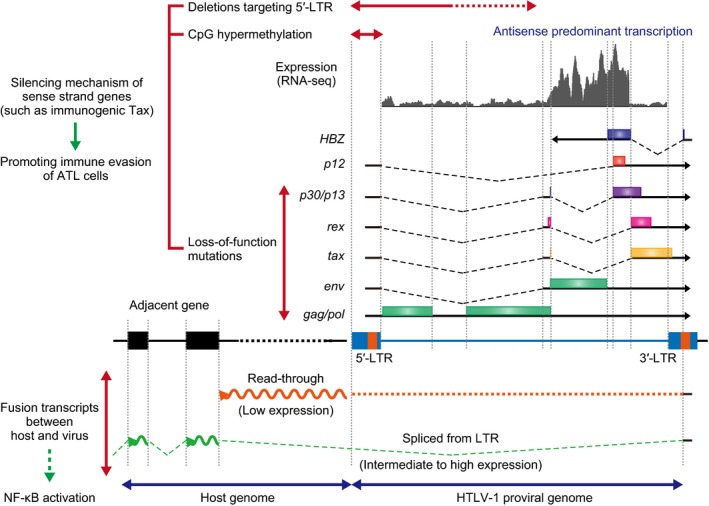
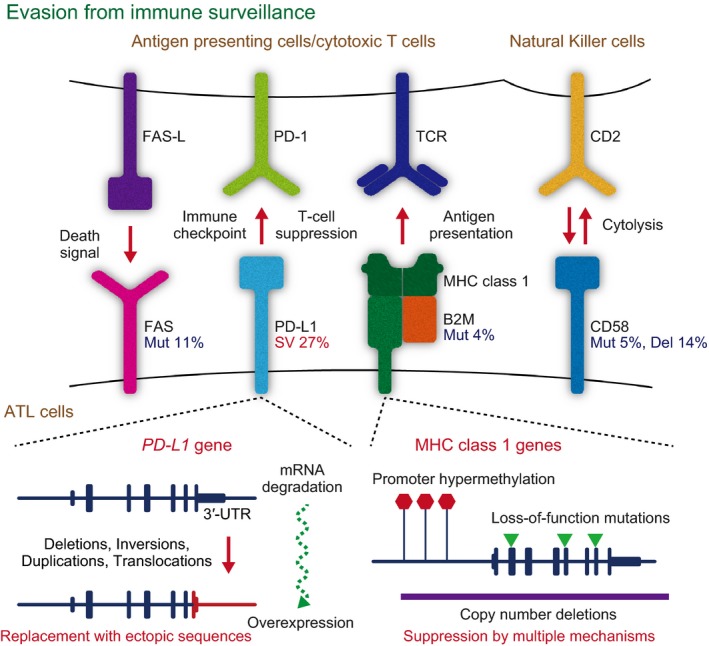
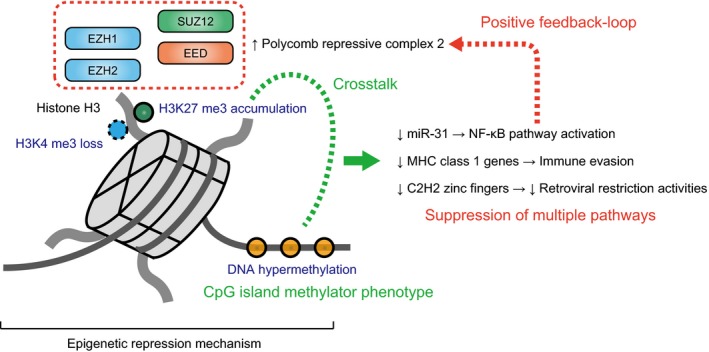
Adult T-cell leukemia/lymphoma (ATL) is a peripheral T-cell neoplasm with a dismal prognosis. It is caused by human T-cell leukemia virus type-1 (HTLV-1) retrovirus. A long latency period from HTLV-1 infection to ATL onset suggests that not only HTLV-1 proteins, such as Tax and HBZ, but also additional genetic and/or epigenetic events are required for ATL development. Although many studies have demonstrated the biological functions of viral genes, alterations of cellular genes associated with ATL have not been fully investigated. Recently, a large-scale integrated genetic analysis revealed the entire landscape of somatic aberrations in ATL. This neoplasm is characterized by frequent gain-of-function alterations in components of the T-cell receptor/NF-κB signaling pathway, including activating mutations in the PLCG1, PRKCB, CARD11 and VAV1 genes, and CTLA4-CD28 and ICOS-CD28 fusions. Importantly, molecules associated with immune surveillance, such as HLA-A/B, CD58 and FAS, are affected recurrently. Among them, one notable lesion occurs as frequent structural variations that truncate the PD-L1 3'-untranslated region, leading to its overexpression. Other genetic targets include transcription factors (IRF4, IKZF2, and GATA3) and chemokine receptors (CCR4, CCR7 and GPR183), which are functionally relevant in normal T cells. A substantial proportion of ATL cases show widespread accumulation of repressive epigenetic changes, such as trimethylation of histone H3 lysine 27 and DNA hypermethylation of CpG islands, which coordinately modulate multiple pathways, including Cys2-His2 zinc finger genes involved in silencing retroelements. Here we review the current understanding of the genetic/epigenetic aberrations in ATL, focusing on their relevance in its molecular pathogenesis.
成人T细胞白血病/淋巴瘤(ATL)是一种预后不良的外周T细胞肿瘤。它由1型人类T细胞白血病病毒(HTLV-1)逆转录病毒引起。从HTLV-1感染到ATL发病的潜伏期很长,这表明ATL的发生不仅需要HTLV-1蛋白,如Tax和HBZ,还需要其他遗传和/或表观遗传事件。尽管许多研究已经证明了病毒基因的生物学功能,但与ATL相关的细胞基因改变尚未得到充分研究。最近,一项大规模综合基因分析揭示了ATL体细胞畸变的全貌。这种肿瘤的特征是T细胞受体/NF-κB信号通路成分频繁发生功能获得性改变,包括PLCG1、PRKCB、CARD11和VAV1基因的激活突变,以及CTLA4-CD28和ICOS-CD28融合。重要的是,与免疫监视相关的分子,如HLA-A/B、CD58和FAS,经常受到影响。其中,一个值得注意的病变是频繁的结构变异,截断了PD-L1的3'非翻译区,导致其过度表达。其他遗传靶点包括转录因子(IRF4、IKZF2和GATA3)和趋化因子受体(CCR4、CCR7和GPR183),它们在正常T细胞中具有功能相关性。相当一部分ATL病例表现出广泛的抑制性表观遗传变化积累,如组蛋白H3赖氨酸27的三甲基化和CpG岛的DNA高甲基化,它们协同调节多个途径,包括参与沉默逆转录元件的Cys2-His2锌指基因。在此,我们综述了目前对ATL中遗传/表观遗传畸变的理解,重点关注它们在分子发病机制中的相关性。