Clamp L D, Hume D J, Lambert E V, Kroff J
Division of Exercise Science and Sports Medicine, Department of Human Biology, Faculty of Health Sciences, University of Cape Town, Cape Town, South Africa.
Nutr Diabetes. 2017 Jun 19;7(6):e282. doi: 10.1038/nutd.2017.31.
Weight gain is associated with deterioration in metabolic health, whereas weight loss improves insulin sensitivity. This study assesses the impact of long-term, successfully maintained weight loss and weight-loss relapse on measures of insulin sensitivity and identifies factors that explain variability in insulin sensitivity.
Women (20-45 years) were recruited into four groups: reduced-overweight/obese (RED, n=15); body mass index (BMI)-matched controls (stable low-weight, n=19), BMI⩽27 kg m; relapsed-overweight/obese subjects (REL, n=11); and BMI-matched controls (obese stable weight, n=11), BMI⩾27 kg m. A 75 g oral glucose tolerance test determined fasting and 2 h plasma glucose and insulin. Homeostatic Model Assessment (HOMA-IR) and insulin sensitivity index (ISI) assessed insulin sensitivity. Anthropometric measurements, fasting resting metabolic rate (RMR) and respiratory quotient (RQ) were measured. Questionnaires and dietary intake were recorded, and physical activity was measured using accelerometers.
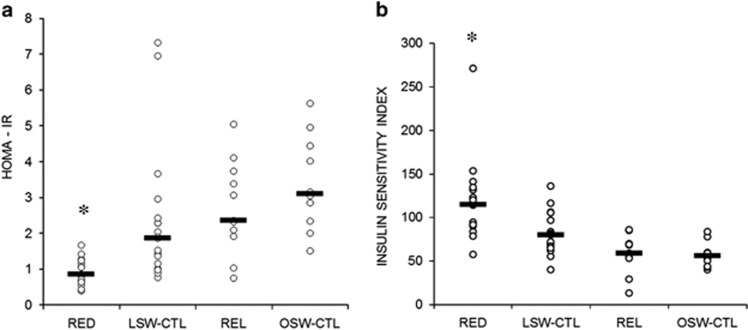
RED were more insulin sensitive, characterised by lower fasting (P=0.001) and 2 h insulin (P=0.003) levels compared with all other groups. There were no significant differences in dietary intake, sedentary, light and moderate activity, RMR or RQ in the RED compared with the other three groups. % Body weight (BW) lost (P<0.001), % BW regained (P<0.05), body fat %, light activity (P<0.05, only log HOMA), vigorous activity (P<0.05) and RQ (P<0.01) predicted 61.4% and 59.7% of variability in log HOMA and log ISI, respectively, in multiple linear regression models.
This study showed sustained enhanced insulin sensitivity in successful weight loss maintainers compared with BMI-matched controls with no weight loss history. Weight-loss-relapsed individuals were indistinguishable from controls. Weight loss itself was the strongest predictor of improved insulin sensitivity, whereas weight regain significantly predicted reduced insulin sensitivity. Weight-loss maintenance programs are essential to retaining metabolic benefits acquired through weight loss. Being physically active, reducing sedentary behaviour and, in particular, including small amounts of vigorous physical activity significantly predicted improved insulin sensitivity.
体重增加与代谢健康恶化相关,而体重减轻可改善胰岛素敏感性。本研究评估长期成功维持体重减轻及体重减轻后复发对胰岛素敏感性指标的影响,并确定解释胰岛素敏感性变异性的因素。
招募20 - 45岁女性,分为四组:体重减轻的超重/肥胖者(RED,n = 15);体重指数(BMI)匹配的对照组(稳定低体重,n = 19),BMI⩽27 kg/m;体重减轻后复发的超重/肥胖受试者(REL,n = 11);以及BMI匹配的对照组(肥胖稳定体重,n = 11),BMI⩾27 kg/m。通过75 g口服葡萄糖耐量试验测定空腹及2小时血浆葡萄糖和胰岛素水平。采用稳态模型评估(HOMA-IR)和胰岛素敏感性指数(ISI)评估胰岛素敏感性。测量人体测量学指标、空腹静息代谢率(RMR)和呼吸商(RQ)。记录问卷和饮食摄入量,并使用加速度计测量身体活动情况。
与所有其他组相比,RED组胰岛素敏感性更高,其空腹胰岛素水平(P = 0.001)和2小时胰岛素水平(P = 0.003)更低。与其他三组相比,RED组在饮食摄入量、久坐、轻度和中度活动、RMR或RQ方面无显著差异。在多元线性回归模型中,体重减轻百分比(P < 0.001)、体重恢复百分比(P < 0.05)、体脂百分比、轻度活动(P < 0.05,仅对数HOMA)、剧烈活动(P < 0.05)和RQ(P < 0.01)分别预测了对数HOMA和对数ISI变异性的61.4%和59.7%。
本研究表明,与无体重减轻史的BMI匹配对照组相比,成功维持体重减轻者的胰岛素敏感性持续增强。体重减轻后复发的个体与对照组无差异。体重减轻本身是改善胰岛素敏感性的最强预测因素,而体重恢复则显著预测胰岛素敏感性降低。体重维持计划对于保持通过体重减轻获得的代谢益处至关重要。进行体育活动、减少久坐行为,特别是进行少量剧烈体育活动,可显著预测胰岛素敏感性的改善。