Wang Yiran, Li Jianhua, Xiong Kun, Chen Zhijin, Zheng Chunping, Tan Yong, Cong Yanguang
Department of Microbiology, Third Military Medical University, Chongqing, China.
The Orthopaedic Center of PLA, 88th Hospital of PLA, Tai'an, Shandong Province, China.
PLoS One. 2017 Jun 19;12(6):e0179649. doi: 10.1371/journal.pone.0179649. eCollection 2017.
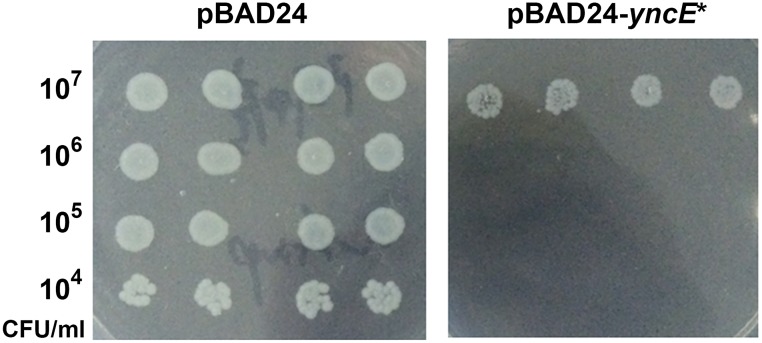
Orally administered vaccine bacteria usually persist for a period of time in the intestinal tracts of immunized individuals, and are excreted in feces to the environment resulting in a potential biosafety issue. The releasing risk can be minimized by immediate elimination of the persistent vaccine bacteria once adequate protective immune responses have been elicited by the vaccine bacteria. In a previous study, inducible expression of truncated yncE gene (yncE*) was found lethal to host bacteria. This feature has an application potential in biosafety control. Here, we assessed the efficacy of YncE* in eliminating an attenuated strain of Salmonella enterica serovar Typhimurium in a mouse model. To this end, a pBAD-derived plasmid containing yncE* under the control of the Ara promoter was transformed into a ΔphoPQ mutant of S. Typhimurium. Our data show that the induced expression of yncE* in the presence of arabinose eliminated the vaccine bacteria both in vitro and in vivo. BALB/c mice with or without streptomycin-pretreatment were used to assess the efficacy of YncE* in vivo. Oral administration of 500 μl of 20% arabinose at 24 h postvaccination removed the vaccine bacteria from the guts of the tested mice without streptomycin-pretreatment. For streptomycin-pretreated mice, which were colonized with higher levels of Salmonella, an additional gavage of arabinose was required to completely eliminate the vaccine bacteria in the guts of the tested mice. The orally administered arabinose did not affect the persistence of bacteria that had penetrated the intestinal mucosa of the immunized mice. Furthermore, there was no significant difference in the protection rate between the routine immunization and the immunization with the arabinose treatment. The results indicate that the yncE* element improves the biosafety of the bacterial vaccine, and can be taken in consideration in future design of live bacterial vaccines.
口服疫苗菌通常会在免疫个体的肠道中持续存在一段时间,并通过粪便排泄到环境中,从而引发潜在的生物安全问题。一旦疫苗菌引发了足够的保护性免疫反应,通过立即清除持续存在的疫苗菌,可以将释放风险降至最低。在先前的一项研究中,发现截短的yncE基因(yncE*)的诱导表达对宿主细菌具有致死性。这一特性在生物安全控制方面具有应用潜力。在此,我们在小鼠模型中评估了YncE在消除肠炎沙门氏菌鼠伤寒血清型减毒株方面的效果。为此,将一个在Ara启动子控制下含有yncE的pBAD衍生质粒转化到鼠伤寒沙门氏菌的ΔphoPQ突变体中。我们的数据表明,在阿拉伯糖存在的情况下yncE的诱导表达在体外和体内均能消除疫苗菌。使用经过或未经过链霉素预处理的BALB/c小鼠来评估YncE在体内的效果。在接种疫苗后24小时口服500 μl 20%的阿拉伯糖,可使未经过链霉素预处理的受试小鼠肠道中的疫苗菌被清除。对于经链霉素预处理且沙门氏菌定植水平较高的小鼠,则需要额外灌胃阿拉伯糖才能完全清除受试小鼠肠道中的疫苗菌。口服的阿拉伯糖不会影响已穿透免疫小鼠肠黏膜的细菌的持续存在。此外,常规免疫和阿拉伯糖处理免疫之间的保护率没有显著差异。结果表明,yncE*元件提高了细菌疫苗的生物安全性,可在未来活细菌疫苗的设计中予以考虑。