Reis Mônica Nogueira da Guarda, Bello Gonzalo, Guimarães Monick Lindenmeyer, Stefani Mariane Martins Araújo
Laboratório de Imunologia da AIDS e da Hanseníase, Instituto de Patologia Tropical e Saúde Pública, UFG, Goiânia, Brazil.
Laboratório de AIDS e Imunologia Molecular, Instituto Oswaldo Cruz, FIOCRUZ, Rio de Janeiro, Brazil.
PLoS One. 2017 Jun 19;12(6):e0178578. doi: 10.1371/journal.pone.0178578. eCollection 2017.
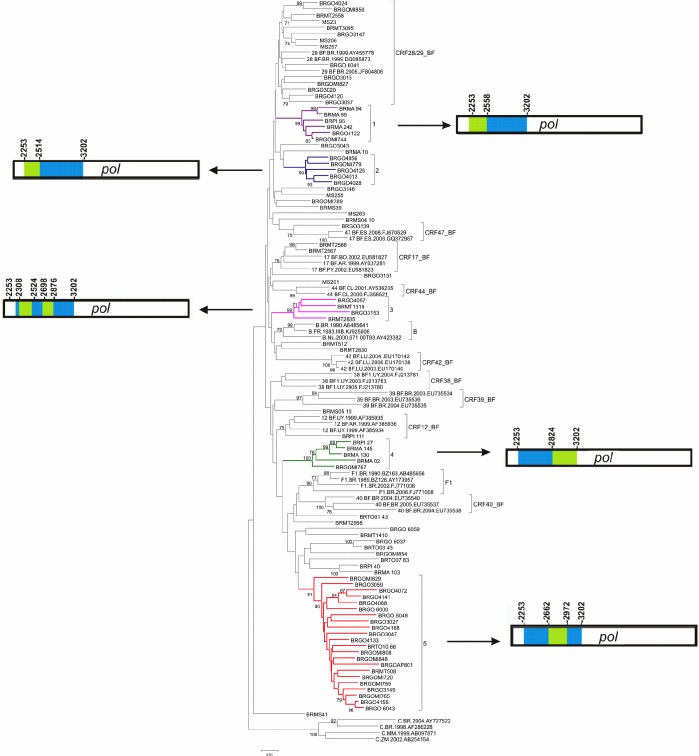
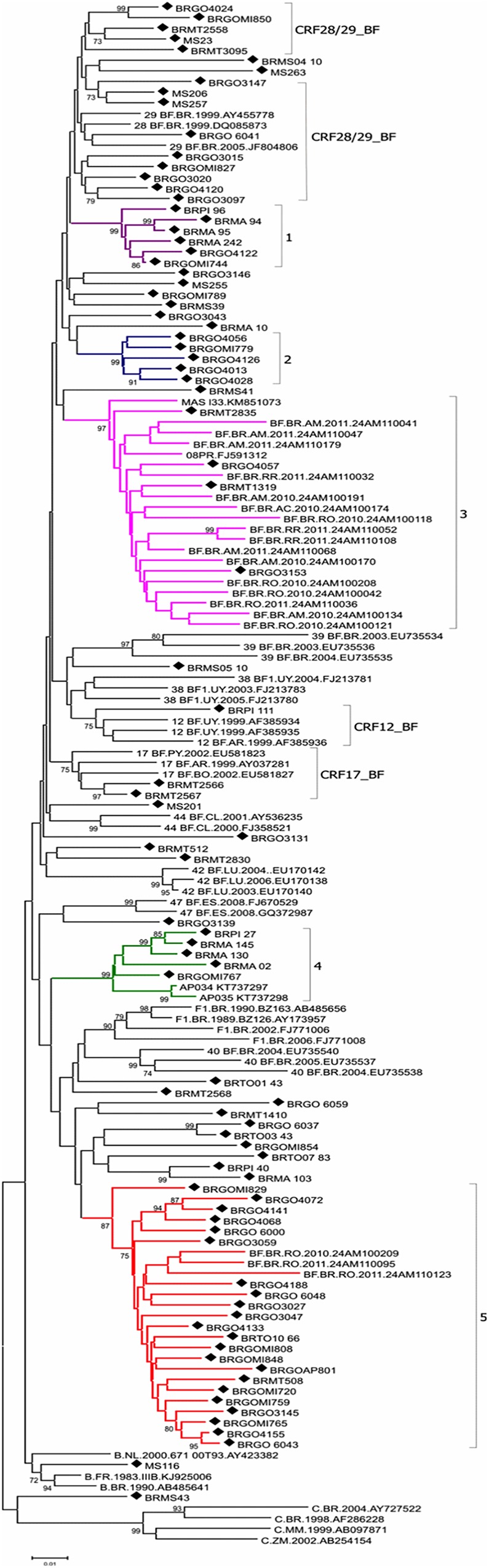
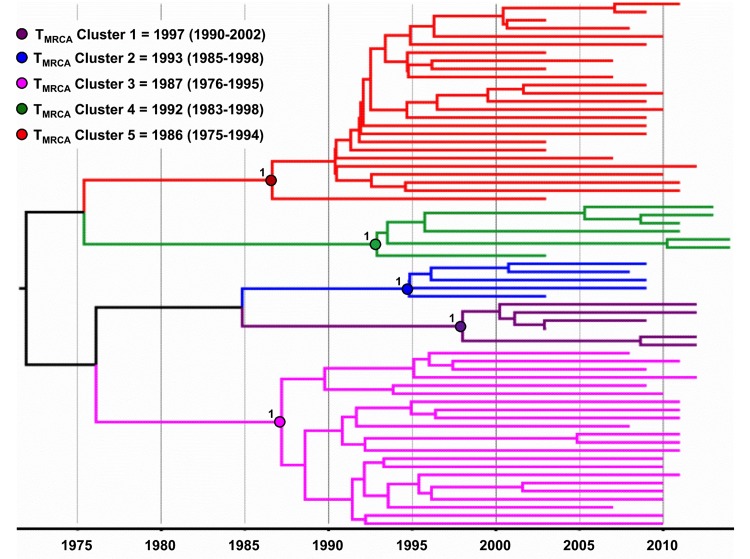
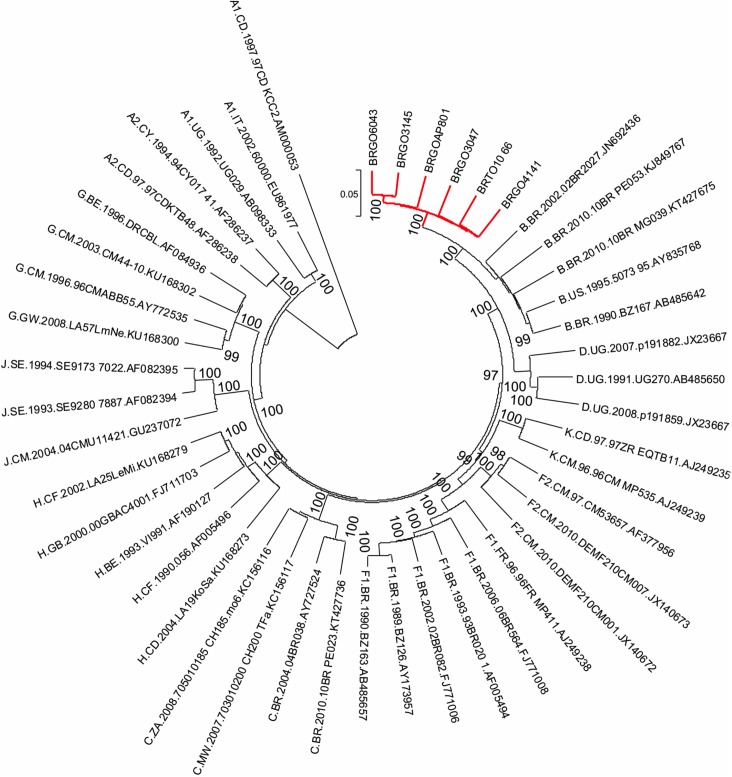
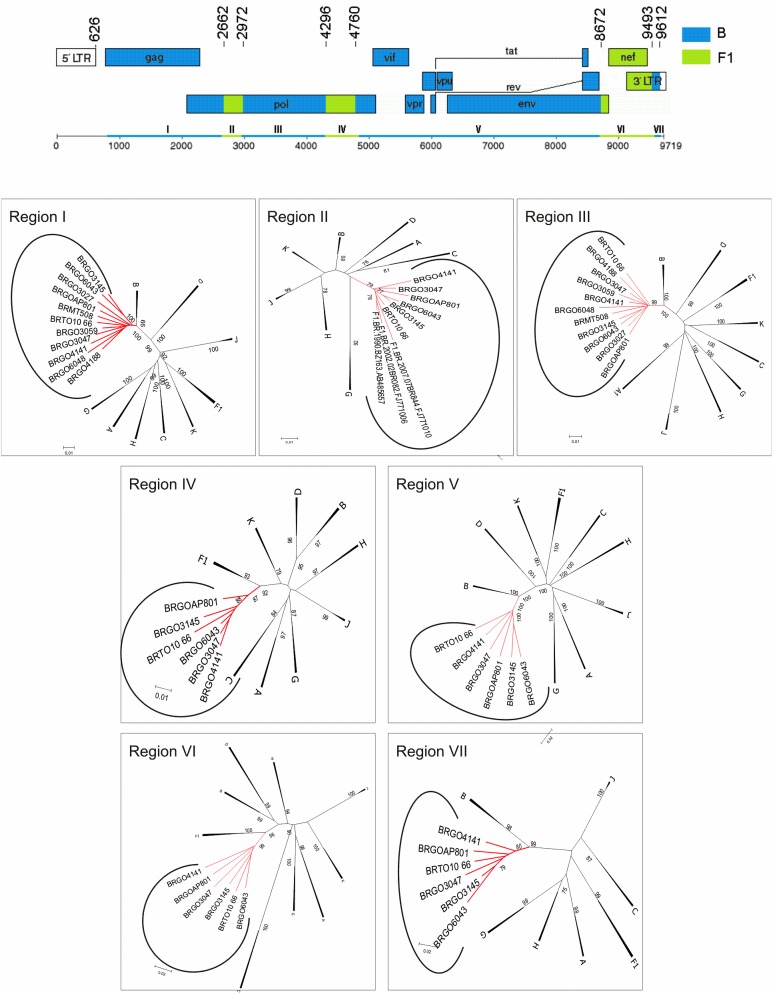
The Brazilian AIDS epidemic has been characterized by an increasing rate of BF1 recombinants and so far eight circulating recombinant forms/CRFs_BF1 have been described countrywide. In this study, pol sequences (protease/PR, reverse transcriptase/RT) of 87 BF1 mosaic isolates identified among 828 patients living in six Brazilian States from three geographic regions (Central West, North, Northeast) were analyzed. Phylogenetic and bootscan analyses were performed to investigate the evolutionary relationship and mosaic structure of BF1 isolates. Those analyses showed that 20.7% of mosaics (18 out of 87) were CRFs-like isolates, mostly represented by CRF28/CRF29_BF-like viruses (14 out of 18). We also identified five highly supported clusters that together comprise 42 out of 87 (48.3%) BF1 sequences, each cluster containing at least five sequences sharing a similar mosaic structure, suggesting possible new unidentified CRFs_BF1. The divergence time of these five potential new CRFs_BF1 clusters was estimated using a Bayesian approach and indicate that they probably originated between the middle 1980s and the middle 1990s. DNA was extracted from whole blood and four overlapping fragments were amplified by PCR providing full/near full length genomes (FLG/NFLG) and partial genomes. Eleven HIV-1 isolates from Cluster # 5 identified in epidemiologically unlinked individuals living in Central West and North regions provided FLG/NFLG/partial genome sequences with identical mosaic structure. These viruses differ from any known CRF_BF1 reported to date and were named CRF90_BF1 by the Los Alamos National Laboratory. This is the 9th CRF_BF1 described in Brazil and the first one identified in Central West and North regions. Our results highlight the importance of continued molecular screening and surveillance studies, especially of full genome sequences to understand the evolutionary dynamics of the HIV-1 epidemic in a country of continental dimensions as Brazil.
巴西艾滋病疫情的特点是BF1重组体的比例不断上升,到目前为止,全国已描述了8种流行重组形式/CRFs_BF1。在本研究中,分析了来自巴西三个地理区域(中西部、北部、东北部)六个州的828名患者中鉴定出的87株BF1镶嵌型分离株的pol序列(蛋白酶/PR、逆转录酶/RT)。进行了系统发育和bootscan分析,以研究BF1分离株的进化关系和镶嵌结构。这些分析表明,20.7%的镶嵌型(87株中的18株)是CRFs样分离株,主要由CRF28/CRF29_BF样病毒代表(18株中的14株)。我们还鉴定了五个高度支持的簇,它们共同包含87个BF1序列中的42个(48.3%),每个簇包含至少五个具有相似镶嵌结构的序列,表明可能存在未鉴定的新CRFs_BF1。使用贝叶斯方法估计了这五个潜在新CRFs_BF1簇的分歧时间,表明它们可能起源于20世纪80年代中期至90年代中期。从全血中提取DNA,通过PCR扩增四个重叠片段,提供全长/近全长基因组(FLG/NFLG)和部分基因组。从生活在中西部和北部地区的流行病学无关联个体中鉴定出的来自簇#5的11株HIV-1分离株提供了具有相同镶嵌结构的FLG/NFLG/部分基因组序列。这些病毒与迄今报道的任何已知CRF_BF1不同,被洛斯阿拉莫斯国家实验室命名为CRF90_BF1。这是巴西描述的第9种CRF_BF1,也是在中西部和北部地区鉴定出的第一种。我们的结果强调了持续进行分子筛查和监测研究的重要性,特别是对全基因组序列的研究,以了解像巴西这样幅员辽阔的国家中HIV-1疫情的进化动态。