Coury Jennifer, Schneider Jennifer L, Rivelli Jennifer S, Petrik Amanda F, Seibel Evelyn, D'Agostini Brieshon, Taplin Stephen H, Green Beverly B, Coronado Gloria D
Kaiser Permanente Center for Health Research, 3800 N. Interstate Ave, Portland, OR, 97227, USA.
Lean HealthCare West, 315 SW 5th Avenue, Suite 900, Portland, OR, 97204, USA.
BMC Health Serv Res. 2017 Jun 19;17(1):411. doi: 10.1186/s12913-017-2364-3.
The Plan-Do-Study-Act (PDSA) cycle is a commonly used improvement process in health care settings, although its documented use in pragmatic clinical research is rare. A recent pragmatic clinical research study, called the Strategies and Opportunities to STOP Colon Cancer in Priority Populations (STOP CRC), used this process to optimize the research implementation of an automated colon cancer screening outreach program in intervention clinics. We describe the process of using this PDSA approach, the selection of PDSA topics by clinic leaders, and project leaders' reactions to using PDSA in pragmatic research.
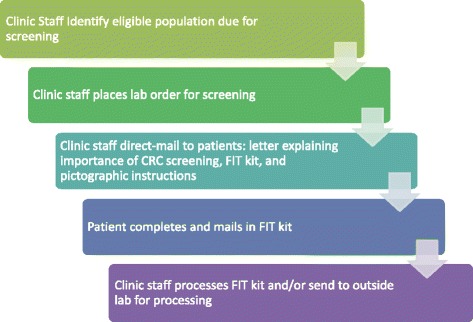
STOP CRC is a cluster-randomized pragmatic study that aims to test the effectiveness of a direct-mail fecal immunochemical testing (FIT) program involving eight Federally Qualified Health Centers in Oregon and California. We and a practice improvement specialist trained in the PDSA process delivered structured presentations to leaders of these centers; the presentations addressed how to apply the PDSA process to improve implementation of a mailed outreach program offering colorectal cancer screening through FIT tests. Center leaders submitted PDSA plans and delivered reports via webinar at quarterly meetings of the project's advisory board. Project staff conducted one-on-one, 45-min interviews with project leads from each health center to assess the reaction to and value of the PDSA process in supporting the implementation of STOP CRC.
Clinic-selected PDSA activities included refining the intervention staffing model, improving outreach materials, and changing workflow steps. Common benefits of using PDSA cycles in pragmatic research were that it provided a structure for staff to focus on improving the program and it allowed staff to test the change they wanted to see. A commonly reported challenge was measuring the success of the PDSA process with the available electronic medical record tools.
Understanding how the PDSA process can be applied to pragmatic trials and the reaction of clinic staff to their use may help clinics integrate evidence-based interventions into their everyday care processes.
Clinicaltrials.gov NCT01742065 . Registered October 31, 2013.
计划-实施-研究-改进(PDSA)循环是医疗保健环境中常用的改进流程,不过其在实用临床研究中的应用记录很少。最近一项名为“优先人群中预防结肠癌的策略与机会”(STOP CRC)的实用临床研究,采用了这一流程来优化干预诊所中自动化结肠癌筛查推广项目的研究实施。我们描述了使用这种PDSA方法的过程、诊所负责人对PDSA主题的选择,以及项目负责人对在实用研究中使用PDSA的反应。
STOP CRC是一项整群随机实用研究,旨在测试一项直接邮寄粪便免疫化学检测(FIT)项目的有效性,该项目涉及俄勒冈州和加利福尼亚州的八家联邦合格健康中心。我们和一位接受过PDSA流程培训的实践改进专家向这些中心的负责人进行了结构化的演示;演示内容涉及如何应用PDSA流程来改进通过FIT检测提供结直肠癌筛查的邮寄推广项目的实施。中心负责人提交了PDSA计划,并在项目咨询委员会的季度会议上通过网络研讨会提交报告。项目工作人员与每个健康中心的项目负责人进行了一对一的45分钟访谈,以评估PDSA流程在支持STOP CRC实施方面的反应和价值。
诊所选择的PDSA活动包括完善干预人员配备模式、改进推广材料以及改变工作流程步骤。在实用研究中使用PDSA循环的共同好处是,它为工作人员提供了一个专注于改进项目的框架,并且让工作人员能够测试他们希望看到的变化。一个普遍报告的挑战是使用现有的电子病历工具衡量PDSA流程的成功程度。
了解PDSA流程如何应用于实用试验以及诊所工作人员对其使用的反应,可能有助于诊所将循证干预措施融入日常护理流程。
Clinicaltrials.gov NCT01742065。于2013年10月31日注册。