Centen Andrew, Lowrey Catherine R, Scott Stephen H, Yeh Ting-Ting, Mochizuki George
Heart and Stroke Foundation Canadian Partnership for Stroke Recovery, Sunnybrook Research Institute, Toronto, ON, Canada.
Toronto Rehabilitation Institute - University Health Network, Toronto, ON, Canada.
J Neuroeng Rehabil. 2017 Jun 19;14(1):59. doi: 10.1186/s12984-017-0272-8.
Spasticity is a common sequela of stroke. Traditional assessment methods include relatively coarse scales that may not capture all characteristics of elevated muscle tone. Thus, the aim of this study was to develop a tool to quantitatively assess post-stroke spasticity in the upper extremity.
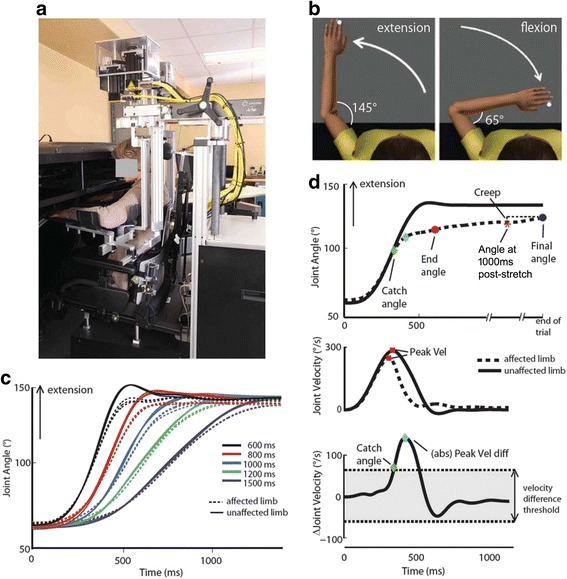
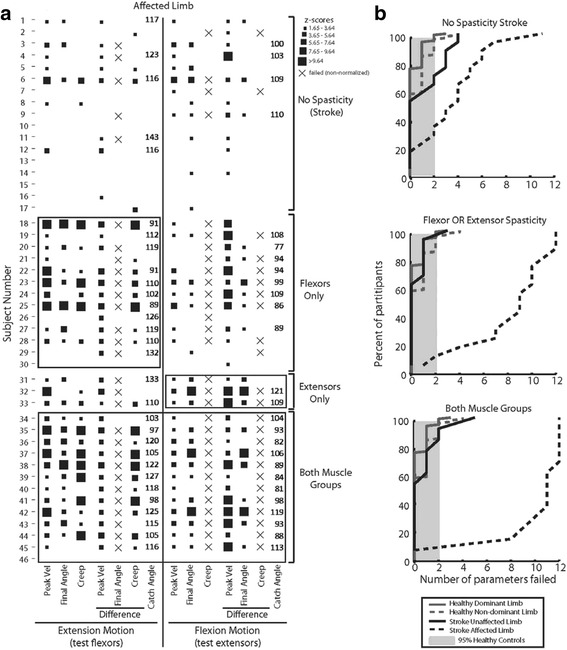
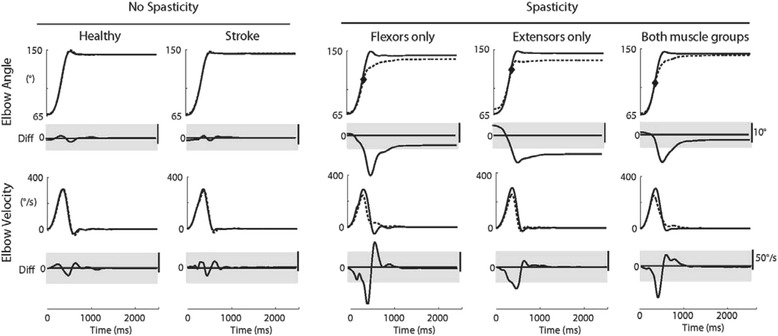
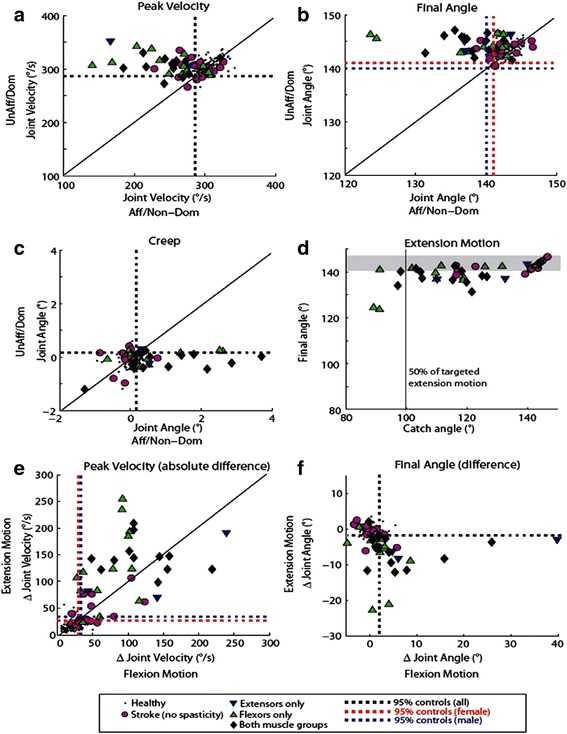
Ninety-six healthy individuals and 46 individuals with stroke participated in this study. The kinematic assessment of passive stretch (KAPS) protocol consisted of passive elbow stretch in flexion and extension across an 80° range in 5 movement durations. Seven parameters were identified and assessed to characterize spasticity (peak velocity, final angle, creep (or release), between-arm peak velocity difference, between-arm final angle, between-arm creep, and between-arm catch angle).
The fastest movement duration (600 ms) was most effective at identifying impairment in each parameter associated with spasticity. A decrease in peak velocity during passive stretch between the affected and unaffected limb was most effective at identifying individuals as impaired. Spasticity was also associated with a decreased passive range (final angle) and a classic 'catch and release' as seen through between-arm catch and creep metrics.
The KAPS protocol and robotic technology can provide a sensitive and quantitative assessment of post-stroke elbow spasticity not currently attainable through traditional measures.
痉挛是中风常见的后遗症。传统的评估方法包括相对粗略的量表,可能无法捕捉到肌张力升高的所有特征。因此,本研究的目的是开发一种工具,用于定量评估中风后上肢痉挛情况。
96名健康个体和46名中风患者参与了本研究。被动伸展运动学评估(KAPS)方案包括在5个运动持续时间内,在80°范围内进行被动肘部屈伸伸展。确定并评估了7个参数以表征痉挛(峰值速度、最终角度、蠕变(或释放)、双臂间峰值速度差、双臂间最终角度、双臂间蠕变和双臂间捕捉角度)。
最快的运动持续时间(600毫秒)在识别与痉挛相关的每个参数的损伤方面最有效。患侧和未患侧肢体在被动伸展过程中峰值速度的降低在识别受损个体方面最有效。痉挛还与被动活动范围减小(最终角度)以及通过双臂间捕捉和蠕变指标观察到的典型“捕捉与释放”现象有关。
KAPS方案和机器人技术能够对中风后肘部痉挛提供一种目前传统测量方法无法实现的敏感且定量的评估。