Dean Samantha G, Zhang Chenan, Gao Jianjun, Roy Shantanu, Shinkle Justin, Sabarinathan Mekala, Argos Maria, Tong Lin, Ahmed Alauddin, Islam Md Tariqul, Islam Tariqul, Rakibuz-Zaman Muhammad, Sarwar Golam, Shahriar Hasan, Rahman Mahfuzar, Yunus Md, Graziano Joseph H, Chen Lin S, Jasmine Farzana, Kibriya Muhammad G, Ahsan Habibul, Pierce Brandon L
Department of Public Health Sciences, University of Chicago, Chicago, IL 60637, USA.
Department of Epidemiology and Biostatistics, University of California, San Francisco, San Francisco, CA 94158, USA.
Aging (Albany NY). 2017 Jun 15;9(6):1537-1551. doi: 10.18632/aging.101246.
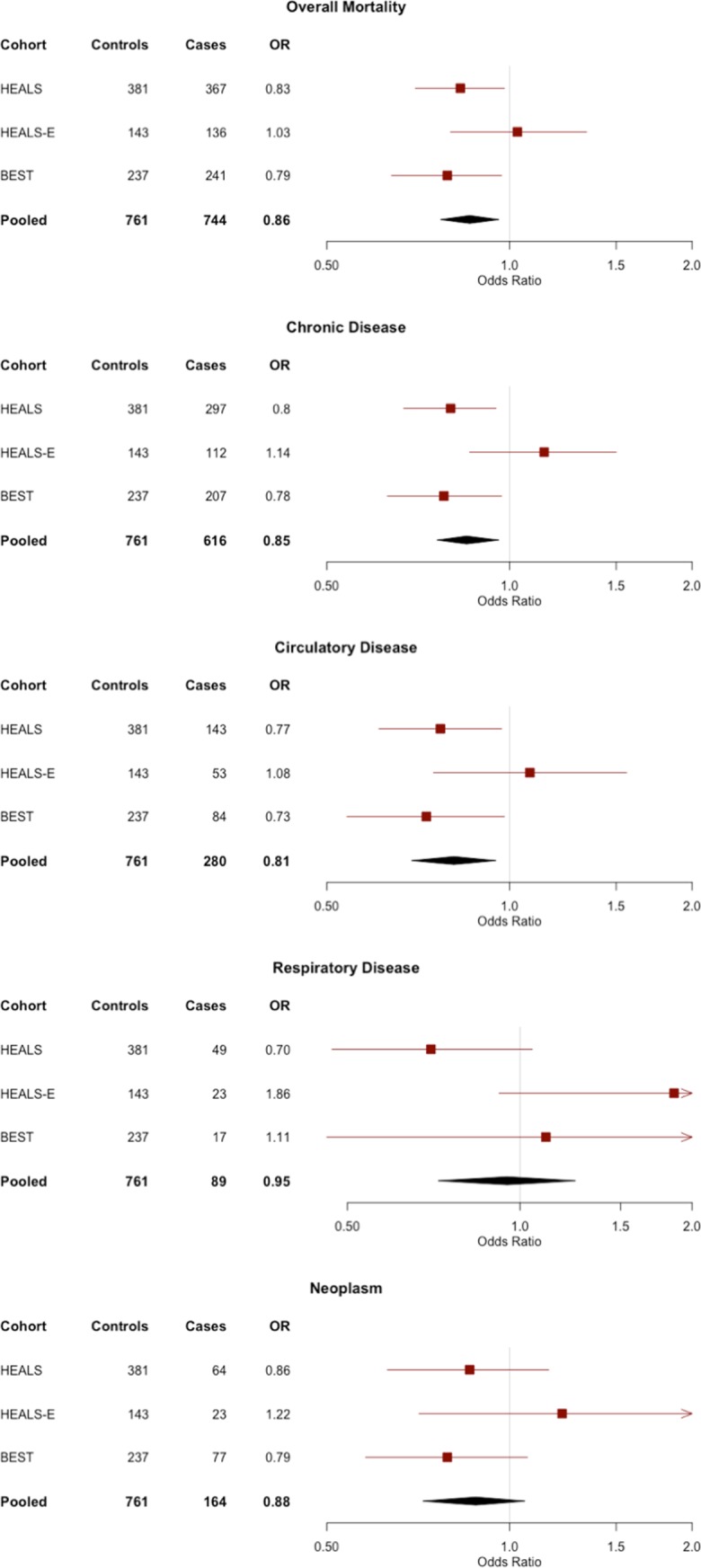
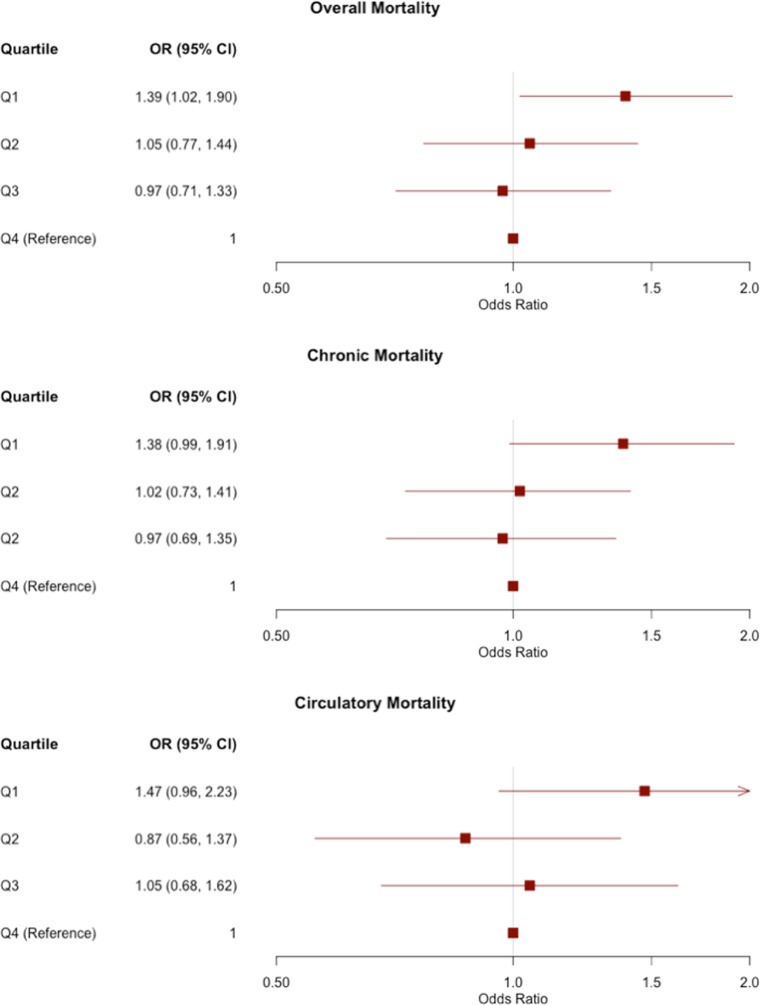
Telomeres are tandem repeat sequences at the end of chromosomes that bind proteins to protect chromosome ends. Telomeres shorten with age, and shorter leukocyte telomere length (TL) has been associated with overall mortality in numerous studies. However, this association has not been tested in populations outside of Europe and the U.S. We assessed the association between TL and subsequent mortality using data on 744 mortality cases and 761 age-/sex-matched controls sampled from >27,000 participants from three longitudinal Bangladeshi cohorts: Health Effects of Arsenic Longitudinal Study (HEALS), HEALS Expansion (HEALS-E), and Bangladesh Vitamin E and Selenium Trial (BEST). We used conditional logistic regression to estimate odds ratios (ORs) for the association between a standardized TL variable and overall mortality, as well as mortality from chronic diseases, respiratory diseases, circulatory diseases, and cancer. In HEALS and BEST, we observed an association between shorter TL and increased overall mortality (P=0.03 and P=0.03), mortality from chronic disease (P=0.01 and P=0.03) and mortality from circulatory disease (P=0.03 and P=0.04). Results from pooled analyses of all cohorts were consistent with HEALS and BEST. This is the first study demonstrating an association between short TL and increased mortality in a population of non-European ancestry.
端粒是染色体末端的串联重复序列,它与蛋白质结合以保护染色体末端。端粒会随着年龄增长而缩短,在众多研究中,较短的白细胞端粒长度(TL)与总体死亡率相关。然而,这种关联尚未在欧洲和美国以外的人群中得到验证。我们利用来自孟加拉国三个纵向队列中超过27000名参与者的744例死亡病例和761例年龄/性别匹配的对照的数据,评估了TL与后续死亡率之间的关联,这三个队列分别是:砷的健康影响纵向研究(HEALS)、HEALS扩展研究(HEALS-E)以及孟加拉国维生素E和硒试验(BEST)。我们使用条件逻辑回归来估计标准化TL变量与总体死亡率以及慢性病、呼吸道疾病、循环系统疾病和癌症死亡率之间关联的优势比(OR)。在HEALS和BEST中,我们观察到较短的TL与总体死亡率增加(P = 0.03和P = 0.03)、慢性病死亡率增加(P = 0.01和P = 0.03)以及循环系统疾病死亡率增加(P = 0.03和P = 0.04)之间存在关联。所有队列的汇总分析结果与HEALS和BEST一致。这是第一项证明在非欧洲血统人群中短TL与死亡率增加之间存在关联的研究。