Gidron Yori, Deschepper Reginald, De Couck Marijke, Thayer Julian F, Velkeniers Brigitte
SCALAB UMR CNRS 9193, Université Lille, BP 60149, Villeneuve d'Ascq CEDEX 59653, France.
Mental Health and Wellbeing Research Group, Vrije Universiteit Brussel (VUB), Laerbeeklaan 103, 1090 Jette, Brussels, Belgium.
J Clin Med. 2018 Oct 19;7(10):371. doi: 10.3390/jcm7100371.
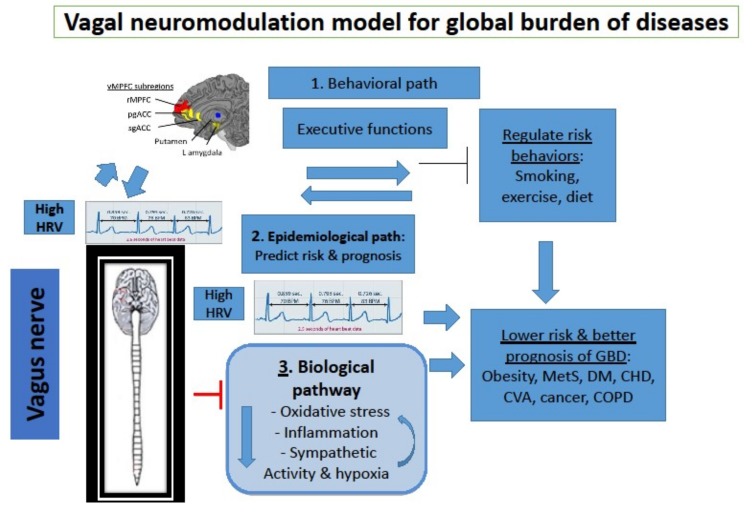
Global burden of diseases (GBD) includes non-communicable conditions such as cardiovascular diseases, cancer and chronic obstructive pulmonary disease. These share important behavioral risk factors (e.g., smoking, diet) and pathophysiological contributing factors (oxidative stress, inflammation and excessive sympathetic activity). This article wishes to introduce to medicine and public health a new paradigm to predict, understand, prevent and possibly treat such diseases based on the science of neuro-immunology and specifically by focusing on vagal neuro-modulation. Vagal nerve activity is related to frontal brain activity which regulates unhealthy lifestyle behaviors. Epidemiologically, high vagal activity, indexed by greater heart rate variability (HRV), independently predicts reduced risk of GBD and better prognosis in GBD. Biologically, the vagus nerve inhibits oxidative stress, inflammation and sympathetic activity (and associated hypoxia). Finally, current non-invasive methods exist to activate this nerve for neuro-modulation, and have promising clinical effects. Indeed, preliminary evidence exists for the beneficial effects of vagal nerve activation in diabetes, stroke, myocardial infarction and possibly cancer. Thus, we propose to routinely implement measurement of HRV to predict such GBD in populations, and to test in randomized controlled trials effects of non-invasive vagal nerve activation on prevention and treatment of GBD, reflecting possible neuro-modulation of health.
全球疾病负担(GBD)包括心血管疾病、癌症和慢性阻塞性肺疾病等非传染性疾病。这些疾病具有重要的行为风险因素(如吸烟、饮食)和病理生理促成因素(氧化应激、炎症和过度的交感神经活动)。本文希望基于神经免疫学,特别是通过关注迷走神经调节,向医学和公共卫生领域介绍一种预测、理解、预防并可能治疗此类疾病的新范式。迷走神经活动与调节不健康生活方式行为的额叶脑活动相关。在流行病学上,以较高心率变异性(HRV)为指标的高迷走神经活动独立预测GBD风险降低和GBD患者预后更好。在生物学上,迷走神经抑制氧化应激、炎症和交感神经活动(以及相关的缺氧)。最后,目前存在激活该神经进行神经调节的非侵入性方法,并且具有有前景的临床效果。确实,有初步证据表明迷走神经激活在糖尿病、中风、心肌梗死以及可能在癌症方面具有有益作用。因此,我们建议常规测量HRV以预测人群中的此类GBD,并在随机对照试验中测试非侵入性迷走神经激活对GBD预防和治疗的效果,反映健康可能的神经调节作用。