Stanley Institute for Cognitive Genomics, Cold Spring Harbor Laboratory, Cold Spring Harbor, NY, USA.
Department of Biology, Howard University, Washington DC, USA.
Mol Psychiatry. 2018 May;23(5):1270-1277. doi: 10.1038/mp.2017.115. Epub 2017 Jun 20.
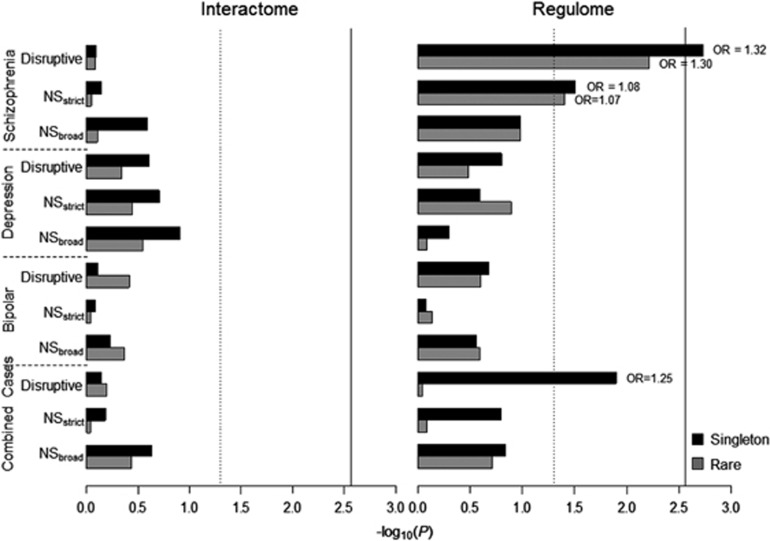
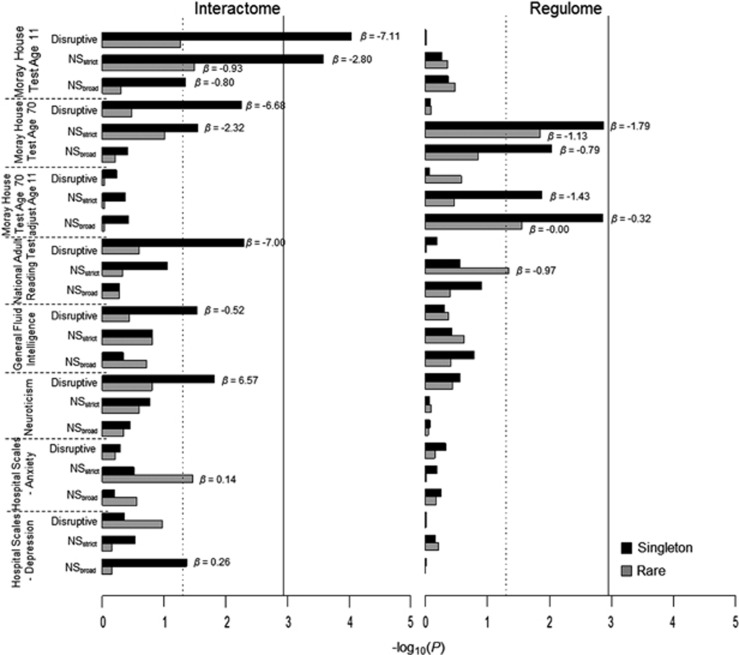
Schizophrenia (SCZ), bipolar disorder (BD) and recurrent major depressive disorder (rMDD) are common psychiatric illnesses. All have been associated with lower cognitive ability, and show evidence of genetic overlap and substantial evidence of pleiotropy with cognitive function and neuroticism. Disrupted in schizophrenia 1 (DISC1) protein directly interacts with a large set of proteins (DISC1 Interactome) that are involved in brain development and signaling. Modulation of DISC1 expression alters the expression of a circumscribed set of genes (DISC1 Regulome) that are also implicated in brain biology and disorder. Here we report targeted sequencing of 59 DISC1 Interactome genes and 154 Regulome genes in 654 psychiatric patients and 889 cognitively-phenotyped control subjects, on whom we previously reported evidence for trait association from complete sequencing of the DISC1 locus. Burden analyses of rare and singleton variants predicted to be damaging were performed for psychiatric disorders, cognitive variables and personality traits. The DISC1 Interactome and Regulome showed differential association across the phenotypes tested. After family-wise error correction across all traits (FWER), an increased burden of singleton disruptive variants in the Regulome was associated with SCZ (FWER P=0.0339). The burden of singleton disruptive variants in the DISC1 Interactome was associated with low cognitive ability at age 11 (FWER P=0.0043). These results identify altered regulation of schizophrenia candidate genes by DISC1 and its core Interactome as an alternate pathway for schizophrenia risk, consistent with the emerging effects of rare copy number variants associated with intellectual disability.
精神分裂症 (SCZ)、双相情感障碍 (BD) 和复发性重度抑郁障碍 (rMDD) 是常见的精神疾病。所有这些疾病都与认知能力下降有关,并且有遗传重叠的证据,以及与认知功能和神经质的大量证据表明存在多效性。精神分裂症 1 区 (DISC1) 蛋白与一大组参与大脑发育和信号转导的蛋白质 (DISC1 相互作用组) 直接相互作用。DISC1 表达的调节会改变一组受限定的基因 (DISC1 调节组) 的表达,这些基因也与大脑生物学和疾病有关。在这里,我们报告了对 654 名精神疾病患者和 889 名认知表型对照者的 59 个 DISC1 相互作用组基因和 154 个调节组基因进行靶向测序,此前我们对 DISC1 基因座的完整测序报告了与性状关联的证据。对预测为有害的罕见和单核苷酸变异进行了罕见变异负担分析。对测试的表型进行全基因组错误校正 (FWER) 后,调节组中的单核苷酸破坏变异的负担增加与 SCZ 相关 (FWER P=0.0339)。DISC1 相互作用组中单核苷酸破坏变异的负担与 11 岁时的认知能力低有关 (FWER P=0.0043)。这些结果表明,DISC1 及其核心相互作用组对精神分裂症候选基因的调控异常是精神分裂症风险的另一种途径,这与与智力障碍相关的罕见拷贝数变异的新兴效应一致。