Key Laboratory of Land Surface Pattern and Simulation, Institute of Geographic Sciences and Natural Resources Research, Chinese Academy of Sciences, Beijing, 100101, China.
University of Chinese Academy of Sciences, Beijing, 100049, China.
Sci Rep. 2017 Jun 19;7(1):3845. doi: 10.1038/s41598-017-04140-7.
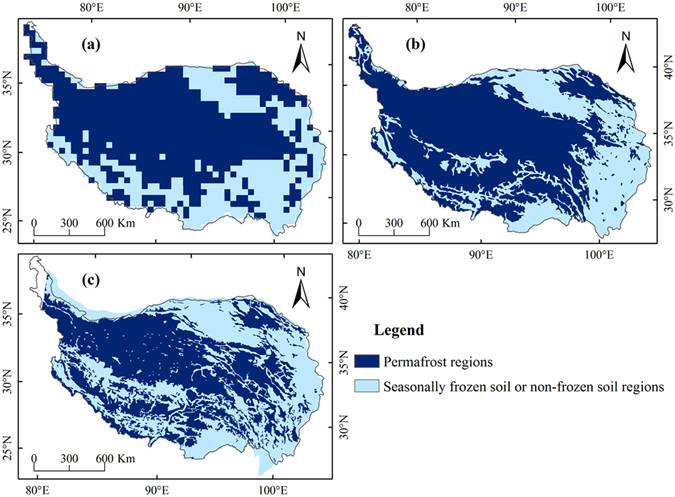
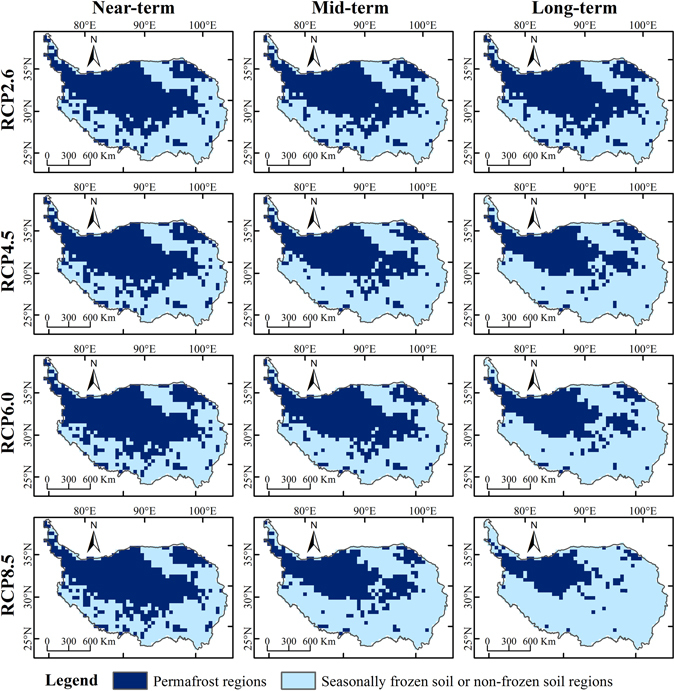
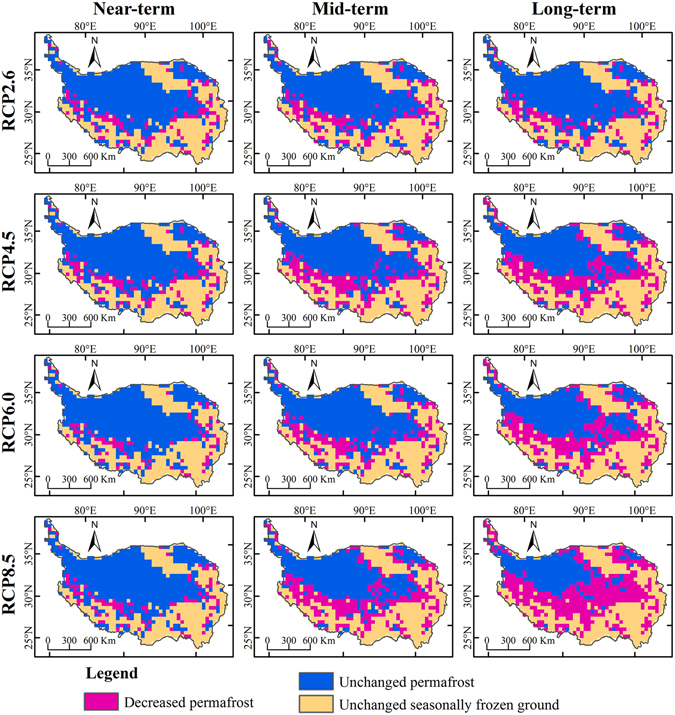
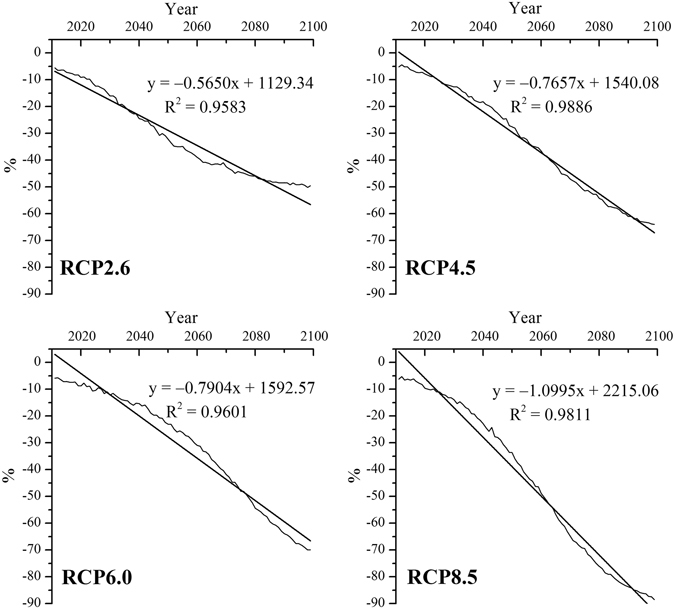
Climate warming causes changes in permafrost distribution, which affects the surface energy balance, hydrologic cycle and carbon flux in cold regions. In this study, the Surface Frost Number model was applied to examine permafrost distribution on the Qinghai-Tibet Plateau (QTP) under the four RCPs (RCP2.6, RCP4.5, RCP6.0, and RCP8.5). The Kappa statistic was used to evaluate model results by comparing simulations of baseline permafrost distribution (1981-2010) with the existing frozen soil maps. The comparison shows that the Surface Frost Number model is suitable for simulating the general characteristics of permafrost distribution on the QTP. Simulated results suggest that areas of permafrost degradation would be the smallest in the near-term (2011‒2040) with the rates of 17.17%, 18.07%, 12.95% and 15.66% under RCP2.6, RCP4.5, RCP6.0 and RCP8.5, respectively. The rate of permafrost degradation would be faster in the mid-term (2041‒2070), especially under the RCP8.5 scenario (about 41.42%). Areas of permafrost degradation would be the largest in the long-term (2071‒2099) relative to baseline conditions, with a modelled 64.31% decrease in permafrost distribution using the RCP8.5 scenario. Our results would help the decision‒making for engineering construction program on the QTP, and support local units in their efforts to adapt climate change.
气候变暖导致多年冻土分布发生变化,进而影响寒区的地表能量平衡、水文循环和碳通量。本研究应用地表霜频数模型,在四个 RCP 情景(RCP2.6、RCP4.5、RCP6.0 和 RCP8.5)下,研究青藏高原多年冻土的分布。通过对比 1981-2010 年多年冻土分布的基准模拟和现有的冻土图,采用 Kappa 统计量评估模型结果。结果表明,地表霜频数模型适用于模拟青藏高原多年冻土分布的总体特征。模拟结果表明,在近期(2011-2040 年),各情景下多年冻土退化面积最小,退化率分别为 17.17%、18.07%、12.95%和 15.66%,在中期(2041-2070 年),各情景下多年冻土退化速度加快,特别是在 RCP8.5 情景下(约 41.42%),在远期(2071-2099 年),多年冻土退化面积相对于基准条件最大,在 RCP8.5 情景下,多年冻土分布减少 64.31%。本研究结果将有助于青藏高原工程建设方案的决策,并为当地适应气候变化提供支持。