Chen Kaiyang, Wang Bo, Chen Chen, Zhou Guoying
Northwest Institute of Plateau Biology, Chinese Academy of Sciences, Xining 810008, China.
University of Chinese Academy of Sciences, Beijing 100049, China.
Plants (Basel). 2022 Feb 28;11(5):670. doi: 10.3390/plants11050670.
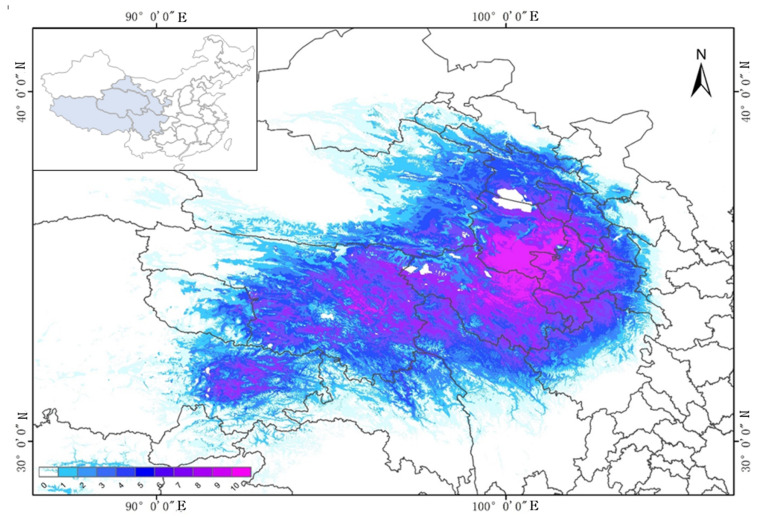
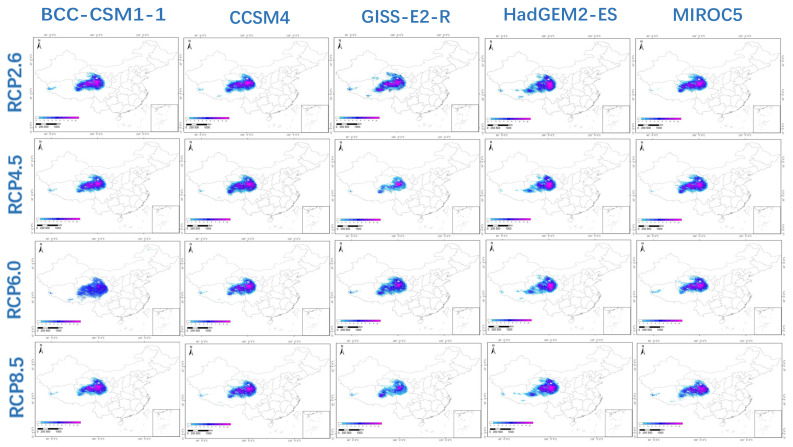
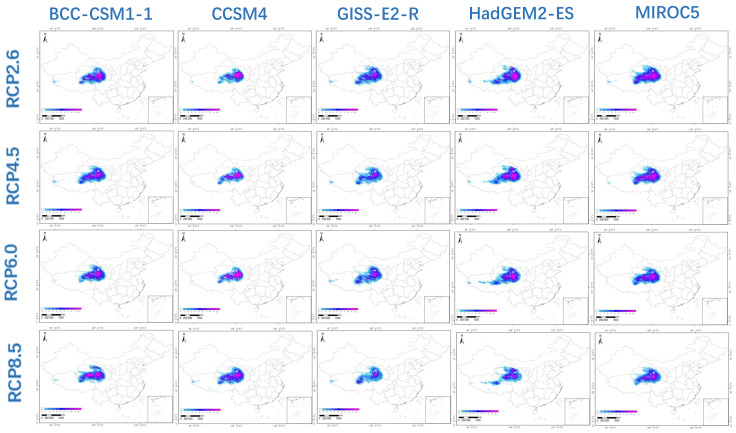
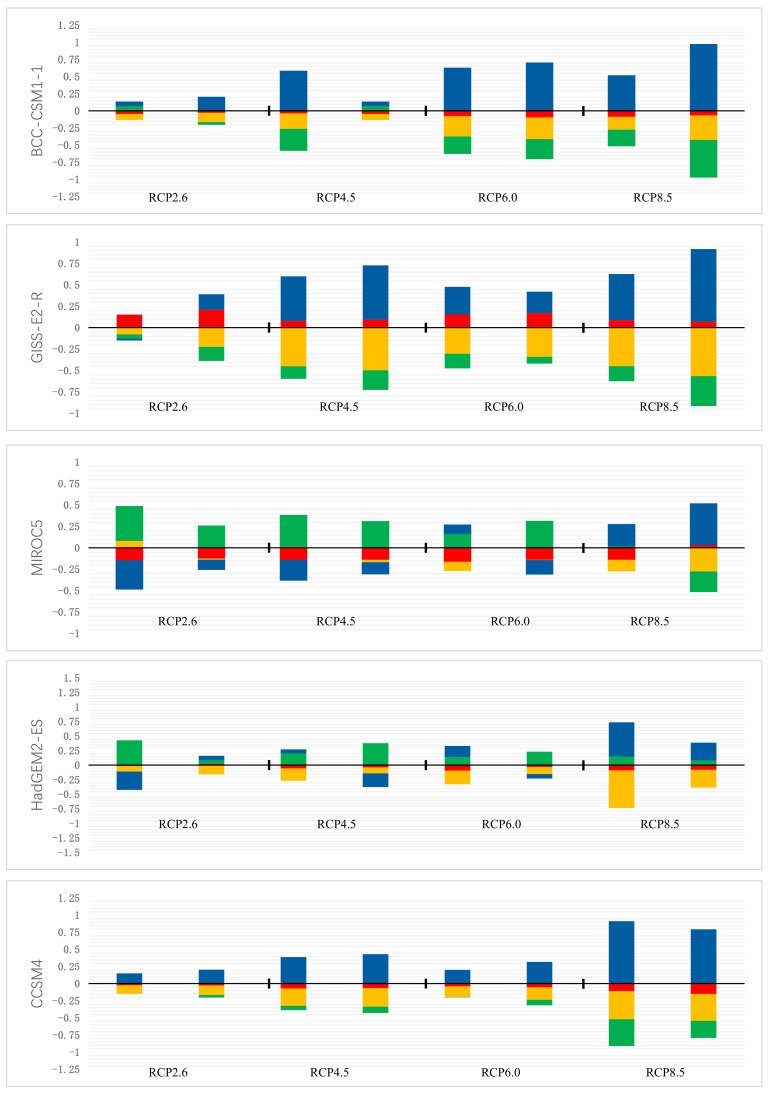
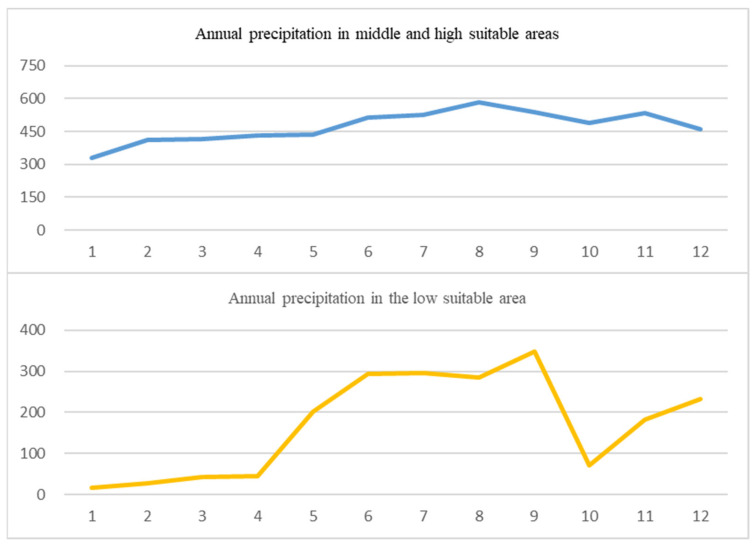
As an important Tibetan medicine and a secondary protected plant in China, is endemic to the country and is mainly distributed in the Qinghai-Tibet Plateau (QTP). However, global climate change caused by greenhouse gas emissions might lead to the extinction of . To understand the potential spatial distribution of in future global warming scenarios, we used the MaxEnt model to simulate changes in its suitable habitat that would occur by 2050 and 2070 using four representative concentration pathway (RCP) scenarios and five global climate models. The results showed that the QTP currently contains a suitable habitat for and will continue to do so in the future. Under the RCP2.6 scenario, the suitable habitat area would increase by 2050 but shrink slightly by 2070, with an average reduction of 2.7%. However, under the RCP8.5 scenario, the area of unsuitable habitat would expand by an average of 54.65% and 68.20% by 2050 and 2070, respectively. The changes in the area of suitable habitat under the RCP4.5 and RCP6.0 scenarios were similar, with the unsuitable area increasing by approximately 20% by 2050 and 2070. Under these two moderate RCPs, the total suitable area in 2070 would be greater than that in 2050. The top three environmental factors impacting the habitat distribution were altitude, annual precipitation (BIO12) and annual temperature range (BIO7). The cumulative contribution rate of these three factors was as high as 82.8%, indicating that they were the key factors affecting the distribution and adaptability of , grows well in damp and cold environments. Due to global warming, the QTP will become warmer and drier; thus, the growing area of will move toward higher elevations and areas that are humid and cold. These areas are mainly found near the Three-River Region. Future climate change will aggravate the deterioration of the habitat and increase the species' survival risk. This study describes the distribution of and provides a basis for the protection of endangered plants in the QTP.
作为一种重要的藏药和中国二级保护植物,它为中国特有,主要分布于青藏高原。然而,温室气体排放导致的全球气候变化可能会致使其灭绝。为了解在未来全球变暖情景下它的潜在空间分布,我们使用最大熵模型(MaxEnt模型),利用四种代表性浓度路径(RCP)情景和五个全球气候模型,模拟到2050年和2070年其适宜栖息地的变化。结果表明,青藏高原目前拥有其适宜栖息地,且未来仍将如此。在RCP2.6情景下,到2050年适宜栖息地面积将会增加,但到2070年将略有缩小,平均减少2.7%。然而,在RCP8.5情景下,到2050年和2070年,不适宜栖息地面积将分别平均扩大54.65%和68.20%。RCP4.5和RCP6.0情景下适宜栖息地面积的变化相似,到2050年和2070年不适宜面积增加约20%。在这两种中等RCP情景下,2070年的适宜总面积将大于2050年。影响栖息地分布的前三个环境因素是海拔、年降水量(BIO12)和年温度范围(BIO7)。这三个因素的累积贡献率高达82.8%,表明它们是影响其分布和适应性的关键因素,它在潮湿寒冷环境中生长良好。由于全球变暖,青藏高原将变得更温暖干燥;因此,它的生长区域将向更高海拔以及潮湿寒冷的地区转移。这些区域主要位于三江地区附近。未来气候变化将加剧其栖息地的恶化,增加该物种的生存风险。本研究描述了它的分布情况,为青藏高原濒危植物的保护提供了依据。