Suzuki Takashi, Ryu Keinosuke, Kojima Kei, Saito Shu, Nagaoka Hiroshi, Tokuhashi Yasuaki
Department of Orthopaedic Surgery, Nihon University Hospital, 1-6 Kandasurugadai, Chiyodaku, Tokyo, 101-8309, Japan.
Department of Orthopaedic Surgery, Nihon University School of Medicine, 30-1 Oyaguchikamimachi, Itabashiku, Tokyo, 173-0032, Japan.
J Orthop Case Rep. 2017 Jan-Feb;7(1):32-35. doi: 10.13107/jocr.2250-0685.676.
Along with the increase of osteoporotic patients in an aging society, complications in surgeries associated with osteoporosis are also increasing. In cementless total knee arthroplasty (TKA), poor primary stability and subsequent initial loosening of the implant may be seen.
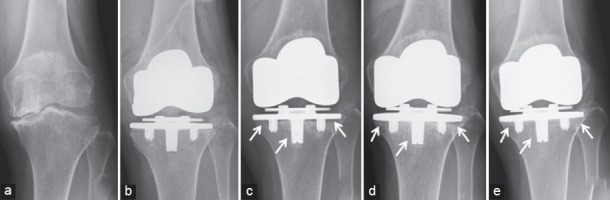
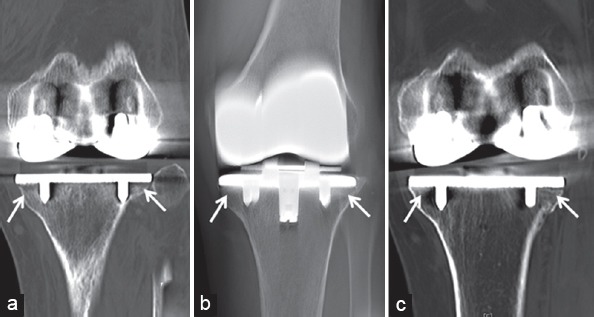
The patient, a 75-year-old Asian woman with a history of osteoporosis, underwent cementless TKA. Knee radiography at 5 weeks postoperatively showed radiolucent lines outlined beneath the tibial tray and around the stem. The tibial component was considered unstable due to loosening. A 56.5 µg weekly dose of teriparatide (rh [1-34] parathyroid hormone) was administered. After 2 months of treatment, knee pain and knee swelling had disappeared. Tomosynthesis taken after 6 months of treatment confirmed complete ingrowth of the component to the bone.
This case showed that a weekly teriparatide administration of 56.5 µg improved initial loosening of the tibial implant in cementless TKA. Administration of teriparatide in cases of the osteoporotic patient who has loosening in cementless TKA may be a useful adjuvant to achieve bone ingrowth again.
随着老龄化社会中骨质疏松症患者数量的增加,与骨质疏松相关的手术并发症也在增多。在非骨水泥全膝关节置换术(TKA)中,可能会出现初次稳定性差以及随后植入物早期松动的情况。
该患者为一名75岁的亚洲女性,有骨质疏松病史,接受了非骨水泥TKA手术。术后5周的膝关节X线片显示胫骨托下方和柄周围有透亮线。由于松动,胫骨部件被认为不稳定。给予每周56.5μg的特立帕肽(rh[1-34]甲状旁腺激素)剂量。治疗2个月后,膝关节疼痛和肿胀消失。治疗6个月后进行的断层合成成像证实部件已完全长入骨内。
本病例表明,每周给予56.5μg特立帕肽可改善非骨水泥TKA中胫骨植入物的早期松动。对于非骨水泥TKA出现松动的骨质疏松症患者,使用特立帕肽可能是再次实现骨长入的有效辅助手段。