Saper Robert B, Lemaster Chelsey, Delitto Anthony, Sherman Karen J, Herman Patricia M, Sadikova Ekaterina, Stevans Joel, Keosaian Julia E, Cerrada Christian J, Femia Alexandra L, Roseen Eric J, Gardiner Paula, Gergen Barnett Katherine, Faulkner Carol, Weinberg Janice
From Boston University School of Medicine, Boston Medical Center, Harvard Medical School, and Boston University School of Public Health, Boston, Massachusetts; University of Pittsburgh School of Health and Rehabilitation Sciences, Pittsburgh, Pennsylvania; Group Health Research Institute and University of Washington, Seattle, Washington; and RAND Corporation, Santa Monica, California.
Ann Intern Med. 2017 Jul 18;167(2):85-94. doi: 10.7326/M16-2579. Epub 2017 Jun 20.
Yoga is effective for mild to moderate chronic low back pain (cLBP), but its comparative effectiveness with physical therapy (PT) is unknown. Moreover, little is known about yoga's effectiveness in underserved patients with more severe functional disability and pain.
To determine whether yoga is noninferior to PT for cLBP.
12-week, single-blind, 3-group randomized noninferiority trial and subsequent 40-week maintenance phase. (ClinicalTrials.gov: NCT01343927).
Academic safety-net hospital and 7 affiliated community health centers.
320 predominantly low-income, racially diverse adults with nonspecific cLBP.
Participants received 12 weekly yoga classes, 15 PT visits, or an educational book and newsletters. The maintenance phase compared yoga drop-in classes versus home practice and PT booster sessions versus home practice.
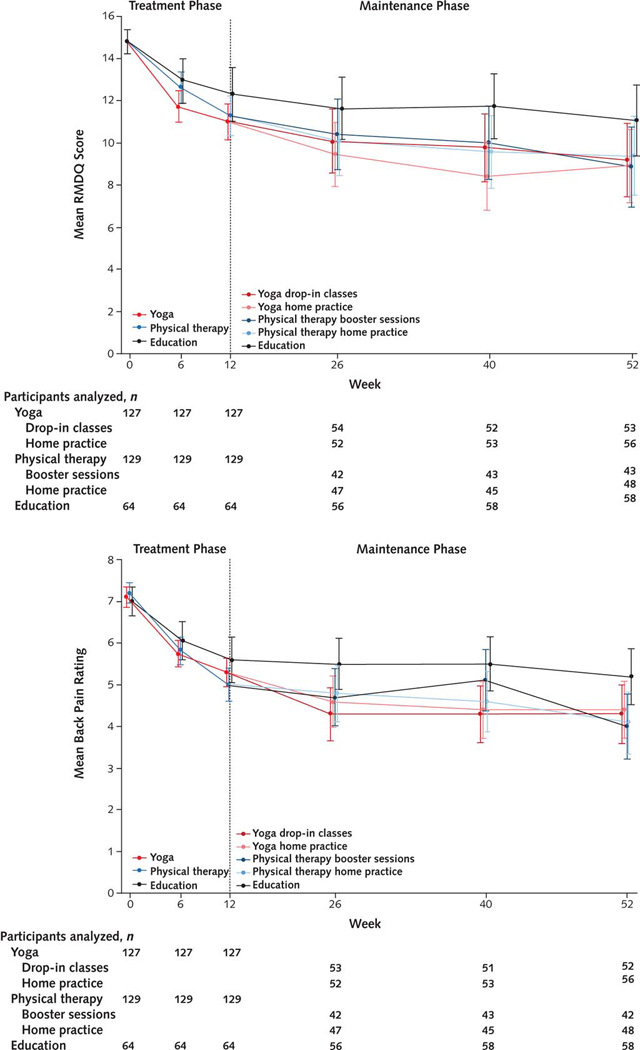
Primary outcomes were back-related function, measured by the Roland Morris Disability Questionnaire (RMDQ), and pain, measured by an 11-point scale, at 12 weeks. Prespecified noninferiority margins were 1.5 (RMDQ) and 1.0 (pain). Secondary outcomes included pain medication use, global improvement, satisfaction with intervention, and health-related quality of life.
One-sided 95% lower confidence limits were 0.83 (RMDQ) and 0.97 (pain), demonstrating noninferiority of yoga to PT. However, yoga was not superior to education for either outcome. Yoga and PT were similar for most secondary outcomes. Yoga and PT participants were 21 and 22 percentage points less likely, respectively, than education participants to use pain medication at 12 weeks. Improvements in yoga and PT groups were maintained at 1 year with no differences between maintenance strategies. Frequency of adverse events, mostly mild self-limited joint and back pain, did not differ between the yoga and PT groups.
Participants were not blinded to treatment assignment. The PT group had disproportionate loss to follow-up.
A manualized yoga program for nonspecific cLBP was noninferior to PT for function and pain.
National Center for Complementary and Integrative Health of the National Institutes of Health.
瑜伽对轻至中度慢性下腰痛(cLBP)有效,但其与物理治疗(PT)相比的有效性尚不清楚。此外,对于功能残疾和疼痛更严重的医疗服务不足患者,瑜伽的有效性知之甚少。
确定瑜伽治疗cLBP是否不劣于PT。
为期12周的单盲、3组随机非劣效性试验及随后40周的维持阶段。(ClinicalTrials.gov:NCT01343927)。
学术安全网医院及7家附属社区卫生中心。
320名主要为低收入、种族多样的非特异性cLBP成年患者。
参与者接受每周12节瑜伽课程、15次PT治疗,或一本教育书籍及时事通讯。维持阶段比较了随时参加的瑜伽课程与家庭练习,以及PT强化课程与家庭练习。
主要结局为12周时通过罗兰·莫里斯残疾问卷(RMDQ)测量的背部相关功能,以及通过11点量表测量的疼痛。预先设定的非劣效性界值为1.5(RMDQ)和1.0(疼痛)。次要结局包括止痛药物使用情况、整体改善情况、对干预的满意度以及健康相关生活质量。
单侧95%置信下限分别为0.83(RMDQ)和0.97(疼痛),表明瑜伽不劣于PT。然而,在这两个结局方面,瑜伽并不优于教育组。在大多数次要结局方面,瑜伽和PT相似。与教育组参与者相比,瑜伽组和PT组参与者在12周时使用止痛药物的可能性分别低21和22个百分点。瑜伽组和PT组的改善在1年时得以维持,维持策略之间无差异。不良事件发生率在瑜伽组和PT组之间无差异,主要为轻度自限性关节和背部疼痛。
参与者未对治疗分配设盲。PT组失访比例过高。
针对非特异性cLBP的标准化瑜伽方案在功能和疼痛方面不劣于PT。
美国国立卫生研究院补充与综合健康国家中心。