Hwang Moon Joo, Kim Tae Nyeun
Division of Gastroenterology and Hepatology, Department of Internal Medicine, Yeungnam University College of Medicine, Daegu, Korea.
Clin Endosc. 2017 Jul;50(4):400-403. doi: 10.5946/ce.2016.150. Epub 2017 Jun 20.
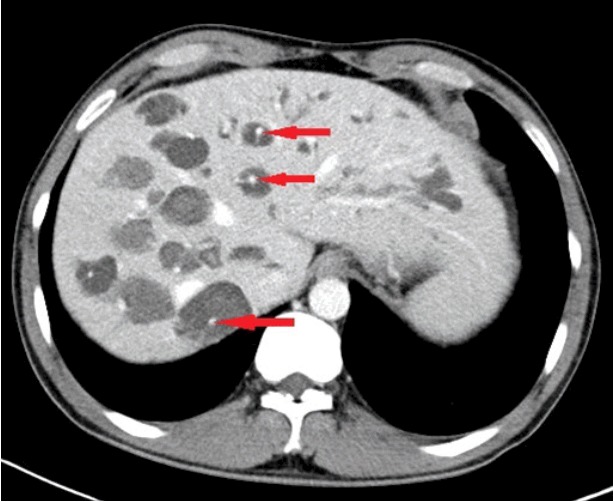
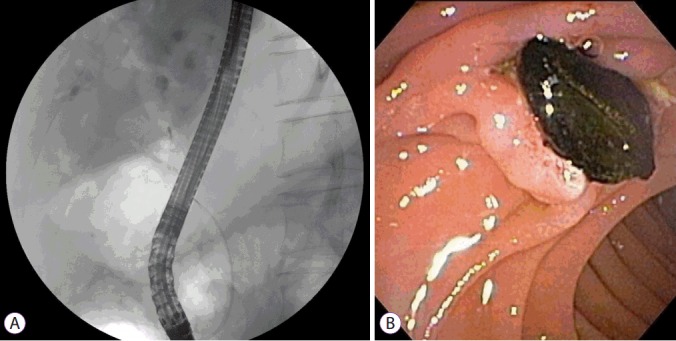
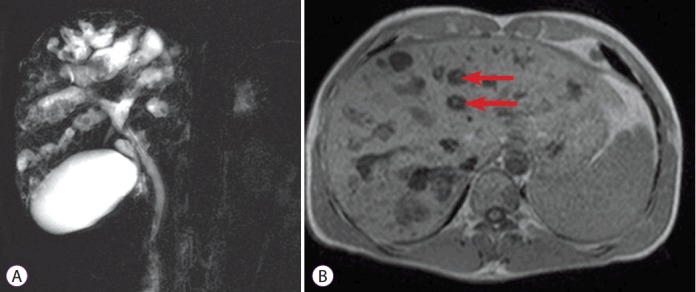
Caroli disease (CD) is a rare congenital malformation of the liver characterized by non-obstructive, segmental, cystic dilatation of the intrahepatic bile ducts (IHDs). The clinical course is usually asymptomatic for the first 5-20 years, and symptoms may seldom occur throughout the patient's life. Bile stagnation leads to recurrent episodes of cholangitis, stone formation, or liver abscesses, and biliary cirrhosis usually occurs years later. Here we report on a 42-year-old man diagnosed with diffuse-type CD with a characteristic central dot sign, who had multiple intrahepatic and common bile duct (CBD) stones. CBD stones were treated successfully with endoscopic retrograde cholangiopancreatography (ERCP).
卡罗里病(CD)是一种罕见的肝脏先天性畸形,其特征为肝内胆管(IHDs)出现非梗阻性、节段性、囊性扩张。在最初的5至20年里,临床过程通常无症状,并且在患者一生中症状可能很少出现。胆汁淤积会导致胆管炎反复发作、结石形成或肝脓肿,而胆汁性肝硬化通常在数年之后发生。在此,我们报告一名42岁男性,被诊断为具有特征性中心点征的弥漫型CD,该患者有多发肝内胆管结石及胆总管结石。通过内镜逆行胰胆管造影术(ERCP)成功治疗了胆总管结石。