Department of Geriatric Psychiatry, Institute of Mental Health, Singapore.
Psychotherapy Unit, Institute of Mental Health, Singapore.
Gerontologist. 2018 Mar 19;58(2):e150-e159. doi: 10.1093/geront/gnx097.
Coping with predeath grief (PDG) is an unmet need in caregivers of persons with dementia (PWD). The Marwit-Meuser Caregiver Grief Inventory (MM-CGI) and its abbreviated MM-CGI-Short-Form (MM-CGI-SF) are among the few empirically developed scales that detect PDG, yet they have not been substantially validated outside United States. We evaluated the reliability and validity of the PDG scales in a multiethnic Asian population distinct from that of United States.
Family caregivers of community-dwelling PWD (n = 300) completed self-administered questionnaires containing MM-CGI and other scales of related construct. Sixty percent of the participants repeated the questionnaires 1 week later for test-retest reliability. Internal-consistency reliability was assessed by Cronbach's α, test-retest reliability by intraclass-correlation-coefficient, construct validity by Spearman's correlation-coefficient, and factorial validity by confirmatory factor analysis (CFA). Cohen's κ was used to compare the agreement between MM-CGI and a commonly-used caregiver burden scale (Zarit Burden Interview).
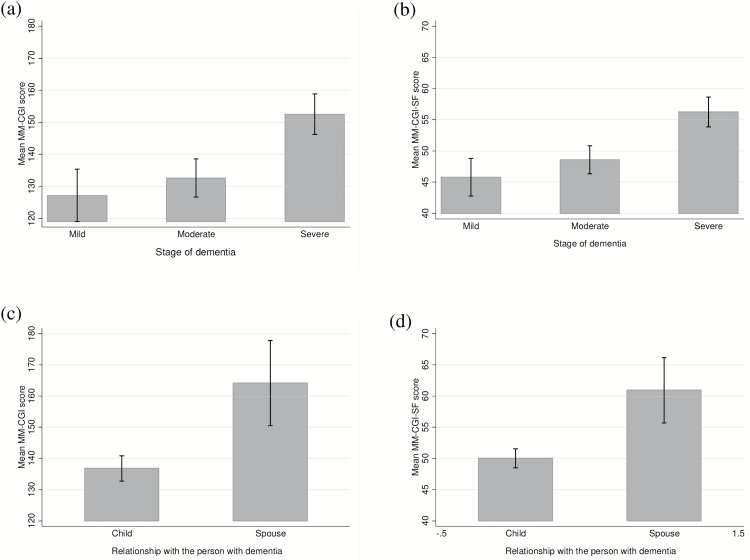
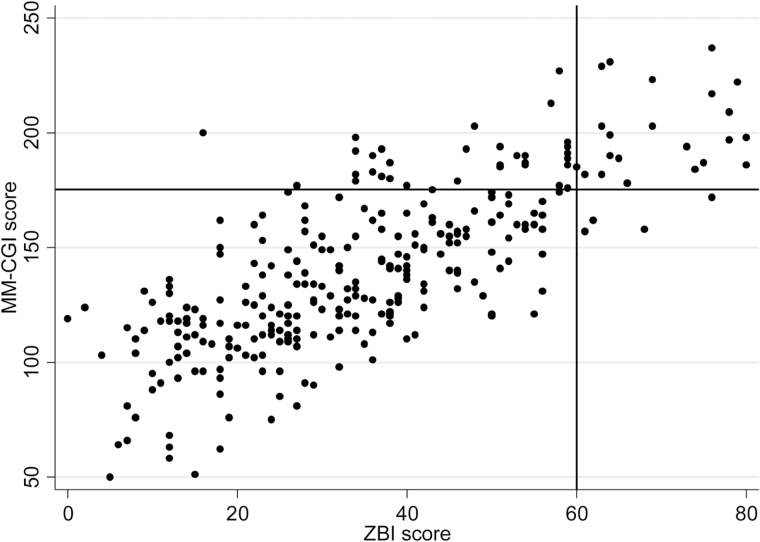
MM-CGI and MM-CGI-SF demonstrated internal-consistency reliability, test-retest reliability, construct validity, and known-group validity. In CFA, MM-CGI showed modest model-fit (comparative-fit-index, CFI = .80; Tucker-Lewis-index, TLI = .79), whereas MM-CGI-SF showed better model-fit (CFI = .91; TLI = .90). Eighty-six percent of the caregivers reported average or high levels of PDG, with 18% reporting high PDG. High scores in the caregiver burden scale only showed modest agreement with high scores in MM-CGI (κ = .47).
MM-CGI and MM-CGI-SF demonstrated adequate psychometric properties and utility, beyond that of a caregiver burden scale, in detecting high PDG in a multiethnic Asian population. They open the way for PDG intervention in clinical care, as well as further exploration in caregiver research.
应对临终悲伤(PDG)是痴呆症患者(PWD)照顾者未满足的需求。Marwit-Meuser 照顾者悲伤量表(MM-CGI)及其缩写 MM-CGI-Short-Form(MM-CGI-SF)是少数经过实证开发的量表之一,可检测 PDG,但尚未在美国以外的地区得到充分验证。我们评估了 PDG 量表在与美国不同的多民族亚洲人群中的可靠性和有效性。
社区居住的 PWD 的家庭照顾者(n=300)完成了自我管理的问卷,其中包含 MM-CGI 和其他相关结构的量表。60%的参与者在一周后重复了这些问卷以进行测试-重测信度。内部一致性可靠性通过 Cronbach's α 进行评估,测试-重测可靠性通过组内相关系数进行评估,结构有效性通过 Spearman 相关系数进行评估,而因素有效性通过验证性因子分析(CFA)进行评估。使用 Cohen's κ 比较 MM-CGI 与常用的照顾者负担量表(Zarit 负担访谈)之间的一致性。
MM-CGI 和 MM-CGI-SF 表现出内部一致性可靠性、测试-重测可靠性、结构有效性和已知组有效性。在 CFA 中,MM-CGI 显示出适度的模型拟合(比较拟合指数,CFI=0.80;Tucker-Lewis 指数,TLI=0.79),而 MM-CGI-SF 显示出更好的模型拟合(CFI=0.91;TLI=0.90)。86%的照顾者报告平均或高度 PDG,其中 18%报告高度 PDG。照顾者负担量表的高分仅与 MM-CGI 的高分显示出适度的一致性(κ=0.47)。
MM-CGI 和 MM-CGI-SF 在多民族亚洲人群中检测高度 PDG 方面,除了照顾者负担量表之外,还表现出足够的心理测量特性和实用性。它们为临床护理中的 PDG 干预以及照顾者研究的进一步探索开辟了道路。