Hemida Maged Gomaa, Alnaeem Abdulmohsen, Chu Daniel Kw, Perera Ranawaka Apm, Chan Samuel Ms, Almathen Faisal, Yau Emily, Ng Brian Cy, Webby Richard J, Poon Leo Lm, Peiris Malik
Department of Microbiology and Parasitology, College of Veterinary Medicine, King Faisal University, Alhufuf, Al-Ahsa 31982, Saudi Arabia.
Department of Virology, Faculty of Veterinary Medicine, Kafrelsheikh University, Kafrelsheikh 33516, Egypt.
Emerg Microbes Infect. 2017 Jun 21;6(6):e56. doi: 10.1038/emi.2017.44.
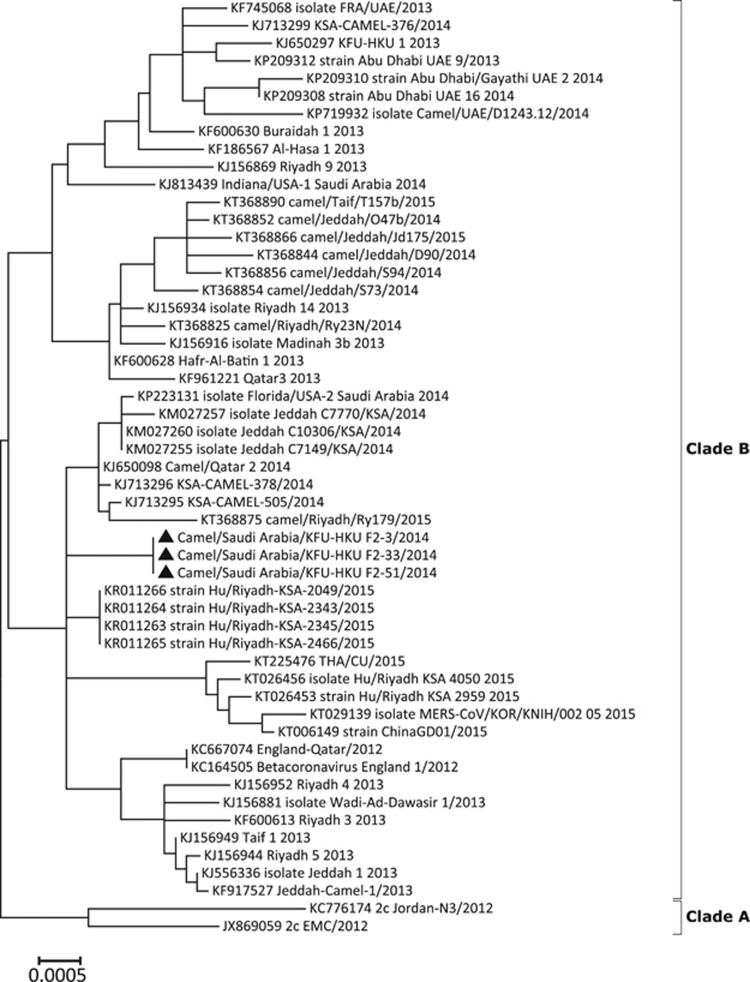
Two herds of dromedary camels were longitudinally sampled with nasal and rectal swabs and serum, between September 2014 and May 2015, and the samples were tested for Middle East Respiratory Syndrome (MERS) coronavirus RNA and antibodies. Evidence of MERS-CoV infection was confirmed in one herd on the basis of detection of virus RNA in nasal swabs from three camels and significant increases in the antibody titers from three others. The three viruses were genetically identical, thus indicating introduction of a single virus into this herd. There was evidence of reinfection of camels that were previously seropositive, thus suggesting that prior infection does not provide complete immunity from reinfection, a finding that is relevant to camel vaccination strategies as a means to prevent zoonotic transmission.
2014年9月至2015年5月期间,对两群单峰骆驼进行了纵向采样,采集了鼻拭子、直肠拭子和血清样本,并对这些样本进行了中东呼吸综合征(MERS)冠状病毒RNA和抗体检测。在一群骆驼中,基于从三头骆驼的鼻拭子中检测到病毒RNA以及另外三头骆驼的抗体滴度显著升高,证实了MERS-CoV感染的证据。这三种病毒在基因上是相同的,因此表明单一病毒引入了这群骆驼。有证据表明先前血清呈阳性的骆驼再次感染,这表明先前感染并不能提供完全的再感染免疫力,这一发现与作为预防人畜共患病传播手段的骆驼疫苗接种策略相关。