Ali Mohamed, El-Shesheny Rabeh, Kandeil Ahmed, Shehata Mahmoud, Elsokary Basma, Gomaa Mokhtar, Hassan Naglaa, El Sayed Ahmed, El-Taweel Ahmed, Sobhy Heba, Fasina Folorunso Oludayo, Dauphin Gwenaelle, El Masry Ihab, Wolde Abebe Wossene, Daszak Peter, Miller Maureen, VonDobschuetz Sophie, Morzaria Subhash, Lubroth Juan, Makonnen Yilma Jobre
National Research Center, Division of Environmental Research, Giza, Egypt.
General Organizations of Veterinary Services, Ministry of Agriculture and Land reclamation (MoALR), Giza, Egypt.
Euro Surveill. 2017 Mar 16;22(11). doi: 10.2807/1560-7917.ES.2017.22.11.30487.
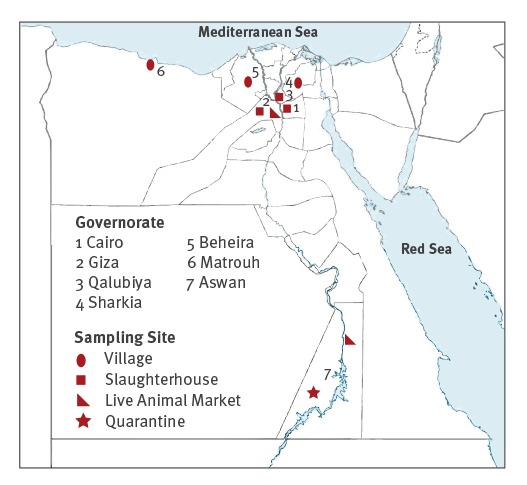
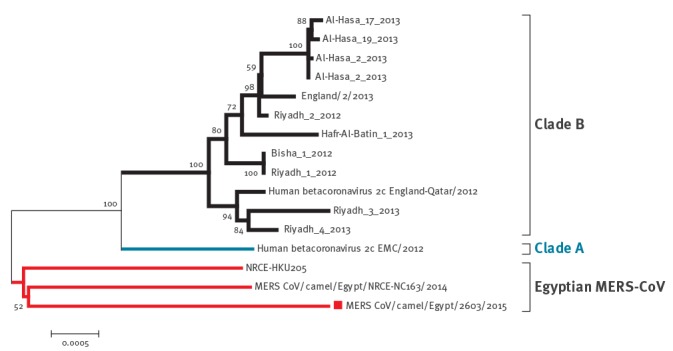
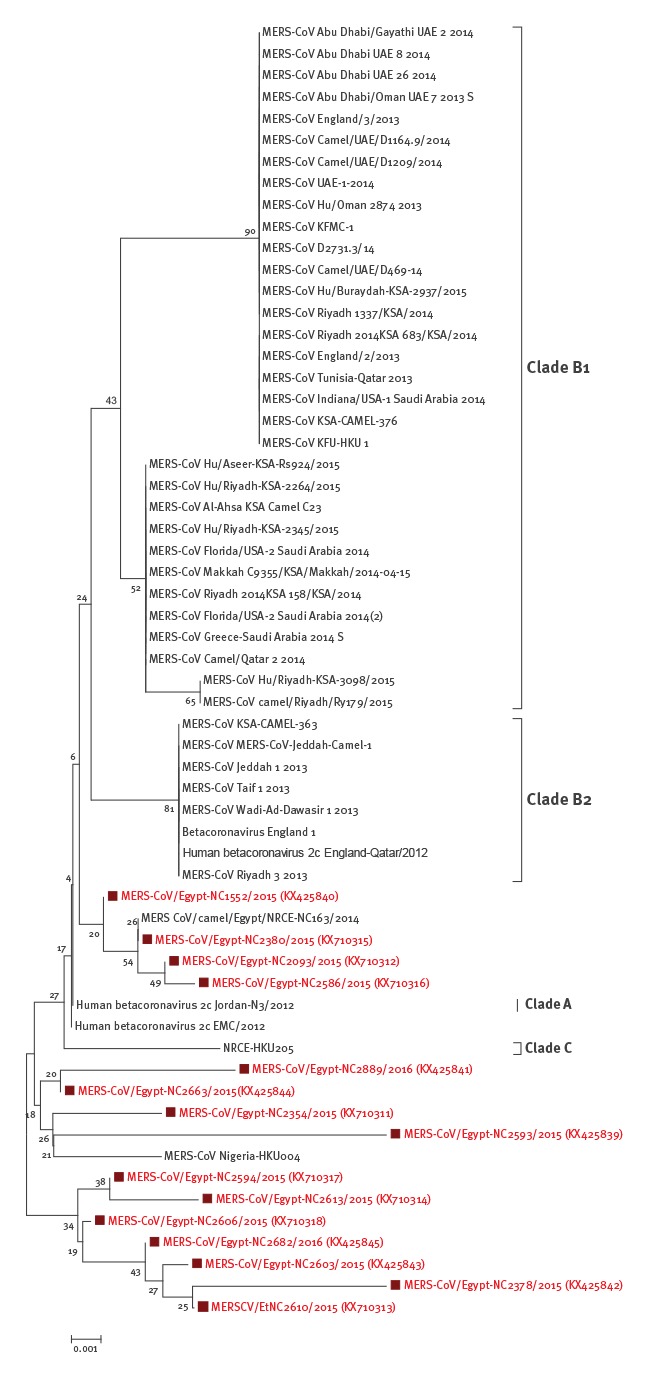
A cross-sectional study was conducted in Egypt to determine the prevalence of Middle East respiratory syndrome coronavirus (MERS-CoV) in imported and resident camels and bats, as well as to assess possible transmission of the virus to domestic ruminants and equines. A total of 1,031 sera, 1,078 nasal swabs, 13 rectal swabs, and 38 milk samples were collected from 1,078 camels in different types of sites. In addition, 145 domestic animals and 109 bats were sampled. Overall, of 1,031 serologically-tested camels, 871 (84.5%) had MERS-CoV neutralising antibodies. Seroprevalence was significantly higher in imported (614/692; 88.7%) than resident camels (257/339; 5.8%) (p < 0.05). Camels from Sudan (543/594; 91.4%) had a higher seroprevalence than those from East Africa (71/98; 72.4%) (p < 0.05). Sampling site and age were also associated with MERS-CoV seroprevalence (p < 0.05). All tested samples from domestic animals and bats were negative for MERS-CoV antibodies except one sheep sample which showed a 1:640 titre. Of 1,078 camels, 41 (3.8%) were positive for MERS-CoV genetic material. Sequences obtained were not found to cluster with clade A or B MERS-CoV sequences and were genetically diverse. The presence of neutralising antibodies in one sheep apparently in contact with seropositive camels calls for further studies on domestic animals in contact with camels.
在埃及开展了一项横断面研究,以确定中东呼吸综合征冠状病毒(MERS-CoV)在进口骆驼和本地骆驼以及蝙蝠中的流行情况,并评估该病毒向家养反刍动物和马属动物的可能传播。从不同类型场所的1078头骆驼中总共采集了1031份血清、1078份鼻拭子、13份直肠拭子和38份乳汁样本。此外,还对145头家畜和109只蝙蝠进行了采样。总体而言,在1031头接受血清学检测的骆驼中,871头(84.5%)具有MERS-CoV中和抗体。进口骆驼(614/692;88.7%)的血清阳性率显著高于本地骆驼(257/339;75.8%)(p<0.05)。来自苏丹的骆驼(543/594;91.4%)的血清阳性率高于来自东非的骆驼(71/98;72.4%)(p<0.05)。采样地点和年龄也与MERS-CoV血清阳性率相关(p<0.05)。除一份显示滴度为1:640的绵羊样本外,所有家畜和蝙蝠的检测样本中MERS-CoV抗体均为阴性。在1078头骆驼中,41头(3.8%)的MERS-CoV基因材料呈阳性。获得的序列未发现与A类或B类MERS-CoV序列聚类,且在基因上具有多样性。一头显然与血清阳性骆驼接触的绵羊中存在中和抗体,这就需要对与骆驼接触的家畜进行进一步研究。