Chen Qingjie, Mo Ran, Wu Ninghua, Zou Xin, Shi Cai, Gong Jing, Li Jingbin, Fang Ke, Wang Dingkun, Yang Deshen, Wang Kaifu, Chen Juan
Institute of Integrated Traditional Chinese and Western Medicine, Tongji Hospital, Tongji Medical College, Huazhong University of Science and TechnologyWuhan, China.
Department of Biochemistry and Molecular Biology, School of Basic Medicine and the Collaborative Innovation Center for Brain Science, Tongji Medical College, Huazhong University of Science and TechnologyWuhan, China.
Front Pharmacol. 2017 Jun 6;8:334. doi: 10.3389/fphar.2017.00334. eCollection 2017.
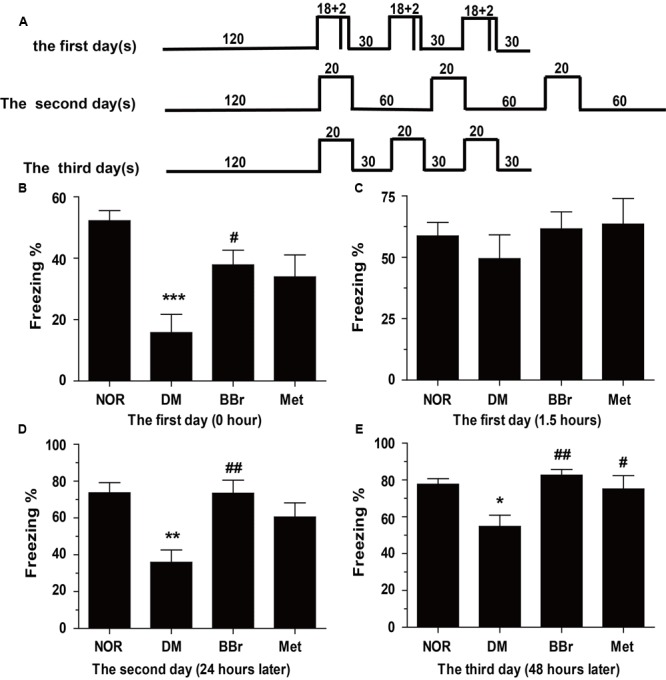
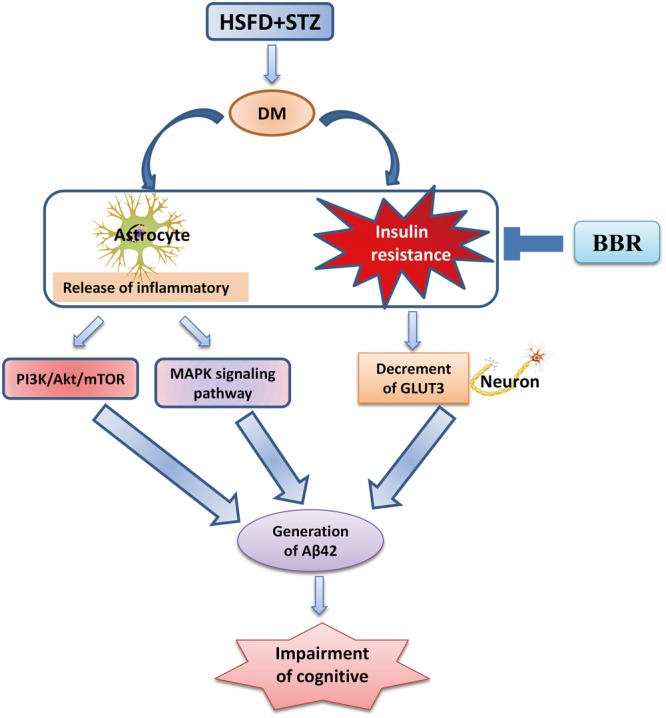
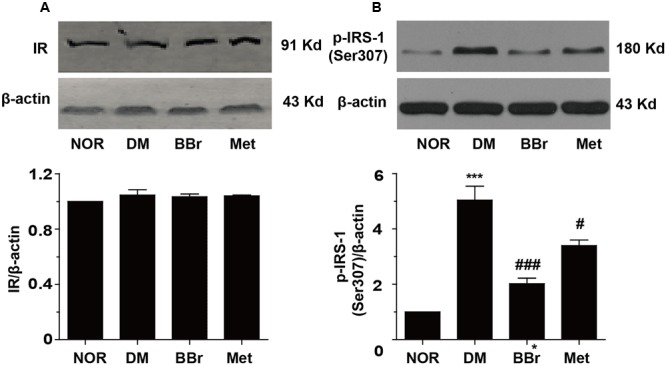
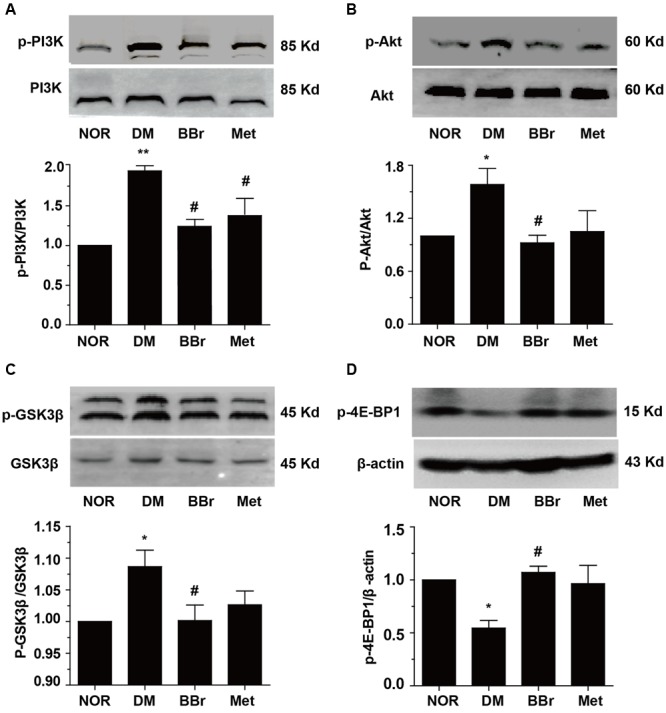
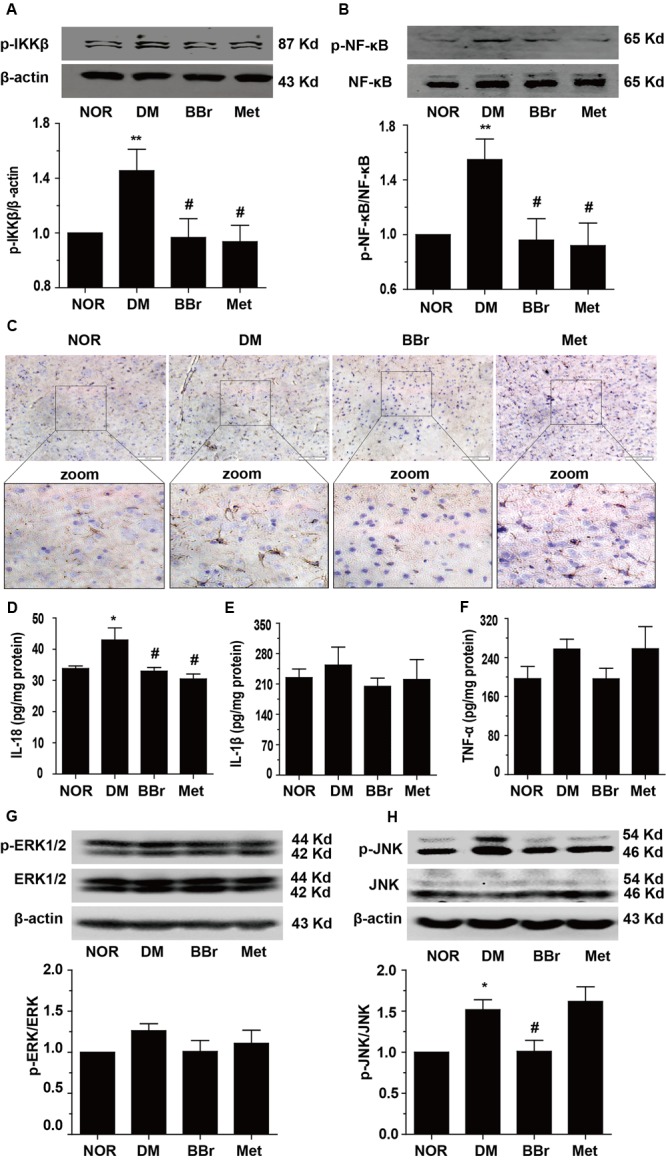
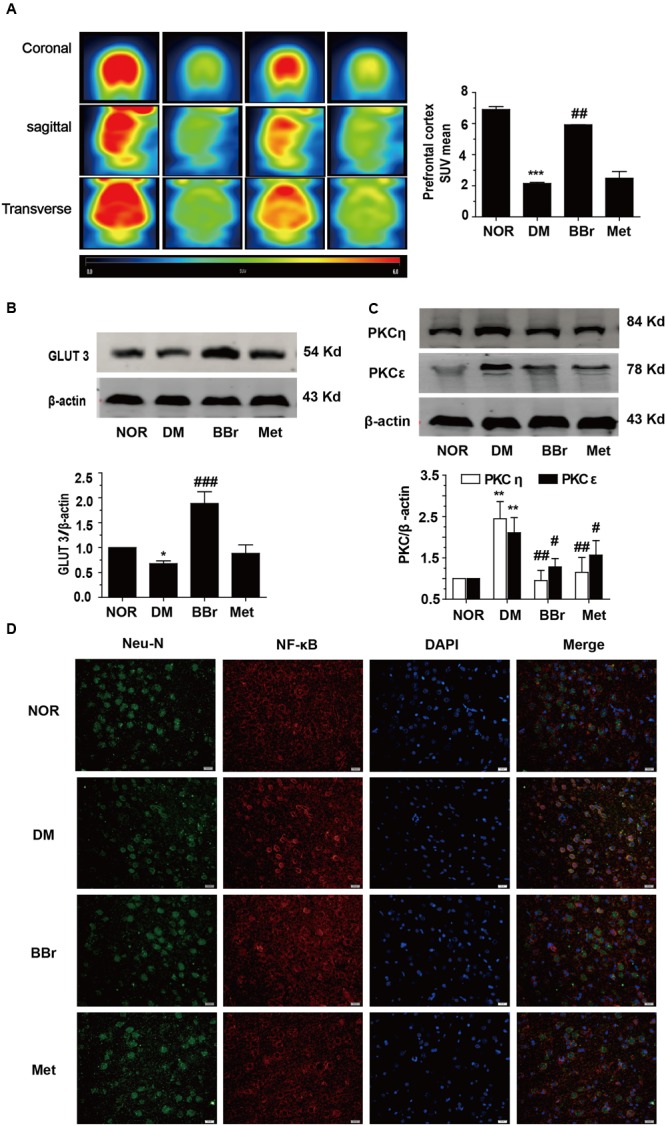
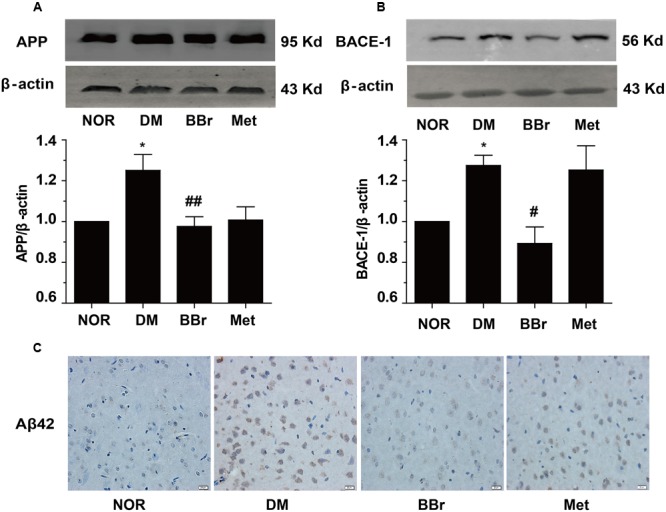
Memory-impairment was one of the common characteristics in patients with diabetes mellitus. The release of chronic inflammation mediators and insulin resistance in diabetic brain gave rise to the generation of toxic factor Aβ42 which was the marker of Alzheimer's disease. In addition, the impairment of memory in diabetes mellitus was also correlated predominantly with uptake/metabolism of glucose in medial prefrontal cortex (mPFC). Previously, anti-inflammation and hypoglycemic effects of berberine (BBr) have been described in peripheral tissues. For better understanding the effects of BBr on cognitive action in diabetics, we investigated the functions of BBr involved in anti-inflammation and ameliorating insulin resistance in prefrontal cortex of diabetic rats. Intragastric administration of BBr (187.5 mg/Kg/d) was used in diabetic rats. Fear-condition assay was applied for cognitive assessment, and relative protein expressions were detected by western-blot. The glucose uptake in prefrontal cortex of diabetic rats was tested by Positron-Emission Tomography imaging. The levels of inflammation mediators were determined by commercial ELISA kits. The inflammation mediator release and insulin resistance in the mPFC of diabetic rats was inhibited by BBr. The activation of PI3K/Akt/mTOR and MAPK signaling pathway, as well as two novel isoforms PKCη and PKC𝜀 and the translocation of NF-κB in neuron were also down-regulated by BBr; furthermore, the neuron specific glucose transporter GLUT3 was remarkably augmented by 2-3 times when compared with diabetic group; meanwhile, BBr also promoted glucose uptake in the brain. Additionally BBr decreased the expressions of amyloid precursor protein and BACE-1, and the production of oligomeric Aβ42. Finally, it accelerates the reinforcement of the information and ameliorates cognitive impairment. BBr inhibited the activation of inflammation pathway and insulin resistance in the mPFC of diabetic rats. Finally, it improved the lesion of cognition in diabetic rats.
记忆障碍是糖尿病患者的常见特征之一。糖尿病脑内慢性炎症介质的释放和胰岛素抵抗导致了有毒因子Aβ42的产生,而Aβ42是阿尔茨海默病的标志物。此外,糖尿病患者的记忆障碍还主要与内侧前额叶皮质(mPFC)中葡萄糖的摄取/代谢有关。此前,黄连素(BBr)在外周组织中的抗炎和降血糖作用已有报道。为了更好地了解BBr对糖尿病患者认知作用的影响,我们研究了BBr在糖尿病大鼠前额叶皮质中抗炎和改善胰岛素抵抗的功能。对糖尿病大鼠采用灌胃给予BBr(187.5mg/Kg/d)。采用恐惧条件试验进行认知评估,通过蛋白质免疫印迹法检测相关蛋白表达。通过正电子发射断层扫描成像检测糖尿病大鼠前额叶皮质的葡萄糖摄取。采用商用酶联免疫吸附测定试剂盒测定炎症介质水平。BBr抑制了糖尿病大鼠mPFC中炎症介质的释放和胰岛素抵抗。BBr还下调了PI3K/Akt/mTOR和MAPK信号通路的激活,以及两种新亚型PKCη和PKCε的表达以及神经元中NF-κB的转位;此外,与糖尿病组相比,神经元特异性葡萄糖转运体GLUT3显著增加了2 - 3倍;同时,BBr还促进了脑内葡萄糖摄取。此外BBr降低了淀粉样前体蛋白和β-分泌酶1的表达以及寡聚Aβ42的产生。最后,它加速了信息强化并改善了认知障碍。BBr抑制了糖尿病大鼠mPFC中炎症通路的激活和胰岛素抵抗。最后,它改善了糖尿病大鼠的认知损伤。