Peschke Benjamin, Keller Christian W, Weber Patrick, Quast Isaak, Lünemann Jan D
Institute of Experimental Immunology, Laboratory of Neuroinflammation, University of Zurich, Zurich, Switzerland.
Department of Immunology and Pathology, Central Clinical School, Monash University, Melbourne, VIC, Australia.
Front Immunol. 2017 Jun 6;8:646. doi: 10.3389/fimmu.2017.00646. eCollection 2017.
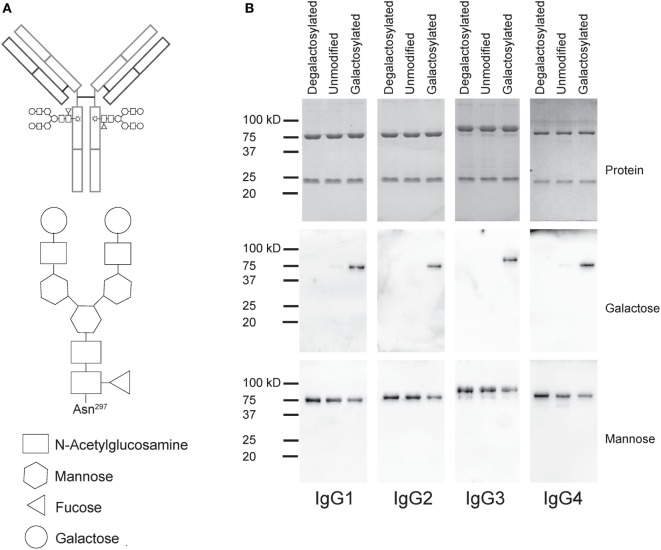
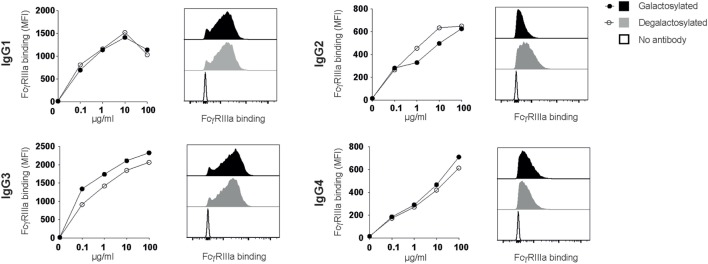
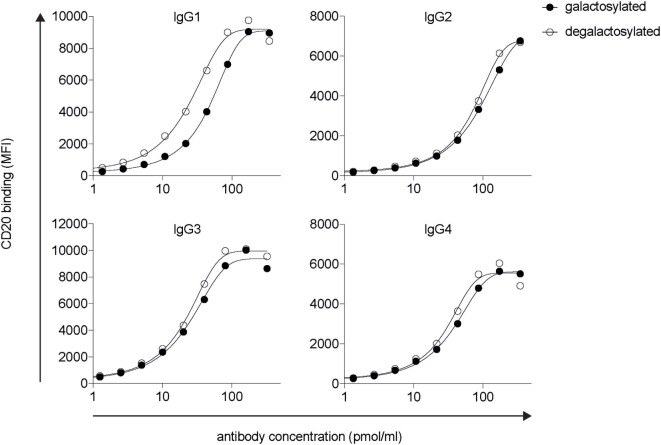
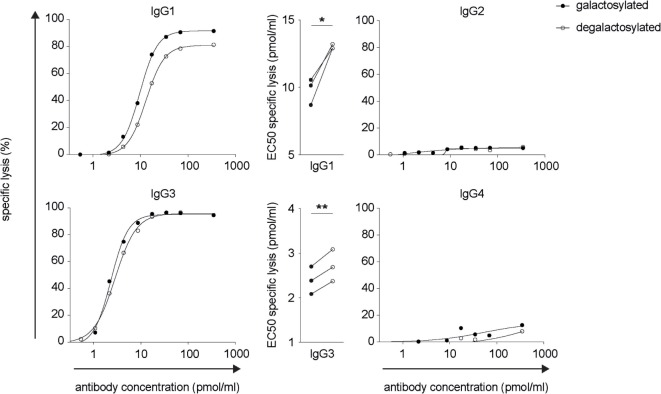
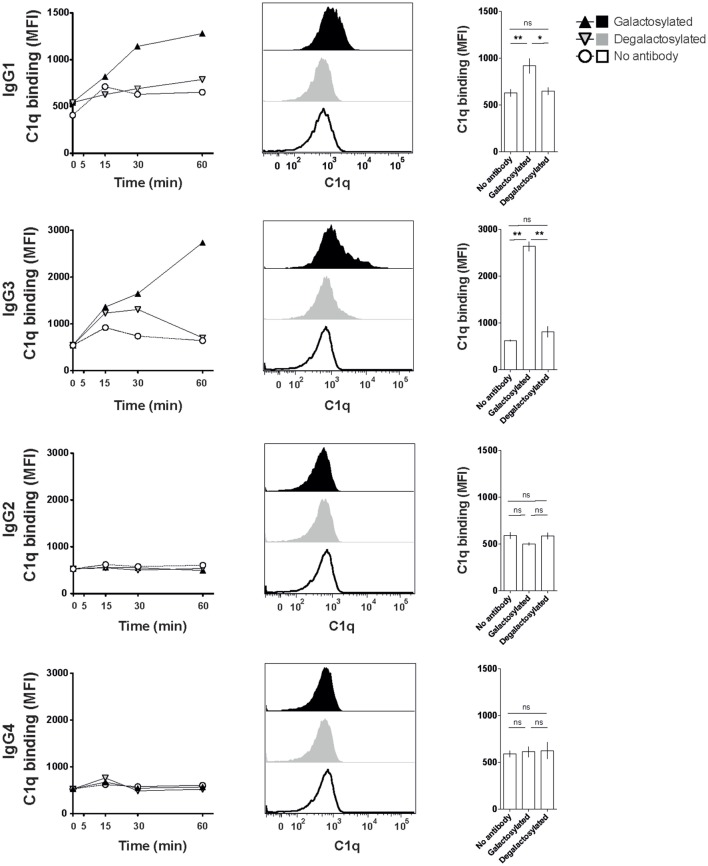
Binding of the complement component C1q to the CH2 domain of antigen-bound immunoglobulin gamma (IgG) activates the classical complement pathway and depends on its close proximity to Fc fragments of neighboring antibodies. IgG subclasses contain a highly conserved asparagine 297 (N)-linked biantennary glycan within their CH2 domains, the core structure of which can be extended with terminal galactose and sialic acid residues. To investigate whether Fc-glycosylation regulates effector functions of human IgG subclasses, we cloned the antigen-binding region of the CD20-specific monoclonal antibody rituximab into IgG isotype expression vectors. We found that Fc-galactosylation enhances the efficacy of CD20-targeting complement-fixing antibodies for C1q binding and complement-mediated tumor cell lysis. Increased efficacies were restricted to IgG1 and IgG3 subclasses indicating that Fc-galactosylation alone is not sufficient for IgG2 and IgG4 to acquire complement-fixing properties. Addition of terminal galactose to the N-glycan specifically improved binding of C1q without changing antigen- and FcγRIIIa-binding affinities of IgG isotypes. These data indicate that Fc galactosylation can be harnessed to enhance the complement-activating properties of IgG1 and IgG3 antibodies.
补体成分C1q与抗原结合的免疫球蛋白γ(IgG)的CH2结构域结合可激活经典补体途径,且这取决于其与相邻抗体的Fc片段的紧密接近程度。IgG亚类在其CH2结构域内含有一个高度保守的天冬酰胺297(N)连接的双天线聚糖,其核心结构可被末端半乳糖和唾液酸残基扩展。为了研究Fc糖基化是否调节人IgG亚类的效应功能,我们将CD20特异性单克隆抗体利妥昔单抗的抗原结合区域克隆到IgG同种型表达载体中。我们发现Fc-半乳糖基化增强了靶向CD20的补体固定抗体与C1q结合及补体介导的肿瘤细胞裂解的功效。功效的增加仅限于IgG1和IgG3亚类,表明仅Fc-半乳糖基化不足以使IgG2和IgG4获得补体固定特性。向N-聚糖添加末端半乳糖可特异性改善C1q的结合,而不改变IgG同种型的抗原和FcγRIIIa结合亲和力。这些数据表明,Fc半乳糖基化可用于增强IgG1和IgG3抗体的补体激活特性。