Dekkers Gillian, Treffers Louise, Plomp Rosina, Bentlage Arthur E H, de Boer Marcella, Koeleman Carolien A M, Lissenberg-Thunnissen Suzanne N, Visser Remco, Brouwer Mieke, Mok Juk Yee, Matlung Hanke, van den Berg Timo K, van Esch Wim J E, Kuijpers Taco W, Wouters Diana, Rispens Theo, Wuhrer Manfred, Vidarsson Gestur
Sanquin Research and Landsteiner Laboratory, Department Experimental Immunohematology, Academic Medical Centre, University of Amsterdam, Amsterdam, Netherlands.
Sanquin Research and Landsteiner Laboratory, Department Blood Cell Research, Academic Medical Centre, University of Amsterdam, Amsterdam, Netherlands.
Front Immunol. 2017 Aug 2;8:877. doi: 10.3389/fimmu.2017.00877. eCollection 2017.
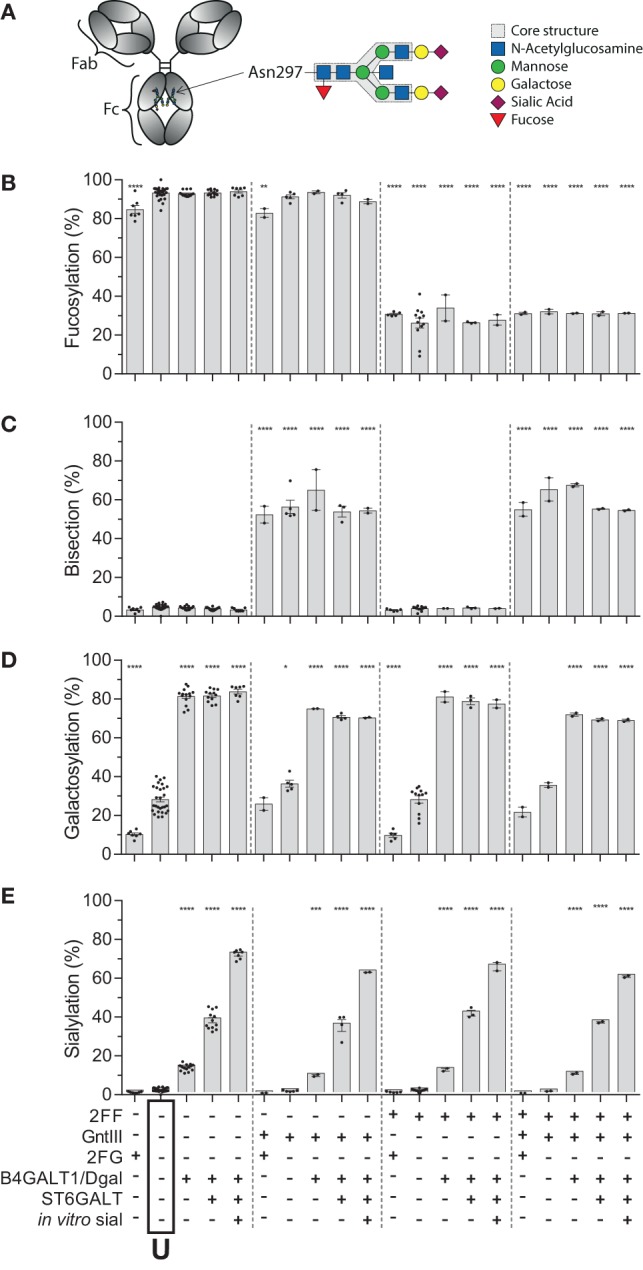
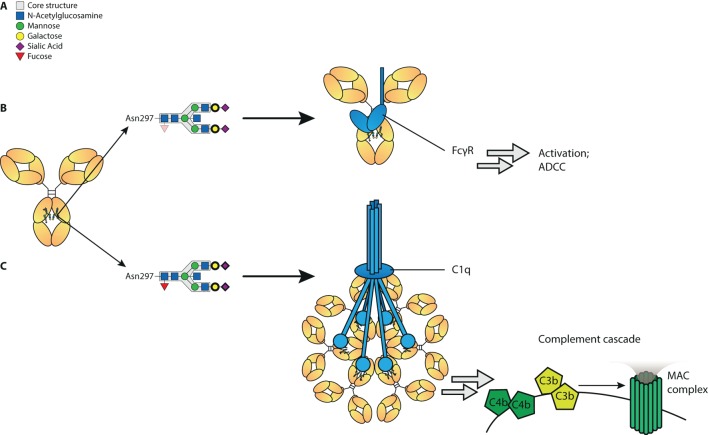
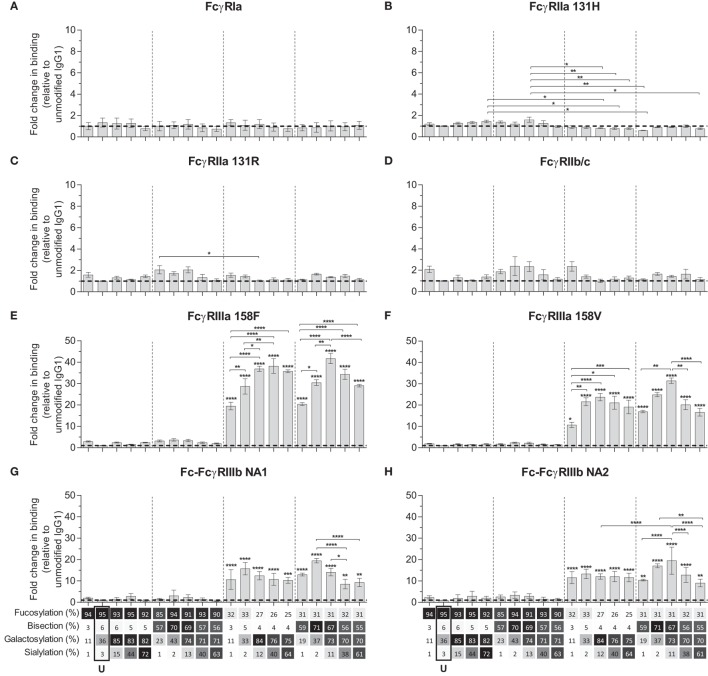
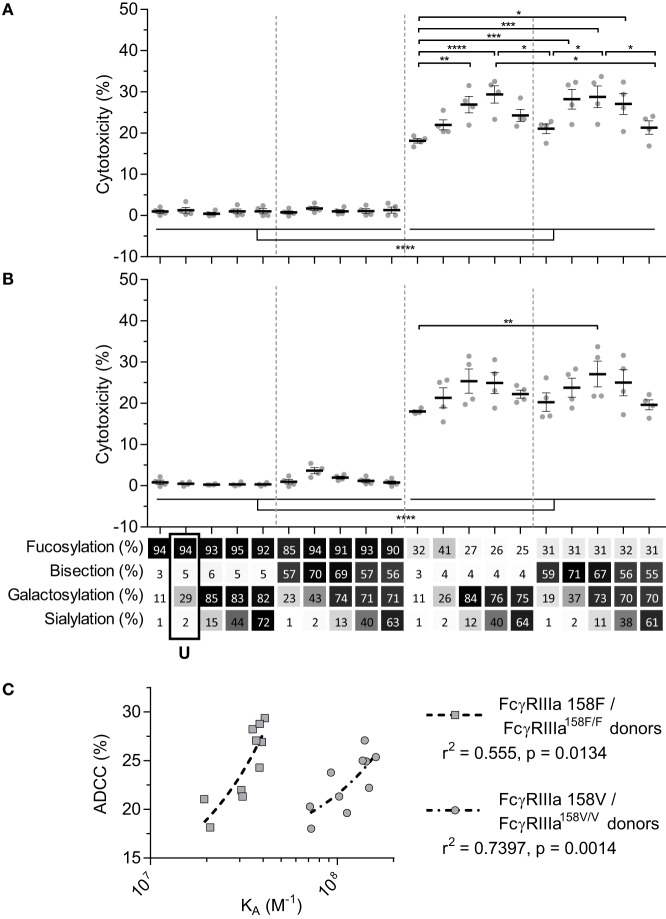
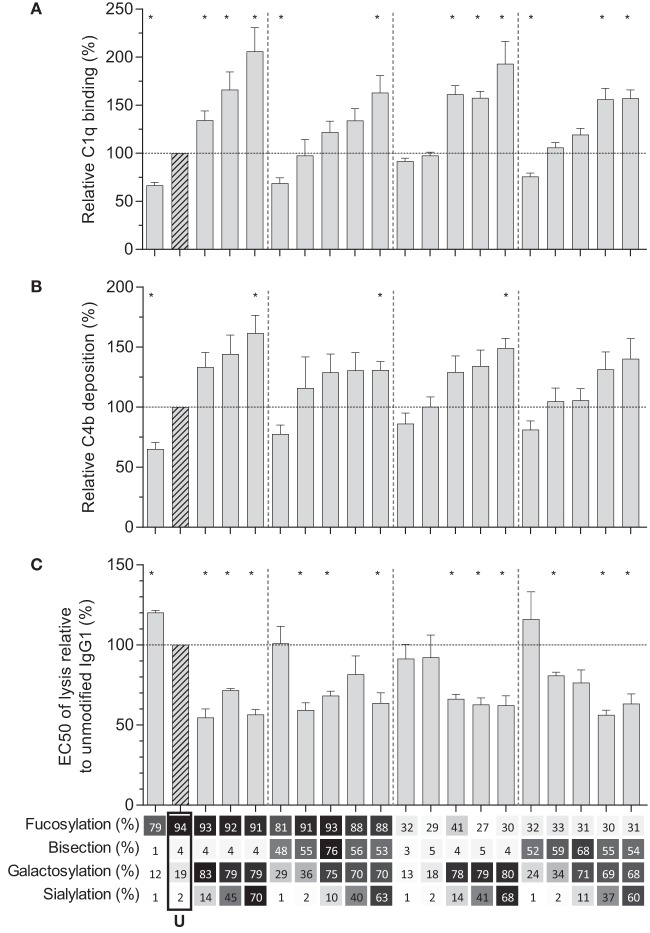
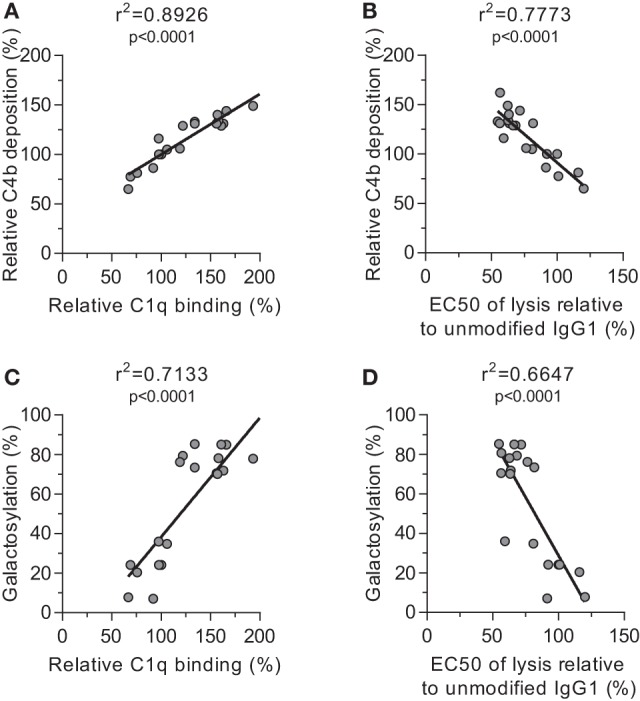
Glycosylation of the immunoglobulin G (IgG)-Fc tail is required for binding to Fc-gamma receptors (FcγRs) and complement-component C1q. A variety of IgG1-glycoforms is detected in human sera. Several groups have found global or antigen-specific skewing of IgG glycosylation, for example in autoimmune diseases, viral infections, and alloimmune reactions. The IgG glycoprofiles seem to correlate with disease outcome. Additionally, IgG-glycan composition contributes significantly to Ig-based therapies, as for example IVIg in autoimmune diseases and therapeutic antibodies for cancer treatment. The effect of the different glycan modifications, especially of fucosylation, has been studied before. However, the contribution of the 20 individual IgG glycoforms, in which the combined effect of all 4 modifications, to the IgG function has never been investigated. Here, we combined six glyco-engineering methods to generate all 20 major human IgG1-glycoforms and screened their functional capacity for FcγR and complement activity. Bisection had no effect on FcγR or C1q-binding, and sialylation had no- or little effect on FcγR binding. We confirmed that hypo-fucosylation of IgG1 increased binding to FcγRIIIa and FcγRIIIb by ~17-fold, but in addition we showed that this effect could be further increased to ~40-fold for FcγRIIIa upon simultaneous hypo-fucosylation and hyper-galactosylation, resulting in enhanced NK cell-mediated antibody-dependent cellular cytotoxicity. Moreover, elevated galactosylation and sialylation significantly increased (independent of fucosylation) C1q-binding, downstream complement deposition, and cytotoxicity. In conclusion, fucosylation and galactosylation are primary mediators of functional changes in IgG for FcγR- and complement-mediated effector functions, respectively, with galactose having an auxiliary role for FcγRIII-mediated functions. This knowledge could be used not only for glycan profiling of clinically important (antigen-specific) IgG but also to optimize therapeutic antibody applications.
免疫球蛋白G(IgG)-Fc尾部的糖基化是与Fc-γ受体(FcγRs)和补体成分C1q结合所必需的。在人血清中可检测到多种IgG1糖型。几个研究小组发现IgG糖基化存在整体或抗原特异性的偏差,例如在自身免疫性疾病、病毒感染和同种免疫反应中。IgG糖谱似乎与疾病预后相关。此外,IgG聚糖组成对基于Ig的疗法有显著贡献,例如自身免疫性疾病中的静脉注射免疫球蛋白(IVIg)和癌症治疗用治疗性抗体。之前已经研究了不同聚糖修饰的作用,尤其是岩藻糖基化的作用。然而,20种个体IgG糖型(其中包含所有4种修饰的综合作用)对IgG功能的贡献从未被研究过。在这里,我们结合了六种糖工程方法来生成所有20种主要的人IgG1糖型,并筛选它们对FcγR和补体活性的功能能力。平分对FcγR或C1q结合没有影响,唾液酸化对FcγR结合没有或几乎没有影响。我们证实,IgG1的低岩藻糖基化使与FcγRIIIa和FcγRIIIb的结合增加了约17倍,但此外我们还表明,对于FcγRIIIa,在同时进行低岩藻糖基化和高半乳糖基化时,这种效应可进一步增加到约40倍,从而增强了自然杀伤(NK)细胞介导的抗体依赖性细胞毒性。此外,高半乳糖基化和唾液酸化显著增加了(与岩藻糖基化无关)C1q结合、下游补体沉积和细胞毒性。总之,岩藻糖基化和半乳糖基化分别是IgG中FcγR和补体介导的效应功能发生功能变化的主要介质,半乳糖对FcγRIII介导的功能具有辅助作用。这些知识不仅可用于临床上重要的(抗原特异性)IgG的聚糖分析,还可用于优化治疗性抗体的应用。